Prelims: (International Relations + CA)
Mains: (GS 2 – International Relations, UN Reforms, India’s Foreign Policy) |
Why in News ?
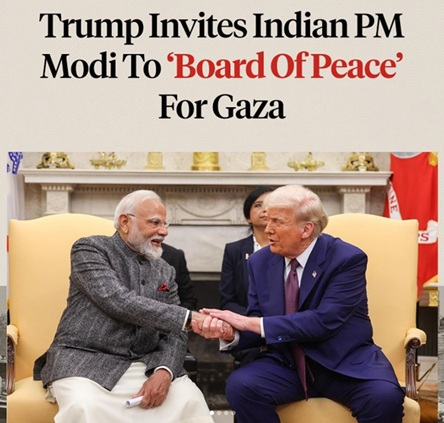
The U.S. President Donald Trump has invited India to join the proposed Board of Peace for Gaza, a new governance and conflict-management mechanism.
The initiative has emerged after a group of Islamic countries backed Trump’s peace plan for Gaza and coincides with broader U.S. efforts to restructure global governance outside traditional multilateral institutions, particularly the United Nations (UN).
The proposal has triggered a global debate on the future of the post-World War II international order, especially the relevance and authority of the UN Security Council (UNSC).
Background: Shifting Approaches to Conflict Management
The prolonged conflict in Gaza has exposed the limitations of existing international mechanisms in delivering durable peace, humanitarian access, and political reconstruction.
Amid growing frustration over UNSC paralysis—particularly due to veto politics—some global powers are exploring alternative governance arrangements that prioritise speed, executive control, and selective participation over universal legitimacy.
The proposed Board of Peace for Gaza reflects this evolving trend toward ad hoc coalitions and executive-led conflict resolution structures.
Board of Peace for Gaza
Purpose and Mandate
The Board is designed to:
- Supervise Gaza’s transitional governance, stabilisation, and reconstruction.
- Oversee a temporary technocratic, apolitical Palestinian administration.
- Manage funding for redevelopment until the Palestinian Authority (PA) completes institutional reforms.
President Trump has indicated that this Gaza-specific body could serve as a global template for managing future international crises.
Composition and Leadership
- The Board will be chaired by U.S. President Donald Trump.
- Membership will include select invited countries and global leaders (such as Tony Blair).
- It will function as an invitation-only body, not based on universal or regional representation.
UN Linkage
- A UNSC Resolution 2803 authorised a Board to supervise Gaza’s transition until 2027.
- While Russia and China abstained, several countries of the Global South voted in favour.
- However, the proposed U.S.-led Board diverges in structure and authority from traditional UN mechanisms.
India’s Position
Current Status
India has received the invitation but has not yet issued a formal response. Pakistan has also reportedly been invited.
India’s Stated Principles
- India has consistently supported a Two-State Solution, advocating peaceful coexistence of Israel and Palestine.
- India welcomed the first phase of Trump’s peace plan, particularly the release of hostages and enhanced humanitarian assistance to Gaza.
On Military Involvement
- The U.S. has sought troop contributions for a temporary International Stabilisation Force (ISF).
- India has clearly ruled out participation, as the ISF is not a UN peacekeeping mission, and India’s overseas deployments are traditionally UN-mandated.
Broader Global Governance Debate
Challenge to the UN System
Critics argue that the Board of Peace undermines:
- The UN Charter principles,
- Sovereign equality of states, and
- Collective decision-making.
It is widely viewed as an attempt to sidestep the UNSC and concentrate authority in a U.S.-led executive framework.
Trump’s Multilateral Skepticism
The proposal aligns with Trump’s long-standing scepticism toward multilateral institutions, reflected in:
- U.S. withdrawals from UNESCO and WHO,
- Exits from over 60 international organisations.
It also resonates with Project 2025 (the Heritage Foundation’s blueprint for a second Trump term), which advocates:
- Sharp reductions in multilateral commitments,
- Preference for ad hoc coalitions where the U.S. sets the agenda.
From Gaza to a Global Template
- Trump seeks to transform the Board into a general crisis-management club, framed as a solution to UNSC paralysis.
- However, critics warn that this risks diverting funds, legitimacy, and political attention away from the UN if such structures gain traction.
Key Challenges and Way Ahead
For the Global Order
- Erosion of multilateralism and weakening of UN centrality.
- Rise of exclusive, power-driven governance mechanisms.
- Undermining of the rules-based international order.
For India
- A tension emerges between India’s commitment to reformed multilateralism and pragmatic engagement with U.S.-led initiatives.
- Risk of legitimising frameworks that weaken India’s long-term push for UNSC reform and marginalise the Global South.
India’s Strategic Options
- Calibrated engagement: Participate diplomatically without endorsing erosion of UN authority.
- Defend UN-centric multilateralism: Reiterate support for UNSC-authorised mechanisms and resist normalisation of extra-UN security architectures.
- Strategic autonomy: Balance ties with the U.S. while safeguarding India’s principled positions.
- Global South coordination: Work with like-minded countries to preserve inclusive governance.
- Push for UN reform: Use the crisis to highlight the urgency of UNSC reform, not its bypassing.
FAQs
1. What is the Board of Peace for Gaza ?
It is a proposed U.S.-led body to oversee Gaza’s transitional governance, stabilisation, and reconstruction.
2. Has India accepted the invitation to join the Board ?
No, India has received the invitation but has not yet issued a formal response.
3. Why is the proposal controversial ?
It is seen as undermining the UN system by shifting conflict management to an exclusive, executive-led framework.
4. Will India contribute troops to the Gaza stabilisation effort ?
No, India has ruled out troop deployment as the force is not UN-mandated.
5. What does this mean for global governance ?
It signals a potential shift away from UN-
|






 Contact Us
  New Batch : 9555124124/ 7428085757
  Tech Support : 9555124124/ 7428085757