Context
The United Nations' declaration of 2026 as the "International Year of Grasslands and Pastoral Communities" acknowledges the fact that grasslands and their dependent communities have not received the appropriate attention in global environmental discourse. Amidst the threefold challenge of climate change, biodiversity loss, and land degradation, this declaration is both an opportunity and a warning.
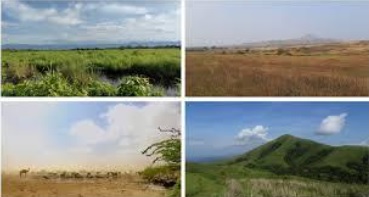
Limits of Forest-Centric Climate Policy
- In 2022, a group of scientists from Tanzania, Zambia, the UK, the US, Germany, and Canada wrote an open letter in the journal "Science" urging the United Nations Framework Convention on Climate Change (UNFCCC) to include all biomes, such as grasslands and savannas, in its policies.
- According to scientists, savannas and grasslands are not only vast carbon reserves but also play a vital role in the water cycle, soil conservation, and livelihood security. Despite this, even recent conferences like COP 30 have prioritized tropical forests, exemplified by the Tropical Forests Forever Facility (TFFF).
- This trend demonstrates that global climate governance continues to prioritize "visible and dense" ecosystems, while open ecosystems are often considered barren or wasteland.
Grasslands: A Threatened Biome
- Grasslands are among the world's most threatened ecosystems today. Indeed, agricultural expansion, mining, invasive species, fossil fuel exploitation, and the suppression of traditional land management systems have all combined to weaken this biome.
- Australia's desert grasslands are a clear example, where droughts and flash floods, exacerbated by climate change, combined with invasive species like buffel grass, are exacerbating the crisis.
- This situation also highlights that the decline of traditional knowledge systems of indigenous and local communities—such as controlled fires and sustainable grazing—has exacerbated ecological imbalances.
The Cerrado and the Amazon: Ecological Interconnections
- Brazil's Cerrado savanna is another significant example of this global problem. This region is as ecologically important as the Amazon because it is the source of the country's major water systems.
- Despite this, the Cerrado is experiencing twice the amount of land loss as the Amazon. This fact reinforces the saying that 'there is no Amazon without the Cerrado'—that is, ecosystems are not isolated but are deeply interconnected.
The Social Justice Dimension
- Grassland conservation is not just an environmental issue but also a question of social justice. Both the Cerrado and Australia demonstrate that indigenous, pastoral, and traditional communities are the first and most affected.
- In fact, land rights violations, toxic waste dumping, and pro-agribusiness policies threaten both the livelihoods and culture of these communities.
- In this context, the UNCCD COP 16's recognition of grasslands as "complex socio-ecological systems" is a positive step, but this effort remains limited in scope.
The Problem of Institutional Silos
-
Globally, the division of work between the UNFCCC, CBD, and UNCCD has led to policy silos. Climate negotiations are limited to carbon, while biodiversity and land degradation are scattered across other forums. Although the 1992 Rio Convention laid the foundation for coordination, this coordination remains weak in practice.
-
The recommendation by the WWF and IUCN report to consider grasslands in an integrated manner across all three Rio Conventions offers a practical solution in this direction.
Implications for India
- The state of grasslands in India is a microcosm of this global problem. Fragmented responsibilities across 18 ministries, the concept of "wastelands," and a forest-centric carbon policy—all hinder the conservation of grasslands.
- While the Union Environment Ministry views grasslands as potential areas for afforestation, the "Wastelands Atlas of India," published by the Ministry of Rural Development, often identifies these same grasslands as land that could be converted to other uses. This policy contradiction demonstrates that grasslands remain unrecognized as independent and valuable ecosystems.
- If policy uniformity is established across governance systems, from the national to the multilateral level, positive impacts can be realized through mechanisms such as country-specific Nationally Determined Contributions (NDCs).
- One of India's eight NDCs aims to create an additional carbon sink of 2.5 to 3 billion tonnes of CO₂ equivalent by 2030 through increased forest and tree cover.
- However, if grasslands are also formally recognized as an effective carbon sink, this target could become more scientific, inclusive, and practical.
Way Forward
- It is essential to move beyond the mindset of considering grasslands merely as vacant or underutilized land. Bringing grasslands to the center of policy is essential to achieve all three goals: climate change, biodiversity conservation, and social justice. This requires:
- Grasslands are recognized as unique and valuable ecosystems.
- They are included in national and global climate plans (NDCs).
- Local communities are provided with land and resources.
Conclusion
Conferences like COP 30 must now move beyond the narrow scope of "carbon management" and adopt a holistic, "biome-based" approach. The United Nations' declaration of 2026 as the "International Year of Grasslands and Pastoral Communities" is an opportunity for India to reform its national policies and present a science-based and community-led conservation model to the global stage.






 Contact Us
  New Batch : 9555124124/ 7428085757
  Tech Support : 9555124124/ 7428085757