
- UPSC Exam
- State PCS
- One Day Exam
- Current Affairs
- PT Quiz
- Downlaods
- About Coaching
- Blog
- Videos

| Prelims: (Economics + CA) Mains: (GS 2 – Governance & Federalism; GS 3 – Environment, Infrastructure & Internal Security) |
The National Green Tribunal (NGT) has approved the ₹81,000-crore Great Nicobar infrastructure project, citing its strategic importance and noting that environmental safeguards are in place.
The decision is significant as it may set a precedent for future strategically sensitive infrastructure projects in ecologically fragile regions.
The 166 sq km mega project seeks to transform Great Nicobar Island into a major strategic, maritime, and economic hub. However, the diversion of nearly 130 sq km of forest land and the felling of approximately one million trees have raised serious environmental and social concerns.
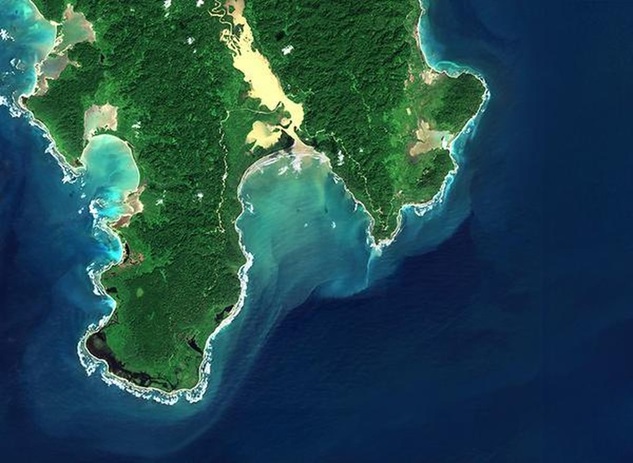
Great Nicobar Island spans approximately 910 sq km and houses India’s southernmost point, Indira Point.
The project aims to convert the island into a strategic gateway in the Indo-Pacific by developing:
The total project area covers 166 sq km, making it one of India’s largest island development initiatives.
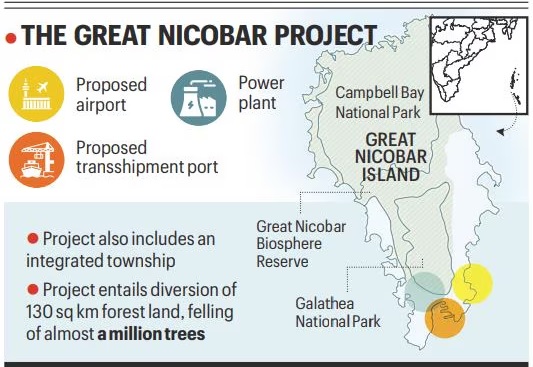
Integrated Township
Transshipment Port at Galathea Bay
Land reclamation of 2.98 sq km is planned for port infrastructure.
Civil and Military Airport
Power Plant
Estimated construction material requirement: 33.35 million cubic metres.
The project represents a coordinated civil-military infrastructure strategy.
Geopolitical and Maritime Advantage
Great Nicobar lies close to the Malacca Strait, one of the world’s most critical maritime chokepoints. Around 94,000 vessels pass through the Strait annually, carrying nearly 30% of global traded goods and a substantial share of maritime oil trade.
Its location provides India a strategic vantage point in Indo-Pacific geopolitics.
Transshipment Hub Ambition
India aims to reduce reliance on foreign ports for transshipment.
Currently, India has one operational transshipment facility at Vizhinjam Port.
The proposed Galathea Bay port aims to compete with:
Projected annual handling capacity: 14.2 million TEUs.
Strengthening Defence Infrastructure
The Andaman and Nicobar Command, India’s only tri-services command, has operated in Port Blair since 2001.
The project includes integrated defence facilities, enhanced airfields, surveillance systems, jetties, and logistics bases.
Large-Scale Forest Diversion
Biosphere and Wildlife Concerns
The island falls within the Great Nicobar Biosphere Reserve.
Impact on Leatherback Turtles
Galathea Bay is a key nesting site for Leatherback turtles. Mitigation includes proposed alternative sanctuaries on nearby islands.
Shompen Tribe
Nicobarese Community
Demographic Transformation
The Great Nicobar project represents a critical case study in reconciling strategic imperatives with ecological prudence.
FAQs1.What is the Great Nicobar Project? It is a ₹81,000-crore mega infrastructure initiative aimed at developing Great Nicobar Island into a strategic maritime, defence, and economic hub. 2.Why is the project strategically important? Its proximity to the Malacca Strait offers India a strategic advantage in maritime trade and Indo-Pacific geopolitics. 3.What are the main environmental concerns? Large-scale forest diversion, impact on biodiversity hotspots, and threats to Leatherback turtle nesting sites. 4.Which indigenous communities may be affected? The Shompen tribe and the Nicobarese community face potential ecological and demographic disruptions. 5.Who approved the project? The National Green Tribunal approved it after reviewing environmental safeguards. |



Our support team will be happy to assist you!

 Contact Us
  New Batch : 9555124124/ 7428085757
  Tech Support : 9555124124/ 7428085757