
- UPSC Exam
- State PCS
- One Day Exam
- Current Affairs
- PT Quiz
- Downlaods
- About Coaching
- Blog
- Videos

| Prelims: (Defence + CA) Mains: (GS-3 – Defence Technology, Internal Security, Science & Technology) |
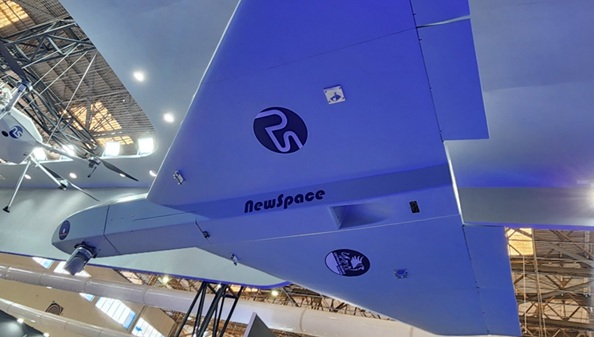
India is developing Sheshnaag-150 swarm drone, a long-range swarm attack drone capable of flying over 1,000 km, carrying heavy payloads, and conducting coordinated strikes using artificial intelligence-driven swarm technology.
The drone is being developed by NewSpace Research and Technologies, a Bengaluru-based aerospace startup specialising in AI-enabled unmanned systems and swarm robotics.
The system is expected to significantly enhance India’s long-range precision strike and autonomous warfare capabilities.
Unmanned Aerial Vehicles (UAVs) have rapidly transformed modern warfare by enabling precision strikes, intelligence gathering, and reduced risk to human soldiers.
Recent conflicts across the world have demonstrated the increasing importance of drone swarms, where multiple autonomous drones coordinate their actions to overwhelm enemy air-defence systems.
Countries such as the United States, China, and Israel are heavily investing in AI-enabled autonomous drone technologies.
India has also accelerated indigenous drone development under initiatives such as Make in India and Aatmanirbhar Bharat to strengthen domestic defence manufacturing.
Sheshnaag-150 swarm drone is a long-range collaborative swarm attack drone designed for deep strike missions and coordinated aerial assaults.
The system uses autonomous artificial intelligence algorithms that allow multiple drones to operate together as a coordinated swarm capable of executing saturation attacks against enemy targets.
Such technology enables drones to identify targets, coordinate flight paths, evade defences, and strike simultaneously.
The drone is being developed by NewSpace Research and Technologies, an Indian aerospace startup based in Bengaluru.
The company focuses on:
Its work aligns with India’s broader push to develop indigenous defence technology ecosystems.
The drone has an operational range of over 1,000 km, enabling deep-strike capabilities against distant targets.
Such long-range capability allows the drone to operate far beyond frontlines.
The drone can carry a payload of 25–40 kg, which is sufficient to damage:
This allows the drone to perform precision strike missions.
One of the most distinctive features of the system is its AI-driven swarm capability.
Multiple drones can operate together autonomously to:
This saturation attack capability can overwhelm conventional air defence systems.
The drone can remain airborne for over five hours, allowing it to loiter over target areas before carrying out a strike.
This improves flexibility during military operations.
The system is equipped with advanced capabilities such as:
These features allow the drone to function as both reconnaissance and attack platform.
The drone can operate even in GPS-jammed environments, which are common in modern electronic warfare.
It uses visual navigation systems and onboard sensors to navigate and reach targets even if satellite navigation signals are disrupted.
1. Strengthening Indigenous Defence Technology
The development of Sheshnaag-150 supports India’s efforts to reduce dependence on imported defence systems.
2. Enhancing Long-Range Strike Capability
With a range exceeding 1,000 km, the drone can conduct deep strikes against strategic targets.
3. Advancing AI-Enabled Warfare
The use of autonomous swarm intelligence represents a significant technological leap in modern warfare.
4. Improving Battlefield Surveillance
Integrated surveillance capabilities allow the drone to collect intelligence while preparing for attacks.
5. Countering Advanced Air Defence Systems
Swarm technology enables multiple drones to attack simultaneously, potentially overwhelming advanced defence systems.
Despite its advantages, swarm drone technology raises several challenges.
Ethical and Legal Issues
Autonomous weapons systems raise concerns regarding accountability and compliance with international humanitarian law.
Counter-Drone Technologies
Adversaries may develop advanced anti-drone systems, including electronic warfare and directed-energy weapons.
Cybersecurity Risks
AI-driven systems could be vulnerable to cyberattacks or electronic interference.
To maximise the benefits of swarm drone technology, India should:
These steps can help India build a robust and technologically advanced defence ecosystem.
FAQs1. What is Sheshnaag-150 ? Sheshnaag-150 is a long-range AI-powered swarm attack drone capable of coordinated strikes and deep-range operations. 2. Which organisation is developing the drone ? It is being developed by NewSpace Research and Technologies, a Bengaluru-based aerospace startup. 3. What is the range of Sheshnaag-150 ? The drone has an operational range of more than 1,000 kilometres. 4. What makes swarm drones different from conventional drones ? Swarm drones use artificial intelligence to coordinate multiple drones simultaneously, allowing them to conduct saturation attacks and evade defences. 5. Can the drone operate without GPS ? Yes. The drone can operate in GPS-denied environments using visual navigation and onboard sensors, ensuring it can reach targets even when satellite signals are jammed. |



Our support team will be happy to assist you!

 Contact Us
  New Batch : 9555124124/ 7428085757
  Tech Support : 9555124124/ 7428085757