
- UPSC Exam
- State PCS
- One Day Exam
- Current Affairs
- PT Quiz
- Downlaods
- About Coaching
- Blog
- Videos

| Prelims: (Science & Technology + CA) Mains: (GS 3 – Science & Technology, Health Security, Disaster Management) |
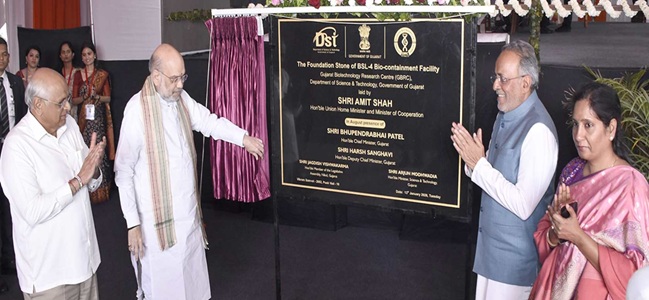
Union Home Minister Amit Shah laid the foundation stone for India’s first state-funded Bio-Safety Level 4 (BSL-4) containment facility in Gandhinagar, Gujarat, describing it as a “health shield” that marks a new era in India’s health security and biotechnology capabilities.
The COVID-19 pandemic highlighted the critical importance of advanced biosafety infrastructure for early detection, research, and response to high-risk infectious diseases.
While India has developed a broad network of BSL-2 and BSL-3 laboratories, its capacity for handling the world’s most dangerous pathogens under maximum containment has remained limited. Recognising the strategic importance of sovereign, civilian-controlled high-containment research facilities, India has begun expanding its BSL-4 and ABSL-4 infrastructure to enhance national preparedness, reduce dependence on foreign laboratories, and accelerate vaccine and therapeutic development.
A Bio-Safety Level 4 (BSL-4) laboratory represents the highest level of biological containment, designed to safely handle the most dangerous and highly infectious pathogens, many of which lack effective vaccines or treatments.
These laboratories operate under stringent international safety protocols and enable:
India’s upcoming BSL-4 facility in Gandhinagar, along with an associated Animal Bio-Safety Level (ABSL) unit, will serve as a strategic national asset for research on high-risk pathogens and zoonotic diseases.
The laboratory is being developed under the Gujarat State Biotechnology Mission and will operate through the Gujarat Biotechnology Research Centre, which already houses a BSL-2+ laboratory and played a significant role during the COVID-19 pandemic by sequencing the SARS-CoV-2 genome.
Planning for the facility began in mid-2022, and the foundation stone was laid on January 13, 2026.
The complex, spread over 11,000 square metres and costing approximately ₹362 crore, will include:
It is being developed in line with international biosafety standards issued by:
The facility will strengthen India’s real-time response capacity to outbreaks of deadly human and zoonotic diseases.
It will support:
Previously, such work often required sending samples to institutions like the ICAR–National Institute of High Security Animal Diseases (NIHSAD), causing delays and logistical challenges.
The Department of Biotechnology has signed a Memorandum of Understanding designating the laboratory as a national facility, ensuring oversight, collaboration, and guidance from leading expert institutions across the country.
Officials have noted that this facility will remove long-standing bottlenecks created by the shortage of civilian BSL-4 infrastructure in India.
Globally, around 69 BSL-4 laboratories are operational or under development, highlighting India’s relatively limited but gradually expanding footprint in high-containment biological research.
As of March 2025, the Ministry of Health and Family Welfare, through the Department of Health Research, has approved 165 biosafety laboratories under the Virus Research and Diagnostic Laboratories (VRDL) scheme, comprising:
These facilities support epidemic preparedness and disaster response.
The Indian Council of Medical Research (ICMR) has established 21 biosafety laboratories, including:
Under the Department of Science and Technology, the Anusandhan National Research Foundation has funded 5 BSL/ABSL-3 laboratories through the Intensification of Research in High Priority Areas (IRHPA) programme.
Gujarat’s state-funded BSL-4 laboratory marks a major milestone in India’s biosecurity architecture by strengthening sovereign, civilian-controlled high-containment research capacity.
It will enhance:
Going forward, sustained investments, skilled workforce development, regulatory harmonisation, and inter-institutional collaboration will be critical to fully realise the potential of India’s expanding biosafety infrastructure.
FAQs1. What is the purpose of a BSL-4 laboratory ? To safely conduct research on the most dangerous and highly infectious pathogens under maximum biological containment. 2. Where is India’s first state-funded BSL-4 facility being established ? In Gandhinagar, Gujarat. 3. Which institution will operate the Gujarat BSL-4 laboratory ? It will operate under the Gujarat Biotechnology Research Centre. 4. How many civilian BSL-4 laboratories does India currently have ? India currently has one functional civilian BSL-4 laboratory at the National Institute of Virology, Pune. 5. Why is this facility significant for India’s health security ? It strengthens national preparedness, accelerates vaccine and therapeutic research, and reduces dependence on external laboratories for high-risk pathogen studies. |



Our support team will be happy to assist you!

 Contact Us
  New Batch : 9555124124/ 7428085757
  Tech Support : 9555124124/ 7428085757