- The Hakki-Pikki tribe is an important tribal community of Karnataka, known for its distinct culture, language, and traditional lifestyle, which sets it apart from other tribes.
- Recently, eight members of the Hakki-Pikki community were stranded in Central Africa after their visas expired. They had travelled there to sell herbal products, highlighting the vulnerabilities associated with their livelihood.
- This incident has once again drawn attention to the socio-economic conditions of the Hakki-Pikki tribe and the challenges faced by their traditional occupations.
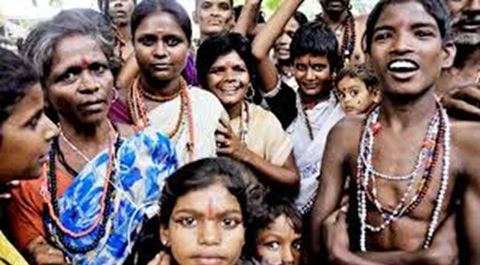
Origin of the Name
- The term ‘Hakki-Pikki’ is derived from the Kannada language, where ‘Hakki’ means bird and ‘Pikki’ means to catch.
- Thus, the literal meaning of Hakki-Pikki is “bird catchers.”
- Historically, the community depended on catching and selling birds, though in modern times many have shifted to selling herbal products, medicinal plants, and traditional medicines.
Constitutional Status
- The Government of India has recognized the Hakki-Pikki community as a Scheduled Tribe (ST).
- This status entitles them to special provisions in education, employment, political representation, and welfare schemes.
Language and Cultural Identity
- Although the Hakki-Pikki live in South India, a region dominated by Dravidian languages, they speak an Indo-Aryan language known as ‘Vaagri’ (also referred to as Vagri).
- Vaagri is mainly used within the family and community.
- For interaction with the outside world and daily activities, they commonly use Kannada.
- UNESCO has classified Vaagri as an endangered language, indicating that it is at risk of gradual extinction.
Customs and Social Structure
- The Hakki-Pikki community largely follows Hindu traditions and celebrates festivals such as Diwali, Holi, and Dussehra.
- Their social organization is clan-based, and marriages traditionally take place within the same clan.
- Cousin marriages have also been historically prevalent.
- The community follows a matrilineal system, where lineage and inheritance pass through the female line.
- Uniquely, the bridegroom pays a bride price to the bride’s family, which is the opposite of the dowry system prevalent in much of Indian society.
Livelihood Patterns and Modern Challenges
Traditionally, the Hakki-Pikki people have depended on:
- Bird catching
- Selling herbs and forest produce
- Preparing traditional medicines
- Trading in minor forest products
However, forest conservation laws, wildlife protection regulations, and changes in the modern economy have severely affected these traditional livelihoods.
As a result, many community members now travel to distant regions and even foreign countries for trade, often without adequate institutional support.
Present Crisis and Concerns
- The recent case of eight Hakki-Pikki members stranded in Central Africa due to visa expiry has exposed their economic vulnerability and the risks involved in informal international trade.
- This incident raises important policy questions, such as:
- Should the government provide better travel, legal, and trade support for such vulnerable communities?
- Are there a need for special schemes to protect and modernize their traditional livelihoods while ensuring legal and economic security ?







 Contact Us
  New Batch : 9555124124/ 7428085757
  Tech Support : 9555124124/ 7428085757