Why in news?
Haryana celebrates its Foundation Day on 1 November every year, commemorating its formation as a separate state in 1966 following its separation from the erstwhile Punjab.
Key Facts
|
Particular
|
Details
|
|
Formation Day
|
1 November 1966
|
|
Formation Act
|
Punjab Reorganisation Act, 1966
|
|
Parent State
|
Punjab
|
|
Capital
|
Chandigarh
|
|
First Chief Minister
|
Bhagwat Dayal Sharma
|
|
First Governor
|
Dharma Vira
|
|
Official Language
|
Hindi
|
|
High Court
|
Punjab and Haryana High Court
|
|
Famous historical site
|
Kurukshetra
|
|
Important Harappan site
|
Rakhigarhi
|
|
Major agricultural identity
|
Wheat and rice production
|
|
Famous industrial hub
|
Gurugram
|
Historical Background
- Haryana before independence
- Historically, the Haryana region was associated with several ancient kingdoms and empires.
- During British rule, much of the region was administered as part of the Punjab Province.
- After India's independence in 1947, the Haryana region continued to remain part of the reorganised Punjab.
- However, differences in language, cultural traditions and regional aspirations gradually strengthened the demand for a separate administrative identity.
- The demand for a separate Haryana
- The movement for a separate Haryana gained momentum during the 1950s and 1960s. Major factors behind the demand were:
- Linguistic identity: A large section of the population in the region spoke Hindi and its regional dialects, particularly Haryanvi.
- Cultural identity: The region had distinct social traditions, customs and historical characteristics.
- Administrative considerations: Supporters argued that a separate state would allow better governance and regional development.
- Regional aspirations: The demand reflected the desire for greater political representation and administrative attention.
- Formation of Haryana in 1966
- The Government of India appointed a commission headed by Justice J.C. Shah to examine the territorial reorganisation of Punjab.
- The commission examined the division of territories between the Hindi-speaking and Punjabi-speaking regions.
- Subsequently, Parliament passed the Punjab Reorganisation Act, 1966. The Act came into effect on 1 November 1966, resulting in the formation of Haryana as a separate state. The reorganisation resulted in:
- the creation of Chandigarh as a Union Territory.
- Chandigarh becoming the shared capital of Punjab and Haryana.
- the transfer of certain hill areas to Himachal Pradesh.
- Bhagwat Dayal Sharma became the first Chief Minister of Haryana.
Constitutional and Legislative Background
- The principal constitutional provision governing the creation of new states is Article 3 of the Indian Constitution.
- Article 3 (Formation of New States): Under Article 3, Parliament has the power to:
- form a new state by separating territory from an existing state.
- unite two or more states or parts of states.
- increase or diminish the area of any state.
- alter the boundaries of a state.
- change the name of a state.
Geographical and Cultural Significance of Haryana
Geographical features
|
Feature
|
Details
|
|
Location
|
Northern India
|
|
Capital
|
Chandigarh
|
|
Major river boundary
|
Yamuna
|
|
Mountain ranges
|
Shivalik Hills and Aravalli Hills
|
|
Major geographical region
|
Indo-Gangetic Plain
|
|
Important neighbouring state
|
Punjab, Rajasthan, Uttar Pradesh and Himachal Pradesh
|
|
Union Territory neighbour
|
Delhi and Chandigarh
|
- Cultural heritage
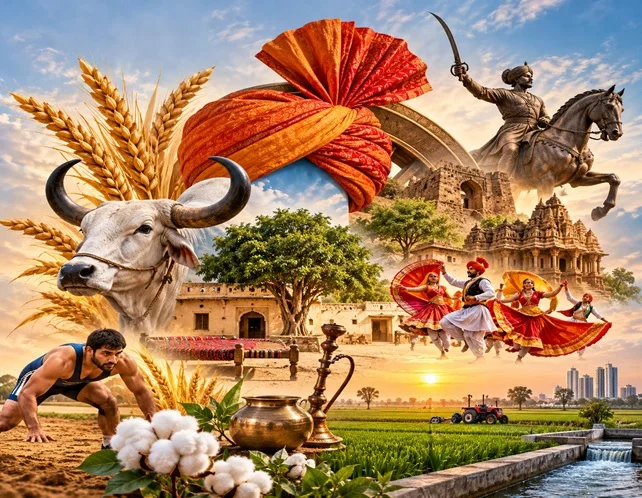
- Folk dances: Phag, Dhamal, Loor and Khoria are among the traditional folk dances associated with Haryana.
- Folk music: Ragini is an important traditional musical and poetic form.
- Festivals: Teej, Baisakhi, Gugga Navami and the Surajkund International Crafts Mela reflect the state's cultural diversity.
- Traditional language: Haryanvi is widely spoken, while Hindi is the official language.
- Historical and Archaeological Heritage
|
Historical site
|
Significance
|
|
Kurukshetra
|
Traditionally associated with the Mahabharata & the Bhagavad Gita
|
|
Panipat
|
Site of three major battles in Indian history
|
|
Rakhigarhi
|
One of the largest known Harappan archaeological sites
|
|
Jyotisar
|
Traditionally associated with the sermon of the Bhagavad Gita
|
|
Agroha
|
Associated with the historical and cultural heritage of the region
|
Three Battles of Panipat
|
Battle
|
Year
|
Major opposing forces
|
|
First Battle of Panipat
|
1526
|
Babur and Ibrahim Lodi
|
|
Second Battle of Panipat
|
1556
|
Akbar's forces and Hemu
|
|
Third Battle of Panipat
|
1761
|
Ahmad Shah Abdali and the Marathas
|
- Rakhigarhi
- Rakhigarhi, situated in Haryana's Hisar district, is one of the most significant archaeological sites associated with the Indus Valley Civilisation.
- It provides valuable evidence regarding the settlement patterns, urban planning, economic activities and material culture of the Harappan civilisation.
Haryana's Contribution to India's Economy
- Agriculture and the Green Revolution
- Haryana played a major role in India's Green Revolution during the 1960s and 1970s.
- The expansion of irrigation facilities, high-yielding varieties of seeds, fertilisers, agricultural mechanisation and rural infrastructure helped improve agricultural productivity.
- Major agricultural crops include Wheat, Rice, Mustard, Cotton, Sugarcane and Bajra.
Industrial development
|
Industrial centre
|
Major economic activity
|
|
Gurugram
|
IT, automobiles, financial and corporate services
|
|
Faridabad
|
Engineering and manufacturing
|
|
Panipat
|
Textiles, petrochemicals and refining
|
|
Manesar
|
Automobile and manufacturing industries
|
|
Hisar
|
Steel and agro-based industries
|
Haryana and Sports: A Major Sporting Powerhouse
- Haryana has earned national and international recognition for producing outstanding athletes.
- The state has made significant contributions to wrestling, boxing, athletics, hockey and other competitive sports.
- Some prominent athletes associated with Haryana include:
- Neeraj Chopra: Javelin Throw
- Sakshi Malik: Wrestling
- Bajrang Punia: Wrestling
- Vinesh Phogat: Wrestling
- Manu Bhaker: Shooting
- The state's sporting culture is supported by traditional akharas, sports academies, training facilities and government initiatives.
Prelims MCQs
Q. Haryana was carved out of which former state following the recommendations of the Shah Commission?
(a) Rajasthan
(b) Punjab
(c) Uttar Pradesh
(d) Himachal Pradesh
Mains Practice Question
Q. Examine the historical and administrative factors that led to the formation of Haryana in 1966.
|
FAQs
When was Haryana established?
1 November 1966.
From which state was Haryana separated?
Punjab.
Who was Haryana's first Chief Minister?
Bhagwat Dayal Sharma.
Which city serves as the shared capital of Haryana and Punjab?
Chandigarh.
Which commission examined the division of Punjab?
The Shah Commission, headed by Justice J.C. Shah.
|