Prelims : International Relations + Economy + CA
Mains : GS Paper 2 – Bilateral Relations; GS Paper 3 – Security; Economic Development |
Why in News ?
India–South Korea relations have entered a new phase of expansion and diversification, reflecting their growing importance in the changing geopolitical and economic landscape of the Indo-Pacific.
- Both countries are actively working to transform their relationship into a future-oriented and technology-driven partnership, moving beyond traditional trade ties
- A long-term roadmap (2026–2030) has been envisaged to deepen cooperation in emerging sectors such as semiconductors, green energy, and resilient supply chains
- There is a renewed push to significantly enhance bilateral trade and investment flows, alongside efforts to correct existing imbalances
- High-level diplomatic engagements have underscored the intent to upgrade the existing economic framework and strengthen strategic coordination
This evolving partnership reflects a broader global trend where middle powers are forging deeper collaborations to navigate economic uncertainties and geopolitical challenges.
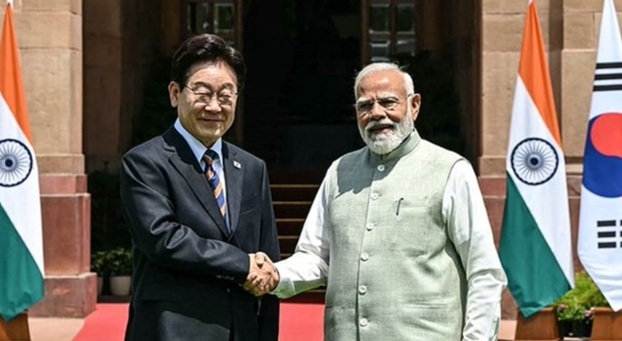
Background of India–South Korea Relations
1. Historical Evolution of Bilateral Ties
- Diplomatic relations between India and South Korea were formally established in 1973, laying the foundation for structured engagement
- The relationship gained momentum after India’s economic liberalisation in the 1990s, which opened avenues for foreign investment, trade expansion, and industrial collaboration
- In 2015, the partnership was elevated to a Special Strategic Partnership, signifying a commitment to deepen cooperation across political, economic, defence, and cultural domains
This evolution highlights a gradual transition from limited engagement to a multi-dimensional partnership.
2. Cultural and Civilisational Linkages
- Historical and cultural connections between the two countries date back centuries, particularly through :
- The spread of Buddhism
- Shared civilisational narratives and legends linking the Indian subcontinent with the Korean peninsula
- In the modern era, cultural ties have been revitalised through :
- Growing popularity of Korean culture in India
- Increased interest in Indian traditions in South Korea
These connections provide a strong soft power foundation, fostering mutual trust and deeper people-to-people engagement.
Key Pillars of India–South Korea Relations
1. Political and Strategic Cooperation
- The political relationship is characterised by regular high-level interactions, including summits, ministerial dialogues, and strategic consultations
- Both countries share common values such as :
- Democracy
- Rule of law
- Commitment to a rules-based international order
- Strategic alignment is evident in the convergence between :
- India’s Act East Policy, which aims to strengthen ties with East and Southeast Asia
- South Korea’s Indo-Pacific strategy, which emphasises regional stability and economic cooperation
- Cooperation in multilateral forums and regional initiatives reflects a shared commitment to :
- Ensuring freedom of navigation
- Promoting peaceful resolution of disputes
Overall, political cooperation has evolved into a stable and forward-looking partnership anchored in shared strategic interests.
2. Economic and Trade Relations
a. Trade and Investment Dynamics
- Bilateral trade has witnessed steady growth over the years, supported by strong industrial linkages
- South Korea is a major investor in India, with companies contributing significantly to :
- Manufacturing
- Electronics
- Automobile sectors
- These investments have :
- Generated employment
- Facilitated technology transfer
- Strengthened India’s industrial base
However, the trade relationship is marked by a persistent imbalance, with India importing more than it exports.
b. Comprehensive Economic Partnership Agreement (CEPA)
- The CEPA, implemented in 2010, serves as the cornerstone of economic engagement
- It covers :
- Trade in goods and services
- Investment facilitation
- While it has boosted trade volumes, certain challenges remain :
- Limited utilisation by small and medium enterprises
- Barriers in services trade
- Continued trade deficit for India
- Efforts are underway to upgrade the agreement to :
- Address structural issues
- Expand market access
- Promote balanced trade
c. Emerging Areas of Economic Cooperation
- The partnership is increasingly focusing on future-oriented sectors, including :
- Semiconductor manufacturing
- Electric mobility and battery technologies
- Shipbuilding and heavy engineering
- Critical minerals and supply chain resilience
This shift indicates a move toward high-value, technology-driven economic collaboration.
3. Defence and Security Cooperation
- Defence ties between India and South Korea have gained importance in recent years, driven by shared security concerns
- Key areas of cooperation include :
- Joint defence production
- Technology transfer
- Maritime security cooperation
- Collaboration in defence manufacturing supports India’s goal of :
- Reducing import dependence
- Promoting indigenous capabilities
- Both countries face distinct but comparable security challenges :
- India in the context of regional tensions in South Asia
- South Korea in relation to the Korean Peninsula
This creates opportunities for mutual learning and strategic coordination.
4. Technology and Innovation Partnership
- South Korea’s strengths in :
- Advanced manufacturing
- Electronics and hardware
complement India’s capabilities in :
- Software
- Digital services
- Innovation ecosystems
- Collaboration in areas such as :
- Artificial Intelligence
- 5G/6G technologies
- Clean energy solutions
can drive next-generation industrial growth
This synergy represents a critical pillar of the future partnership.
5. Indo-Pacific and Global Cooperation
- Both countries are increasingly aligning their strategies in the Indo-Pacific region
- Key areas of cooperation include :
- Maritime security
- Freedom of navigation
- Supply chain resilience
- Their partnership contributes to :
- Regional stability
- Balance of power dynamics
- Participation in global initiatives reflects a shared commitment to :
- Sustainable development
- Climate action
6. Cultural and People-to-People Relations
- Cultural exchanges have become a vibrant aspect of the relationship
- Growing interest in :
- Korean entertainment and culture in India
- Indian traditions and spirituality in South Korea
has strengthened mutual understanding
- Educational exchanges, tourism, and diaspora engagement further deepen ties
These interactions build long-term societal connections that reinforce diplomatic relations.
Significance of India–South Korea Relations
1. Strategic Importance in the Indo-Pacific
- The partnership contributes to maintaining :
- Stability
- Security
- Balance in the region
2. Economic Complementarity
- India offers :
- Large market
- Skilled workforce
- South Korea provides :
- Capital
- Advanced technology
This creates a mutually beneficial economic relationship.
3. Supply Chain Resilience
- Collaboration helps reduce dependence on :
- Single-country supply chains
- Strengthens global economic stability
4. Technological Advancement
- Joint initiatives accelerate:
- Innovation
- Industrial modernisation
5. Defence Modernisation
- Supports India’s efforts to :
- Strengthen defence capabilities
- Promote indigenous production
Challenges in the Relationship
1. Persistent Trade Imbalance
- India’s imports from South Korea exceed exports, leading to a structural imbalance
2. Underutilisation of Economic Agreements
- CEPA has not been fully utilised due to :
- Lack of awareness
- Regulatory challenges
3. Investment and Regulatory Barriers
- Complex regulatory environment can discourage investors
4. Geopolitical Constraints
- Different regional priorities may limit deeper strategic convergence
5. Limited People-to-People Engagement
- Despite improvements, interaction levels remain below potential
Way Forward
1. Upgrading CEPA
- Address trade imbalances
- Expand coverage to new sectors
2. Strengthening Technology Partnerships
- Focus on emerging and critical technologies
3. Enhancing Defence Cooperation
- Promote joint development and production
4. Expanding Cultural Exchanges
- Increase educational and tourism initiatives
5. Deepening Indo-Pacific Cooperation
- Collaborate on regional security and economic initiatives
Practice Questions
Prelims
Q. With reference to India–South Korea relations, consider the following statements :
- CEPA was implemented in 2010
- The relationship is termed as Special Strategic Partnership
- South Korea is a major investor in India
Which of the above statements is/are correct ?
(a) 1 and 2 only
(b) 2 and 3 only
(c) 1 and 3 only
(d) 1, 2 and 3
Mains
“India–South Korea relations have evolved from economic cooperation to a comprehensive strategic partnership.” Analyse the opportunities and challenges.
FAQs
Q1. When were diplomatic relations established ?
In 1973.
Q2. What is CEPA ?
A trade agreement covering goods, services, and investment.
Q3. What is Special Strategic Partnership ?
A multi-dimensional partnership including defence, technology, and economic cooperation.
Q4. Why is the relationship important ?
For Indo-Pacific stability, economic growth, and technological collaboration.
Q5. What is the key challenge ?
Trade imbalance and underutilisation of CEPA.
|






 Contact Us
  New Batch : 9555124124/ 7428085757
  Tech Support : 9555124124/ 7428085757