|
Prelims : (Economy + Environment + CA)
Mains : (GS 3 – Infrastructure, Energy, Industrial Policy, Renewable Energy)
|
Why in News ?
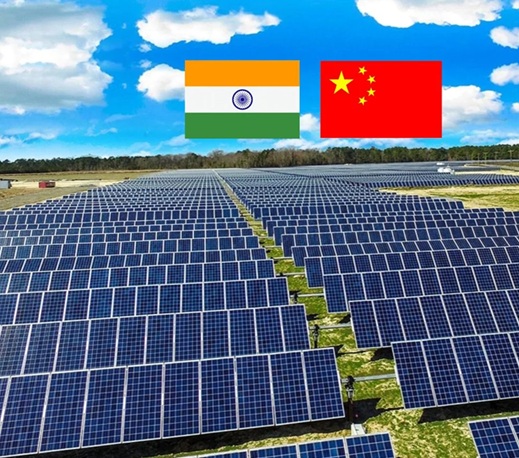
The Government of India has expanded domestic sourcing norms in the solar sector to include wafers and ingots, effective from June 2028, as part of efforts to reduce dependence on imports, particularly from China, and strengthen domestic manufacturing.
Background and Context
India is one of the fastest-growing renewable energy markets, with ambitious targets under its clean energy transition strategy.
Solar power plays a central role in achieving :
- Energy security
- Climate commitments (Net Zero goals)
- Reduced fossil fuel dependence
However, India’s solar sector has been heavily dependent on imports, especially from China, which dominates the global solar supply chain.
While India has developed strong capacity in solar modules and cells, upstream components like polysilicon, ingots, and wafers remain underdeveloped.
To address this, the government has progressively introduced localisation policies through schemes like the Production Linked Incentive Scheme and initiatives such as PM Surya Ghar.
Key Policy Change: Expansion of Domestic Sourcing Norms
- Domestic sourcing requirement now extended to :
- Wafers and ingots (effective June 2028)
- Applies mainly to :
- Government-backed projects
- Utility-scale solar installations
- Commercial solar projects
- Earlier mandate covered :
- Primarily solar PV modules
- Additional rule :
- Mandatory use of domestic solar cells from June (earlier timeline)
Understanding the Solar Manufacturing Value Chain
Solar panel manufacturing involves multiple stages :
- Polysilicon (raw material)
- Ingots (solid blocks formed from polysilicon)
- Wafers (thin slices of ingots)
- Solar Cells
- Solar Modules (Panels)
Strengthening wafer and ingot production is crucial for complete supply chain self-reliance.
Domestic Wafer Rollout Norms
As per the Ministry of New and Renewable Energy :
- A domestic wafer manufacturer list will be notified only when :
- At least 3 independent manufacturers exist
- Combined capacity reaches 15 GW
- Creation of a new :
- ALMM List-III (for wafers)
- Requirement :
- Manufacturers must also have matching ingot production capacity
ALMM Framework for Solar Supply Chain
The Approved List of Models and Manufacturers (ALMM) ensures domestic sourcing :
- List-I: Solar Modules
- List-II: Solar Cells
- List-III: Solar Wafers (newly introduced)
Cascading Requirement
- Modules → from List-I
- Cells → from List-II
- Wafers → from List-III
Transitional Provisions
Exemptions
- Projects are exempt if :
- Bid submitted before cut-off date
- Cut-off = 7 days after first ALMM wafer list
- Projects with existing PPAs remain exempt
Post Cut-Off Compliance
- Mandatory sourcing from ALMM Lists I, II, III
- Tender documents must include these conditions
Upstream Challenges in India’s Solar Sector
1. Limited Manufacturing Capacity
- Modules : ~172 GW
- Cells : ~27.2 GW
- Wafers & Ingots : ~2 GW
2. High Capital Requirements
- Significant investment needed for :
- Polysilicon plants
- Wafer manufacturing units
3. Competition from Cheap Imports
- Chinese imports are cheaper due to scale and subsidies
- Makes domestic production less competitive
Performance of PLI Scheme
- Launched in 2021 with ₹24,000 crore outlay
- Target: 65 GW capacity creation
Progress Status (as of June 2025)
Segment-wise :
- Modules : 59%
- Cells : 22%
- Wafers/Ingot : 10%
- Polysilicon : 14%
Indicates major gaps in upstream manufacturing
Continued Import Dependence
India still relies heavily on imports :
- Solar Cells: $1,641 million
- Wafers: $156 million
- Polysilicon: Minimal but critical
Highlights vulnerability in critical supply chain components
Significance of the Policy Move
1. Reducing Import Dependence
- Cuts reliance on foreign suppliers
- Enhances supply chain resilience
2. Boost to Domestic Manufacturing
- Encourages investment in upstream segments
- Strengthens “Make in India” initiative
3. Strategic Energy Security
- Ensures availability of critical solar components
- Reduces geopolitical risks
4. Employment Generation
- Promotes industrial growth and job creation
- Supports manufacturing ecosystem
5. Strengthening Renewable Energy Goals
- Facilitates sustainable and self-reliant energy transition
Way Forward
- Introduce targeted capital subsidies for upstream segments
- Improve ease of doing business for solar manufacturers
- Enhance R&D in solar technologies
- Strengthen global partnerships for technology transfer
- Ensure policy stability to attract long-term investments
FAQs
1. What is the new solar sourcing policy about ?
It expands domestic sourcing requirements to include wafers and ingots to reduce import dependence.
2. What is ALMM ?
Approved List of Models and Manufacturers ensures that solar components are sourced from approved domestic producers.
3. Why are wafers important in solar manufacturing ?
They are an essential intermediate stage between ingots and solar cells.
4. What challenges does India face in solar manufacturing ?
Limited upstream capacity, high capital costs, and competition from cheaper imports.
5. What is the goal of this policy change ?
To achieve self-reliance in the solar supply chain and strengthen domestic manufacturing.
|






 Contact Us
  New Batch : 9555124124/ 7428085757
  Tech Support : 9555124124/ 7428085757