Recently, the Hyderabad team of the Directorate of Revenue Intelligence (DRI) recovered a live Indian Red Sand Boa from a man in Warangal. This man was involved in illegal snake smuggling and trade. This snake belongs to the Eryx johnii species.
About the Red Sand Boa
The Red Sand Boa is a two-headed or matiya snake.
This snake does not have venom.
Scientific Name
It is called Eryx johnii.
Habitat
This snake is found primarily in India, Pakistan, and Iran.
It prefers areas with dry, sandy, and loose soil. In such soil, it easily digs a hole and hides underground.
This snake spends most of its time underground. It comes out at night (nocturnal) and remains hidden during the day.
This snake does not lay eggs; instead, its eggs develop inside the body, and it gives birth directly to young.
Color and Size
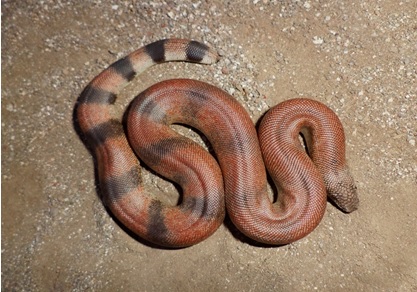
Its body is quite thick and is usually reddish-brown in color. Its average length is about 2.5 feet (75 centimeters).
The tail of this snake is as round and thick as its front head. This is why, from a distance, it appears to have two heads, although it has only one mouth.
Its Protection and Status
The number of this snake in the wild is gradually decreasing, so it has been listed as Near Threatened.
In India, the Red Sand Boa receives legal protection under Schedule 1 of the Wildlife (Protection) Act, 1972. Catching, selling, or keeping one is a serious and non-bailable offense, punishable by severe punishment and fine.
Reasons for Red Sand Boa Smuggling
In recent years, India's domestic illegal markets have seen a surge in demand for red sand boas, largely due to new-age superstitions associated with them.
They bring good luck to their owners.
There are also claims that this snake contains iridium (one of the rarest and most expensive elements found in the Earth's crust) and therefore possesses supernatural powers.






 Contact Us
  New Batch : 9555124124/ 7428085757
  Tech Support : 9555124124/ 7428085757