(Preliminary Examination: Current Affairs; International Relations)
(Mains Examination, General Studies Paper 2: Bilateral, regional, and global groupings and agreements related to and/or affecting India's interests.) |
Context
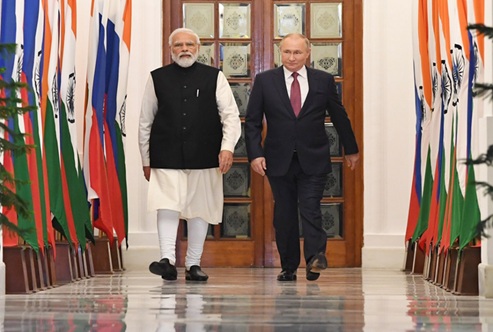
Russian President Vladimir Putin's visit to India in December 2025 and the 23rd India-Russia Annual Summit added a new dimension to the long-standing partnership between the two countries, based on trust, mutual respect, and strategic alignment.
About President Putin's Visit to India
- Russian President Vladimir Putin visited India on a two-day state visit on December 4-5, 2025, at the invitation of Prime Minister Modi.
- This was their 23rd Annual Summit.
- During the visit, the two leaders held bilateral talks, signed several agreements, and issued a joint statement.
- The opening of Indian Consulates General in Yekaterinburg and Kazan was also mentioned during the visit, which will enhance inter-regional cooperation.
Key Issues
- Timely achievement of the $100 billion bilateral trade target by 2030
- Strengthening trade and payment systems in national currencies
- Cooperation in energy, nuclear, defense, space, and emerging technologies
- Northern Sea Route, INSTC and connectivity projects such as the Chennai-Vladivostok Corridor
- Coordination on terrorism, extremism, and the situation in Afghanistan
- Multilateral cooperation in BRICS, SCO, and G-20
Key Outcomes of the Visit
- Adoption of a Programme for Strategic Areas of Economic Cooperation until 2030
- Signing of 15+ Agreements/MoUs on Migration-Mobility, Health, Food Security, Polar Water Training, Fertilizers, and Media Cooperation
- Russia Decides to Join the International Big Cat Alliance (IBCA)
- Free 30-day e-visa and group tourist visa facility for Russian citizens
- Accelerating construction of the remaining units of the Kudankulam Nuclear Project and Discussions on a Relocation
About India-Russia Bilateral Relations
Historical Background
- India-Russia relations have been a cornerstone of independent India's foreign policy. The two countries have enjoyed a deep friendly relationship since 1947.
- It was elevated to a strategic partnership in 2000 and to a "Special and Privileged Strategic Partnership" in 2010.
- This relationship has stood the test of time and remains one of the most stable partnerships in the world.
Political
- Both countries fully respect each other's sovereignty and territorial integrity.
- Regular summits, 2+2 dialogues (foreign and defense ministers), National Security Advisor-level talks, and foreign ministry consultations are regular.
Trade
- Bilateral trade is expected to reach a record $68.7 billion in 2024-25.
- India imports oil, fertilizers, diamonds, and coal from Russia and exports pharmaceuticals, tea, and textiles.
- Revised target of $100 billion by 2030.
- Negotiations on trade in national currencies and the India-Eurasian Economic Union (FTA) are intensifying.
Defense
- Defense cooperation is the strongest pillar of the partnership.
- Projects such as the BrahMos missile, Su-30 MKI, T-90 tank, S-400; now emphasizing co-development and co-production.
- Participation of Indian contingent in the INDRA-2025 joint military exercise and Zapad-2025 in 2025.
- Manufacturing of components in India and export to third countries under Make in India.
Tourism
- Sharp increase in tourist arrivals following the introduction of e-visa facility.
- 30-day free e-visa and new group visa facility for Russians in 2025.
- More than 8.5 lakh people attended the 'Festival of India' in Moscow in 2025.
Cultural
- Yoga, Indian films, dance, and literature are extremely popular in Russia.
- India was the guest of honor at the Moscow International Book Fair in 2025.
- The Russian Cultural Center in India and the Jawaharlal Nehru Cultural Center in Russia are active. Film co-productions and participation in international film festivals are increasing.
Diaspora
- Approximately 15,000 Indians live in Russia and over 5,000 Russians in India.
- Russian tourists and students in India, while Indian medical students (approximately 20,000) and IT professionals in Russia.
- A new agreement on the mobility of skilled workers in 2025.
Multilateral Organizations
- Russia supports India's permanent membership in the United Nations.
- Close coordination in BRICS, SCO, and G-20.
- Russia's full support to India's BRICS presidency in 2026.
- SCO-RATS cooperation in counter-terrorism. and utilizing the BRICS mechanism.
Projects
- Kudankulam Nuclear Power Plant (6 units operational/under construction)
- BrahMos missile (exports to third countries)
- Northern Sea Route and Chennai-Vladivostok Corridor
- Investments in the Russian Far East and Arctic (2024-2029 program)
- Russian cooperation in Gaganyaan
Challenges
- Trade imbalance (India's trade deficit)
- Payment and logistics constraints due to Western sanctions
- Competition from third countries (China, US) in some sectors
- Indirect impact of global polarization due to the Ukraine conflict
Conclusion
Both countries aim to achieve balanced trade and reach $100 billion by 2030. Particular emphasis will be placed on trade in national currencies, new connectivity corridors, emerging technologies (AI, quantum, critical minerals), long-term partnerships in nuclear and space, and Indian investments in the Russian Far East and Arctic. Both countries are united on issues like terrorism, climate change and multipolar world order.
Country: Russia
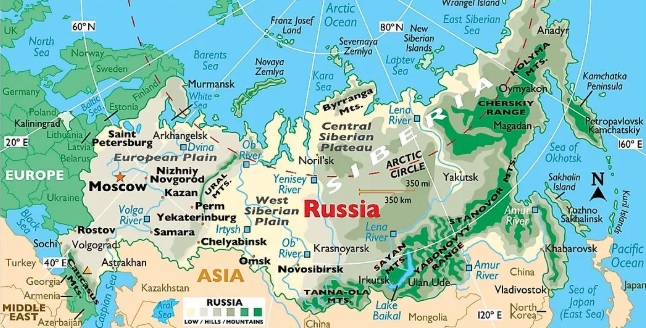
- Capital: Moscow; the world's most populous capital in the Northern Hemisphere and the largest city in Europe (population: approximately 13 million)
- National Day: June 12 (Russia declared independence from the Soviet Union in 1990)
- Area: 17,109,242 sq km; The world's largest country (1/8 of the world's total land area)
- Geographical extent: Spanning 11 time zones (from Kaliningrad to Kamchatka)
- Location: Located on two continents, Europe and Asia (the Ural Mountains form the borderline)
- Population (2025 estimate): Approximately 144 million (decreasing)
- Major ethnic groups: Russian 78%, Tatar 4%, Ukrainian, Chuvash, Bashkir, Chechen
- Official language: Russian (the most widely spoken Slavic language in the world)
- Religion: Orthodox Christian majority (70%+), Islam, Buddhism, Jewish minority
- Currency: Russian ruble (RUB)
- Government system: Federal semi-presidential republic
- Current President: Vladimir Vladimirovich Putin (in power since 2000, re-elected in 2024)
- Highest mountain: Mount Elbrus (5,642 meters) is the highest peak in Europe.
- Deepest Lake: Lake Baikal; the world's deepest and oldest freshwater lake (1,642 meters deep, 25-30 million years old).
- Major Rivers: Volga (Europe's longest river), Yenisei, Lena, Ob, Amur.
- Administrative Divisions: 85 Federal Units – including 22 republics, 9 krais (provinces), 46 oblasts, 3 federal cities, 1 autonomous oblast, and 4 autonomous okrugs.
- Natural Resources: World's largest natural gas reserves, second-largest coal reserves, leading in oil, diamonds, gold, nickel, platinum, and uranium.
- Military Power: World's second-largest nuclear power; largest tank fleet, most nuclear weapons (approximately 6,000).
|






 Contact Us
  New Batch : 9555124124/ 7428085757
  Tech Support : 9555124124/ 7428085757