Prelims: S-500 Prometheus, Air Defence System, Ballistic Missile Defence, Hypersonic Weapons, MTCR, India-Russia Defence Cooperation.
Mains: GS-II India-Russia Strategic Partnership GS-III Defence Technology, Missile Defence, National Security, Defence Indigenisation |
Why in News?
Russia is pushing India to consider its advanced S-500 Prometheus air and missile defence system as part of a wider package of defence proposals during Russian President Vladimir Putin’s visit to New Delhi for the 2026 BRICS Summit.
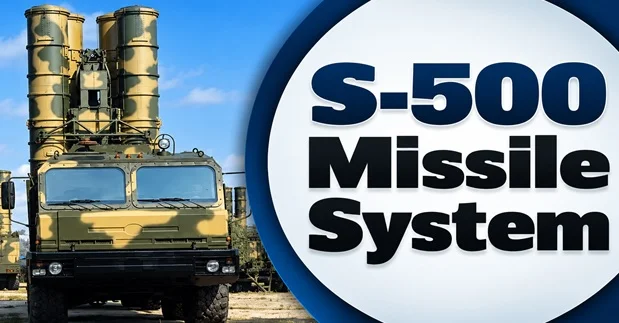
What is the S-500 Prometheus?
- The S-500 Prometheus, also known as the 55R6M Prometey or Triumfator-M, is an advanced Russian mobile surface-to-air and anti-ballistic missile defence system.
- It has been developed by Russia's Almaz-Antey defence company.
- Unlike an ordinary air-defence weapon intended mainly to shoot down aircraft, the S-500 has been developed as a strategic system capable of dealing with extremely fast and high-altitude aerial and missile threats.
- Its intended targets include ballistic missiles, advanced aircraft, cruise missiles and certain hypersonic threats.
- Russia also associates the system with a potential capability against suitable targets operating in near-space and low-Earth-orbit environments.
Missiles Used by the S-500
- The S-500 system can employ different interceptor missiles depending on the type of target.
- The 77N6 series of interceptors is associated primarily with high-speed and ballistic missile defence missions.
- The system has also been associated with the 40N6 family for long-range engagements against aerodynamic targets.
- The ability to use different interceptors gives the S-500 a broader mission profile rather than limiting it to a single type of aerial threat.
How Does the S-500 Work?
- The process begins with long-range surveillance radars searching for incoming aerial or missile threats.
- Once a threat is detected, the system determines its speed, altitude, trajectory and probable target.
- The command system then identifies the most suitable interceptor.
- Fire-control radars track the incoming target as well as the interceptor missile.
- The interceptor is subsequently guided towards the target for destruction before the incoming weapon reaches its intended destination.
- The entire process needs to occur within seconds when dealing with ballistic or hypersonic threats.
What is Ballistic Missile Defence?
- Ballistic Missile Defence (BMD) refers to technologies designed to detect, track and intercept ballistic missiles before they reach their targets.
- A ballistic missile initially accelerates under rocket power and then follows a high-speed trajectory towards the target.
- Depending on the system, interception can take place during different stages of the missile's flight.
What is the MTCR?
- The Missile Technology Control Regime (MTCR) is an informal international export-control arrangement created in 1987.
- Its objective is to limit the proliferation of missiles and unmanned delivery systems capable of delivering weapons of mass destruction.
- India became the 35th member of the MTCR on June 27, 2016.
Strategic Significance for India
- Stronger Protection against Missile Threats: The rapid development of ballistic and hypersonic weapons has increased the importance of strategic missile defence.
- Protection of Critical Infrastructure: Advanced missile defence can provide an additional protective layer for strategically important national and military assets.
- Strengthening Deterrence: A credible ability to intercept incoming missiles can complicate an adversary's strike planning and strengthen deterrence.
- India-Russia Strategic Partnership: The offer demonstrates Russia's continuing interest in retaining a major role in India's defence modernisation.
- Access to Advanced Technology: India could use future negotiations to seek technology transfer, localisation, maintenance capability and greater participation of Indian industry.
Way Forward
- India should evaluate the S-500 primarily on the basis of operational requirements rather than headline range figures.
- Any possible procurement must examine real-world performance, delivery schedules, technology transfer, localisation, lifecycle cost and compatibility with India's wider air-defence architecture.
- India should also ensure that foreign acquisition supports rather than weakens the development of indigenous defence technologies.
Prelims MCQs
Q. India became a member of the MTCR in:
A. 2008
B. 2012
C. 2016
D. 2021
Mains Question
Russia's S-500 offer highlights the growing importance of integrated air and missile defence in India's security architecture. Examine the strategic opportunities and challenges associated with such advanced defence cooperation.
|
FAQs
Why is S-500 in news?
Russia is pushing India to consider the S-500 Prometheus during President Vladimir Putin's September 2026 visit to New Delhi as part of a broader package of defence proposals.
Has India decided to buy the S-500?
No. As of September 12, 2026, India has not announced a final contract to purchase the S-500.
What is the range of S-500?
Open-source and Russian assessments place the maximum engagement range of some S-500 interceptors at around 500–600 km, depending on the target and missile used.
Who manufactures the S-500?
The S-500 Prometheus has been developed by Russian defence manufacturer Almaz-Antey.
What type of threats can S-500 target?
It has been designed for ballistic missiles, aircraft and other advanced aerial threats, with Russia also claiming capabilities against certain hypersonic and near-space targets.
|






 Contact Us
  New Batch : 9555124124/ 7428085757
  Tech Support : 9555124124/ 7428085757