Overview
- Relations between India and Turkey have remained complex and unpredictable, largely influenced by third-party issues, especially Pakistan. Even limited tensions between India and Pakistan often impact bilateral ties. Despite strong economic potential and shared strategic interests, political trust between the two countries has remained weak. Recent diplomatic engagements indicate attempts to revive cooperation, but persistent geopolitical differences continue to constrain stable relations.
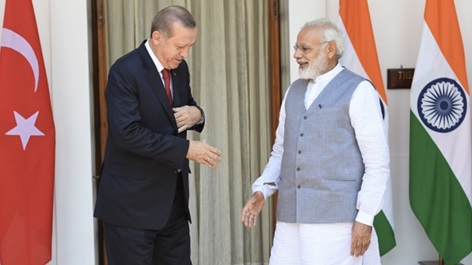
Different Phases of India-Turkey Relations
- Cold War Era : Turkey’s Alignment with Pakistan
- During the Cold War, Turkey and Pakistan emerged as close strategic partners and allies of the United States. Turkey consistently supported Pakistan on key issues, which restricted the development of independent ties with India.
- De-hyphenation Phase in the 1980s
- A significant shift came in 1984 when both countries informally agreed to avoid linking bilateral relations with disputes related to Kashmir and Cyprus. This helped improve engagement and encouraged Turkey to pursue a relatively independent policy toward India.
- Growth Phase under Endogen
- After 2002, bilateral ties witnessed improvement through high-level visits, growing economic cooperation, and stronger diplomatic engagement. Trade between the two countries expanded significantly, rising from nearly $700 million to around $13.82 billion by 2022.
- Strategic Regression after 2019
- Relations deteriorated after the abrogation of Article 370 in Jammu and Kashmir. Turkey openly supported Pakistan’s position on Kashmir, causing renewed tensions and pushing bilateral relations back toward a security-centric framework.
- Recent Strain after Operation Sindoor
- Turkey’s support for Pakistan during Operation Sindoor triggered strong political and public backlash in India. As a result, political engagement weakened and economic relations also experienced setbacks.
Significance of Turkey for India
1. Strategic Geographical Location
Turkey acts as a bridge between Europe and Asia, making it important for trade connectivity and access to European markets.
2. Role in Multilateral Forums
Turkey participates in major international platforms such as the United Nations and G20, where cooperation can support India’s global diplomatic interests.
3. Influence in the Islamic World
Turkey holds significant influence among Muslim-majority countries, which can help India strengthen diplomatic outreach in West Asia.
4. Economic Gateway
Turkish ports and transport corridors provide opportunities for Indian businesses seeking easier access to European and Mediterranean markets.
5. Institutional Mechanisms
Several structured dialogue mechanisms support bilateral engagement, including:
- Foreign Office Consultations (2000)
- Joint Committee on Economic and Technical Cooperation (JCETC, 1983)
- Policy Planning Dialogue (2020)
6. Humanitarian Cooperation
India’s humanitarian mission Operation Dost in 2023, launched after the devastating earthquake in Turkey, demonstrated that cooperation remains possible despite political differences.
Challenges in India-Turkey Relations
1. Pakistan Factor
Turkey’s continued support to Pakistan on Kashmir remains the biggest obstacle in bilateral relations. This repeatedly links India–Turkey ties to India–Pakistan tensions.
2. Defence Cooperation with Pakistan
Growing defence exports and military cooperation between Türkiye and Pakistan have increased strategic mistrust in India.
3. Cyprus Issue
India supports Cyprus, while Turkey supports Pakistan on Kashmir-related matters. This creates a parallel diplomatic conflict between both sides.
4. Limits of Economic Engagement
Trade and economic ties have not been strong enough to prevent political deterioration during major crises such as Operation Sindoor.
5. Economic and Tourism Impact
Political tensions have affected economic engagement :
- Bilateral trade declined to nearly $8.71 billion.
- Indian tourist arrivals reportedly dropped significantly in 2025.
6. Weak Political Engagement
The absence of major high-level political visits reflects limited diplomatic momentum and weak strategic engagement.
7. Perception Gap
Limited understanding of India’s strategic concerns among Turkish institutions and society continues to weaken mutual trust.
Emerging Opportunities for Cooperation
1. Trade and Economic Agreements
Following the progress in India–EU trade negotiations, Turkey may explore the possibility of signing a Free Trade Agreement (FTA) or a Comprehensive Economic Partnership Agreement (CEPA) with India. Such agreements could strengthen bilateral trade, improve market access, and create new opportunities for economic cooperation between the two countries.
2. Alternative Connectivity Corridors
Turkey’s connectivity initiatives could provide alternative trade routes linking India with Europe, especially if projects like IMEC face delays.
3. Shared Regional Interests
Both countries have overlapping interests in :
- West Asia
- Central Asia
- Africa
This creates opportunities for strategic cooperation.
4. Role in West Asian Diplomacy
Turkey’s increasing diplomatic role in regional mediation aligns with India’s interest in stability in West Asia.
5. Turkey’s Multi-Alignment Strategy
Turkey is gradually shifting from a purely NATO-centric approach toward a more flexible multi-alignment strategy, increasing possibilities for diversified partnerships with India.
Way Forward
1. De-hyphenation from Pakistan and Cyprus Issues
Both countries should avoid linking bilateral ties to the Kashmir and Cyprus disputes. Independent engagement is necessary for long-term stability.
2. Balancing Political and Economic Relations
Economic cooperation alone cannot sustain relations. Stronger political trust and continuous diplomatic dialogue are equally important.
3. Strengthening Institutional Mechanisms
Regular meetings through established frameworks such as :
- Foreign Office Consultations
- JCETC
- Policy Planning Dialogue
can improve continuity in bilateral engagement.
4. Improving Mutual Understanding
Greater academic, diplomatic, and cultural exchanges are needed to reduce perception gaps and strengthen trust.
5. Leveraging Regional Convergence
Cooperation in connectivity projects, trade corridors, and regional diplomacy can create long-term strategic benefits for both countries.
6. Pragmatic Diplomacy
India and Turkey should adopt a practical and interest-based diplomatic approach, similar to India’s engagement with other countries despite political differences.
Conclusion
- India-Turkey relations represent a combination of strong strategic potential and recurring geopolitical disruptions. Economic engagement alone has proved insufficient during periods of crisis. However, shared interests in connectivity, trade, West Asia, and multilateral cooperation make disengagement impractical.
- A sustainable reset in bilateral ties will require stronger political dialogue, reduced dependence on third-party disputes, and better mutual understanding so that relations can evolve into a more stable and balanced partnership.






 Contact Us
  New Batch : 9555124124/ 7428085757
  Tech Support : 9555124124/ 7428085757