Prelims: (International Relations + CA)
Mains: (GS 2 – Bilateral Relations, Act East Policy, Indo-Pacific Strategy, Global Governance Reforms) |
Why in News?
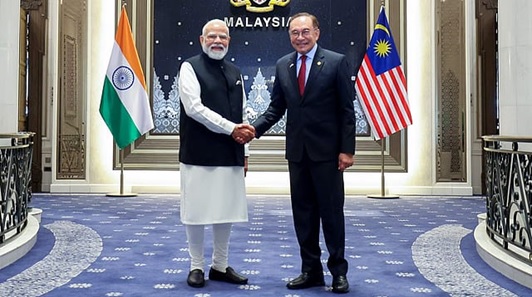
India and Malaysia signed multiple agreements during Prime Minister Narendra Modi’s visit to Kuala Lumpur in February 2026, marking a significant deepening of their Comprehensive Strategic Partnership and expanding cooperation across defence, technology, energy, and economic domains.
Background and Context: Evolution of India–Malaysia Relations
- India and Malaysia have historically shared close ties rooted in centuries of maritime trade, cultural diffusion, and people-to-people contact across the Indian Ocean. Ancient Indian traders and scholars influenced Southeast Asia’s political, religious, and linguistic landscape, evident in Malaysia’s early Hindu-Buddhist heritage and later Islamic cultural synthesis.
- After India’s independence, Malaysia emerged as one of its key partners in Southeast Asia. Bilateral relations gained renewed momentum following India’s “Look East Policy” in the 1990s, later upgraded to the “Act East Policy,” which positioned Malaysia as a strategic partner in India’s engagement with ASEAN and the Indo-Pacific.
- In 2024, the two countries elevated their relationship to a Comprehensive Strategic Partnership, reflecting growing political trust, economic interdependence, and security convergence. The February 2026 visit marks a continuation of this upward trajectory, aligning bilateral ties with shifting regional geopolitics, supply chain reconfiguration, and the global push for resilient economic and security architectures.
India–Malaysia Bilateral Relationship
Historical and Civilisational Links
- India and Malaysia share deep civilisational connections dating back over two millennia, shaped by trade, religion, language, and cultural exchanges across the Indian Ocean.
- Elements of Indian culture, including Sanskrit influences, Hindu-Buddhist traditions, and later Islamic connections, are visible in Malaysia’s historical evolution.
- Modern diplomatic relations were established soon after India’s independence, with consistent political engagement since then.
Political and Diplomatic Engagement
- India and Malaysia elevated their relationship to a Comprehensive Strategic Partnership in 2024, reflecting growing political trust.
- High-level visits, regular foreign office consultations, and cooperation at multilateral forums such as the United Nations and ASEAN-led platforms form the backbone of diplomatic engagement.
- Malaysia has supported India’s demand for permanent membership of a reformed UN Security Council, reinforcing political convergence and shared commitment to global governance reforms.
Trade and Economic Cooperation
- Malaysia is India’s 3rd largest trading partner within ASEAN. Between April 2000 and March 2025, Malaysia invested about US$ 1.27 billion in India.
- Bilateral trade between the two countries stood at US$ 19.86 billion in 2024–25, comprising Indian exports worth US$ 7.32 billion and imports valued at US$ 12.54 billion.
- Owing to its strategic location along the Strait of Malacca and the South China Sea, Malaysia is a key pillar of India’s Act East Policy and an important partner in India’s maritime connectivity strategy.
- India’s major exports include petroleum products, engineering goods, meat and dairy products, and organic chemicals, while major imports from Malaysia consist of vegetable oils, machinery, electrical equipment, and minerals.
Defence and Security Cooperation
- Defence ties have expanded steadily through joint exercises, maritime cooperation, and capacity-building initiatives.
- As maritime neighbours in the Indian Ocean and Indo-Pacific region, both countries share concerns over freedom of navigation, maritime security, and non-traditional threats such as piracy, terrorism, and transnational crime.
- Intelligence sharing and counter-terrorism cooperation have gained prominence, particularly in the context of evolving security challenges in the Indo-Pacific.
Diaspora and People-to-People Ties
- The Indian diaspora in Malaysia, numbering over 2 million, plays a crucial role in strengthening bilateral ties.
- Persons of Indian Origin are active in Malaysia’s politics, business, education, and culture, serving as a living bridge between the two countries.
- Educational exchanges, tourism, cultural festivals, and academic cooperation further enhance people-to-people relations and societal linkages.
Shared Regional and Global Platforms
- Both countries actively engage through ASEAN, the East Asia Summit, and the Indian Ocean Rim Association (IORA).
- India recognises ASEAN centrality in the Indo-Pacific, while Malaysia supports India’s Act East Policy, creating strategic alignment at the regional level.
- Their cooperation reflects a shared vision for a free, open, inclusive, and rules-based Indo-Pacific order.
Significance of Strengthening India–Malaysia Relations
1. Advancing India’s Act East and Indo-Pacific Strategy
Malaysia’s geostrategic location near vital sea lanes makes it central to India’s maritime security and regional connectivity objectives.
2. Enhancing Economic Resilience and Supply Chain Integration
Collaboration in semiconductors, electronics, digital technologies, and renewable energy supports India’s goal of becoming a global manufacturing hub and reduces dependence on concentrated supply chains.
3. Strengthening Counter-Terrorism and Maritime Security
Shared concerns over extremism, piracy, and non-traditional threats enhance security cooperation and intelligence coordination in a volatile regional environment.
4. Promoting ASEAN Centrality and Regional Stability
Closer ties with Malaysia reinforce India’s commitment to ASEAN-led regional architecture and multipolar stability in the Indo-Pacific.
5. Supporting Global Governance Reforms
Malaysia’s backing of India’s UNSC bid and cooperation in multilateral fora strengthen India’s voice in shaping global institutions.
Challenges and Way Forward
Challenges
- Trade Imbalance: India’s imports from Malaysia significantly exceed exports, requiring diversification and value-added exports.
- Geopolitical Pressures: Increasing strategic competition in the Indo-Pacific may complicate regional alignments.
- Implementation Gaps: Translating MoUs into actionable outcomes requires institutional coordination and sustained political commitment.
Way Forward
- Deepen Economic Integration: Expand cooperation in manufacturing, semiconductors, green technologies, and digital services.
- Institutionalise Security Dialogue: Regularise defence consultations and maritime domain awareness mechanisms.
- Strengthen Regional Architecture: Enhance cooperation through ASEAN-led forums and IORA to ensure inclusive regional stability.
- Promote People-to-People Connectivity: Expand education, tourism, cultural exchanges, and diaspora engagement.
- Link Bilateral Cooperation with Global Reforms: Use shared platforms to advocate reforms in international financial and governance institutions.
FAQs
1. What is the current status of India–Malaysia relations?
India and Malaysia share a Comprehensive Strategic Partnership, strengthened through political trust, economic cooperation, and security collaboration.
2. Why is Malaysia important for India’s Act East Policy?
Malaysia’s strategic location near key maritime routes and its role within ASEAN make it central to India’s engagement with Southeast Asia and the Indo-Pacific.
3. How does defence cooperation benefit both countries?
It enhances maritime security, counter-terrorism efforts, intelligence sharing, and regional stability in the Indo-Pacific.
4. What is the significance of local currency trade settlement?
It reduces transaction costs, mitigates exchange rate risks, and lowers dependence on third-country currencies, strengthening bilateral trade resilience.
5. How do people-to-people ties shape bilateral relations?
The large Indian diaspora in Malaysia, along with cultural, educational, and tourism exchanges, deepens societal linkages and mutual understanding.
|






 Contact Us
  New Batch : 9555124124/ 7428085757
  Tech Support : 9555124124/ 7428085757