
- UPSC Exam
- State PCS
- One Day Exam
- Current Affairs
- PT Quiz
- Downlaods
- About Coaching
- Blog
- Videos

| Prelims : Economy + CA Mains : GS Paper 3 – Inclusive Growth, Employment; GS Paper 1 – Society |
Recent policy discussions and economic analyses have highlighted that while India’s economic growth has successfully reduced extreme poverty, it has simultaneously led to the emergence of a “vulnerable middle class”, raising concerns about the sustainability, inclusiveness, and resilience of India’s growth model.
This issue has gained prominence as rising inflation, job uncertainty, and global economic instability are increasingly affecting households that are above the poverty line but still lack economic security.
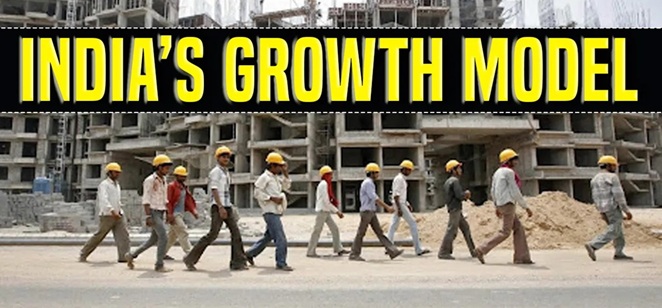
India’s growth trajectory over the past few decades has been characterised by relatively high GDP growth, expansion of welfare programmes, and increasing integration with the global economy.
Economic growth has contributed significantly to poverty reduction by improving access to basic services, increasing income levels, and strengthening welfare delivery systems through mechanisms such as direct benefit transfers and financial inclusion initiatives.
However, despite these achievements, the growth model has shown structural limitations, particularly in generating sufficient employment, ensuring income stability, and distributing the benefits of growth equitably across different sections of society.
As a result, while many households have moved above the poverty line, they have not necessarily achieved long-term financial security.
Traditional poverty measurement relies on a fixed income threshold to classify individuals as poor or non-poor, which provides only a limited understanding of economic well-being.
This binary approach fails to capture the lived realities of households that are just above the poverty line but remain highly vulnerable to economic shocks. It does not account for:
Therefore, there is a growing recognition of the need to move towards a broader framework that captures economic vulnerability and quality of life, rather than relying solely on poverty statistics.
Middle class vulnerability refers to a condition where households have crossed the poverty threshold but do not possess sufficient financial stability, income security, or resilience to sustain a decent standard of living over time.
Such households often exist in a precarious situation where :
As a result, even minor economic shocks—such as a medical emergency, job loss, or increase in living costs—can push them back into poverty.
Thus, instead of experiencing stable upward mobility, these households remain trapped in a cycle of economic fragility and uncertainty.
A large segment of the workforce, particularly those employed in the informal sector, earns low and unpredictable incomes, which makes it difficult for households to plan their finances or accumulate savings.
In the absence of stable earnings, households often struggle to meet basic expenses and are unable to invest in long-term assets such as education, housing, or healthcare.
Declining household savings and increasing reliance on credit further indicate that many families are living close to subsistence levels despite being classified as part of the middle class.
Middle-class households are increasingly vulnerable to various types of shocks, including job loss, health emergencies, inflation, and economic downturns.
With rising costs of essential services such as healthcare and education, even a temporary disruption in income can have long-lasting financial consequences.
The traditional notion of maintaining a few months’ worth of savings as a safety net is becoming inadequate in the face of rising economic uncertainty.
Despite sustained economic growth, real wages for a large section of the population have not increased proportionately.
This indicates a disconnect between GDP growth and income growth, suggesting that the benefits of economic expansion are not being evenly distributed.
As a result, households find it difficult to improve their standard of living over time, leading to frustration and economic insecurity.
One of the most significant structural issues in India’s growth model is the lack of sufficient formal employment opportunities.
A large proportion of the workforce remains engaged in informal employment, which is characterised by:
The limited growth of labour-intensive sectors, particularly manufacturing, has further constrained job creation, weakening the link between economic growth and employment generation.
India’s economy exhibits a structural imbalance where a significant portion of the workforce is still dependent on agriculture, even though the sector contributes a relatively smaller share to GDP.
At the same time, the manufacturing sector has not expanded enough to absorb surplus labour, while the services sector—though growing rapidly—does not generate sufficient employment opportunities for all skill levels.
This imbalance leads to underemployment and limits productivity gains, contributing to economic vulnerability.
Economic growth in India has been accompanied by increasing inequality, with wealth and income becoming concentrated among a smaller segment of the population.
The middle class does not benefit proportionately from growth, which restricts upward mobility and reinforces economic insecurity.
This growing inequality also affects access to opportunities, such as quality education and healthcare, further deepening vulnerability.
A particularly concerning trend is the high level of unemployment among educated youth.
Despite higher levels of education, many young individuals are unable to secure stable and well-paying jobs, which undermines the role of education as a pathway to economic mobility.
This not only affects individual aspirations but also has broader implications for economic productivity and social stability.
The vulnerability of the middle class is reflected in several economic indicators, such as :
These indicators suggest that a significant portion of the population remains economically insecure despite being above the poverty line.
India’s growth model reveals a fundamental challenge: while it has been effective in reducing poverty, it has not been equally successful in creating stable, secure, and well-paying employment opportunities.
This has resulted in a situation where economic mobility is not accompanied by economic security, leading to the emergence of a large vulnerable middle class.
The existence of a vulnerable middle class highlights the limitations of a growth model that does not adequately address inequality and employment.
If income growth remains stagnant and structural issues persist, India may struggle to transition to a high-income economy.
Since the middle class is a key driver of domestic consumption, its financial insecurity can weaken demand and slow down economic growth.
Economic vulnerability among the middle class can lead to increased demand for welfare support, social dissatisfaction, and potential political instability.
A comprehensive approach is required to address the structural challenges in India’s growth model.
Prelims
Q. Which of the following best describes “middle class vulnerability” ?
(a) High-income inequality
(b) Lack of economic security despite being above poverty line
(c) Decline in agricultural productivity
(d) Increase in government expenditure
Mains
“India’s growth model has reduced poverty but created a vulnerable middle class.” Critically analyse.
FAQsQ1. What is middle class vulnerability ? It refers to economic insecurity among households above the poverty line. Q2. Why is it rising in India ? Due to income instability, weak job creation, and inequality. Q3. What is the key structural issue ? The disconnect between economic growth and employment generation. Q4. Why is it important ? It affects consumption, growth, and social stability. Q5. What is the solution ? Inclusive growth with focus on jobs, wages, and social security. |



Our support team will be happy to assist you!

 Contact Us
  New Batch : 9555124124/ 7428085757
  Tech Support : 9555124124/ 7428085757