Prelims: (Health + CA)
Mains: (GS 2: Governance; GS 3 - Public Health, Biotechnology, Ethical Issues in Healthcare) |
Why in News ?
Recent data presented by the Union Health Ministry (2020–2024) shows a worsening organ transplant crisis in India, marked by:
- Long waiting lists
- Rising deaths during wait periods
- State-wise inequalities
- A troubling dependence on living donors
Despite being third globally in the number of transplants, India’s deceased organ donation rate remains among the lowest in the world.
Background & Context
Organ transplantation in India has grown rapidly over the last two decades due to advancements in surgical techniques and private healthcare expansion. However, this progress remains uneven because:
- Deceased organ donation is poorly institutionalised
- Brain death declarations are inconsistent across states
- Public awareness on organ donation remains minimal
- Transplant infrastructure is concentrated in a few urban centres
The result is a structurally unequal system, where access to life-saving transplants varies widely based on geography, affordability, and family circumstances.
Organ Donation in India
Overview
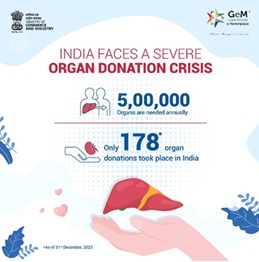
India ranks third globally with over 18,900 transplants in 2024, yet:
- Deceased donor rate < 1 per million population (pmp)
- Spain has ~48 pmp; US has ~36 pmp
- Only 1,000–1,200 deceased donors annually despite 1.6 lakh road accident deaths
India remains heavily dependent on living donors, especially for kidney and liver transplants.
Key Statistics
- 2024: 1,128 deceased donors vs. 15,000+ living donors
- Southern states contributed 70%+ of deceased donors
- Demand-supply gap:
- Kidney: 63,000+ patients waiting
- Liver: 22,000 waiting
- Heart: 1,695
- Lungs: 970
- Pancreas: 306
The gap leads to thousands dying without receiving transplants.
Magnitude of the Crisis
Rising deaths while waiting
Between 2020–2024, 2,805 people died while awaiting organs.
Top states with highest waitlist deaths:
- Delhi: 1,425 deaths
- Maharashtra: 297
- Tamil Nadu: 233
Despite high transplant volume, Delhi shows the worst mortality, reflecting the mismatch between demand and deceased donor availability.
Growing waiting lists
As of December 2025, 82,285 individuals are on transplant waitlists:
- Kidney: 60,590
- Liver: 18,724
- Heart: 1,695
- Lungs: 970
- Pancreas: 306
State-wise Burden of Organ Demand
Highest Burden States (2025):
- Maharashtra: 20,553 (13,045 kidney)
- Gujarat: 9,592 (7,405 kidney; 2,019 liver)
- Tamil Nadu: 9,166 (6,448 kidney; 2,020 liver)
- Delhi: 8,853 (5,894 kidney; 2,835 liver)
Why Delhi has highest deaths
- Although it leads in overall transplants, over 80% are from living donors, not deceased donors.
- Long queues + shortage of cadaver organs = higher mortality.
Organ Allocation Systems in India
India lacks a uniform national allocation policy. States follow diverse models:
1. State-Specific Criteria (Fragmented Models)
- Telangana, Maharashtra, Gujarat use state-specific scoring
- West Bengal, Karnataka, Rajasthan, Kerala follow first-come-first-served
2. Zonal Allocation (Tamil Nadu Model)
- State divided into three zones
- Organs allocated zone-wise, then state-wide
- Considered the most efficient model in India
3. Priority-Based Allocation (MP, Chhattisgarh)
Preference for:
- Patients without a living donor
- Cases where donor availability is medically or socially impossible
Challenges in India’s Organ Transplant Ecosystem
1. Overreliance on Living Donors
Creates inequity for:
- Orphans
- Single adults
- Economically disadvantaged individuals
- Those whose relatives are medically unfit
2. Fragmented Allocation Policies
- No national standard
- Geographic inequity
- Unfair prioritisation across regions
3. Long Waiting Periods
Driven by:
- Blood group mismatch
- Organ shortage
- Limited deceased donor retrieval
- Low awareness of brain death
4. Uneven Infrastructure
- Few states dominate transplants
- Northeastern and central states lag behind
5. High Mortality on Waitlists
- Over 2,800 deaths show structural inefficiencies.
Government Measures to Improve Organ Donation
Institutional Reforms
- Strengthening NOTTO, ROTTO, SOTTO
- National Organ Transplant Programme (NOTP)
- Funding for infrastructure, retrieval, and coordination
Legal Reforms (2023–2025)
- Removed upper age limit for deceased donors
- Removed state domicile requirement
- Simplified documentation for brain death certification
Digital Platforms
- NOTTO-ID for unified registration
- Mandatory digital reporting of transplants
Policy Response & Way Forward
1. Toward Uniform National Allocation
NOTTO is developing:
- Standardised allocation model
- Centralised real-time waitlist
- Uniform scoring for all states
2. Strengthen Deceased Organ Donation
- Mandatory brain death audits
- Hospital incentives for organ retrieval
- Public awareness campaigns
3. Improve Infrastructure
- Dedicated transplant units in underserved regions
- Skilled personnel training
- Reliable organ transport logistics
4. Ethical Oversight
- Strong monitoring to prevent organ trafficking
- Transparent documentation for living donors
FAQs
1. Why is India’s deceased donor rate so low ?
Low awareness, reluctance to certify brain death, and infrastructural gaps limit organ retrieval.
2. Which organs are most in demand ?
Kidneys (60,000+ patients), followed by liver, heart, and lungs.
3. Is organ allocation centralised in India ?
Not fully. Allocation varies state-wise, though NOTTO is moving toward a centralised national system.
4. Why do so many people die while waiting ?
Severe organ shortage, slow brain death declarations, and long queues lead to high mortality.
5. Which states lead in deceased organ donation ?
Tamil Nadu, Telangana, Karnataka, Maharashtra, Kerala, and Gujarat.
|






 Contact Us
  New Batch : 9555124124/ 7428085757
  Tech Support : 9555124124/ 7428085757