Prelims: (Economy + International Relations + CA)
Mains: (GS 2 – Foreign Policy, Strategic Autonomy; GS 3 – Energy Security, Trade and Infrastructure) |
Why in News ?
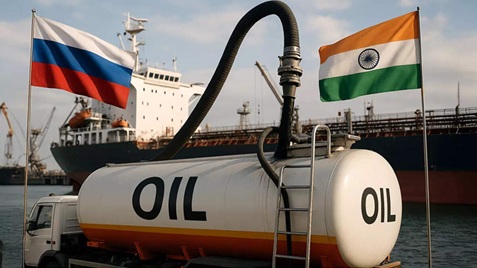
US President Donald Trump announced a sharp reduction in tariffs on Indian goods from 50% to 18%, claiming that India has agreed to stop buying Russian crude oil and instead increase purchases from the US and Venezuela. While India welcomed the trade deal, it has not confirmed any commitment to halt Russian oil imports, signalling that energy security remains its top priority.
Background and Context
- India is the world’s third-largest oil importer, meeting over 85% of its crude oil needs through imports.
- Energy security—defined as affordable, reliable, and diversified access to energy supplies—is central to India’s economic growth and political stability.
- Historically, India sourced most of its oil from West Asia. Before the Ukraine conflict, Russia accounted for less than 2% of India’s oil imports.
- After Western sanctions on Russia in 2022, Moscow offered crude at deep discounts, prompting Indian refiners to significantly increase purchases.
- As a result, Russia emerged as India’s largest crude supplier, peaking at over 2 million barrels per day (bpd) in mid-2025.
- The current debate arises at the intersection of:
- Geopolitical pressure,
- Trade negotiations with the US,
- India’s long-standing commitment to strategic autonomy in foreign policy.
India’s Official Position: Energy Security First
- India has not publicly endorsed President Trump’s claim regarding halting Russian oil imports.
- The Ministry of External Affairs (MEA) reiterated that:
- Energy security for 1.4 billion people remains India’s overriding priority.
- India’s oil procurement strategy is guided by:
- Diversification of sources,
- Market conditions,
- Evolving international dynamics.
- No formal directive has been issued to Indian refiners to stop importing Russian crude.
- India’s stance reflects continuity in policy rather than a sudden geopolitical realignment.
Why a Complete Halt Is Unlikely ?
Completely stopping Russian oil imports is impractical in the current context due to:
1. Technical Constraints
- Indian refineries are configured to process specific crude grades.
- Rapidly switching from Russian medium-sour crude to alternative grades is technically complex and inefficient.
2. Commercial Constraints
- Many crude purchases are tied to:
- Long-term contracts,
- Forward orders,
- Pricing benchmarks that favour Russian supplies due to discounts.
3. Logistical Limitations
- Scaling up supplies from the US and Venezuela requires:
- Additional shipping capacity,
- Longer transit routes,
- Stable production and export infrastructure.
4. Strategic Autonomy Concerns
- India’s energy policy is designed to balance:
- Geopolitical pressures,
- Cost competitiveness,
- Supply reliability.
- A sudden halt would undermine India’s strategic autonomy and expose it to price volatility and supply risks.
Industry analysts therefore expect:
- A gradual reduction in Russian imports,
- A measured increase in purchases from alternative suppliers,
- Continued emphasis on flexibility and diversification rather than rigid alignment.
Economic Logic: Discounts and Refining Compatibility
- Russian crude remains economically attractive:
- Deep discounts on Urals crude relative to ICE Brent support refinery margins.
- Indian refiners are technically well-suited to process Russian grades.
- Volumes are already locked in:
- Cargoes are booked for the next 8–10 weeks.
- Immediate cancellations would entail financial penalties and operational disruptions.
Russian Oil to Remain a Major Part of India’s Import Basket in the Near Term
- Indian refiners have booked Russian crude cargoes through March and parts of April, making abrupt cancellations impractical.
- Even if advised to reduce imports, refiners would require several months to gradually scale down due to:
- Existing contracts,
- Supply-chain rigidities.
- A complete halt is especially unfeasible due to Nayara Energy:
- Processes around 400,000 bpd,
- Is almost entirely dependent on Russian oil.
- Rosneft, Russia’s national oil company, is a major shareholder in Nayara.
- Nayara has been sanctioned by the European Union, and Rosneft faces US and EU sanctions, severely limiting access to alternative crude sources.
Likely Scale of Reduction: Gradual, Not Zero
- Energy experts broadly agree:
- India is unlikely to reduce Russian oil imports to zero.
- Imports could fall from an average of ~1.6 million bpd in 2025 to around 500,000 bpd in the medium term.
- Even at 500,000 bpd, Russian crude would still account for about 10% of India’s total oil imports.
Recent Trends: Decline Already Underway
- India’s Russian oil imports have already declined to a three-year low following US sanctions on major Russian producers, including Rosneft and Lukoil.
- Data shows:
- Imports peaked at 2.09 million bpd in June 2025,
- Fell to 1.16 million bpd in January 2026.
- Despite the decline:
- Russian oil still accounted for 22% of India’s total imports in January 2026,
- Down from 35–40%+ earlier, but still significant.
- This dominance is expected to persist for several months.
Replacing Russian Crude with US and Venezuelan Oil: Constraints
Replacing Russian crude is theoretically possible, as Russia accounted for less than 2% of India’s oil imports before the Ukraine war. However, the real challenge lies in how much and how fast alternative supplies can substitute Russian volumes.
US Oil: Cost and Compatibility Constraints
- India has increased imports from the US, but two key constraints remain:
- Higher transportation costs: Shipping crude from the US to India costs more than double compared to supplies from West Asia.
- Crude quality mismatch: US crude is generally lighter and sweeter, whereas Indian refineries are optimised for medium-sour crude from Russia and West Asia.
- While Indian refineries can technically process most crude types, efficiency and output vary significantly by grade.
Venezuelan Oil: Opportunity with Limits
- Venezuelan crude is closer in quality to Russian oil and could be a partial substitute.
- However:
- Low production: Venezuela currently produces only about 1 million bpd.
- High competition: Much of this output is already in demand in the US.
- Long-term constraints: Significantly increasing production would require years and billions of dollars in investment.
- As a result, Venezuelan oil can only partially and intermittently replace Russian volumes.
India’s Strategic and Trade Autonomy in Oil Imports
- India has consistently defended its right to make independent energy trade decisions, despite sustained pressure from the US under President Donald Trump to curb Russian oil purchases.
- New Delhi has resisted being directed on trade partners, particularly Russia—a long-standing strategic partner.
- Importantly:
- Recent reductions occurred only after US sanctions on Rosneft and Lukoil,
- Not due to bilateral political pressure.
- A recent MEA statement suggests that India is unlikely to change its stance on trade autonomy.
- Maintaining some Russian oil volumes preserves:
- Flexibility in sourcing,
- Bargaining power with other suppliers,
- Resilience against external shocks.
Significance of the Issue
1. Energy Security and Economic Stability
- Affordable oil imports are essential for:
- Inflation control,
- Industrial growth,
- Transport and logistics.
2. Strategic Autonomy in Foreign Policy
- India’s stance reinforces its long-standing policy of non-alignment and strategic independence in global affairs.
3. Geopolitical Balancing
- India continues to balance relationships with:
- The US and Western partners,
- Russia as a strategic partner,
- Oil suppliers in West Asia and Latin America.
4. Implications for Global Energy Markets
- Changes in India’s oil sourcing patterns influence:
- Global crude prices,
- Shipping routes,
- Energy geopolitics.
5. Domestic Refining and Industrial Policy
- Refinery compatibility and operational efficiency remain critical constraints in reshaping India’s import basket.
FAQs
1. Has India agreed to stop buying Russian oil ?
No. India has not confirmed any commitment to halt Russian oil imports and continues to prioritise energy security.
2. Why is it difficult for India to stop importing Russian crude immediately ?
Due to technical refinery constraints, long-term contracts, logistical limitations, and strategic autonomy concerns.
3. How much Russian oil does India currently import ?
As of January 2026, India imports about 1.16 million barrels per day, accounting for roughly 22% of total crude imports.
4. Can US or Venezuelan oil fully replace Russian crude ?
Not in the near term. US oil faces cost and compatibility issues, while Venezuelan oil is constrained by low production and high global demand.
5. What is India’s broader strategy on oil imports ?
India follows a diversification strategy guided by market conditions, energy security, and strategic autonomy rather than political alignment.
|






 Contact Us
  New Batch : 9555124124/ 7428085757
  Tech Support : 9555124124/ 7428085757