(Prelims: Current Events of National Importance, General Science)
(Mains, General Studies Paper 3: Science and Technology—Developments and Applications and Their Impact on Everyday Life; Achievements of Indians in Science and Technology; Indigenous Technology Development and Development of New Technologies; Space, Computers, Robotics) |
Context
The year 2025 marked a turning point for the Indian Space Research Organization (ISRO). The country is no longer merely a low-cost satellite launcher but has emerged as a sophisticated power on the global space stage. The successful launch of the 6,100-kilogram Bluebird Block-2 satellite by the LVM3-M6 rocket is not just a technological achievement but a clear declaration of India's space capabilities and readiness for future human missions.
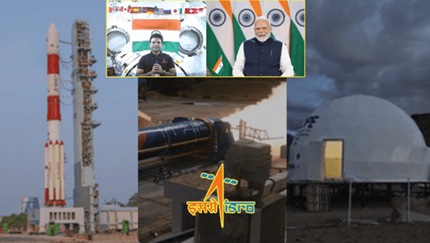
India's Space Performance in 2025
Unprecedented Demonstration of Ultra-Heavy Satellite Launch Capability
- ISRO's Launch Vehicle Mark-3 (LVM3), formerly known as the GSLV Mk-III, has now firmly established itself on the international map as a "heavy-lift vehicle."
- The heaviest launch ever from Indian soil was of the US satellite Bluebird Block-2 (AST Spacemobile), weighing 6,100 kg. This satellite was successfully placed into low earth orbit (LEO).
- The Bluebird Block-2 satellite is designed for space-based cellular broadband. It will allow ordinary smartphones to connect directly to the satellite, potentially eliminating "dead zones" around the world.
- This was the ninth consecutive success of the LVM3, making it a launch vehicle with a 100% success rate. This kind of reliability not only attracts high-value international contracts but also provides a strong foundation for upcoming human-based missions.
Technological Efficiency
- SPADEX (Space Docking Experiment): In January, a successful test of in-orbit satellite docking and detaching was conducted, crucial for future projects such as the Indian Space Station and Chandrayaan-4.
- NISAR (NASA-ISRO Synthetic Aperture Radar): In July, high-resolution data was provided for monitoring climate change, deforestation, and natural disasters.
- CMS-03 and GTO Capability: By placing a 4,400-kilogram satellite into geostationary orbit in November, India reduced its dependence on foreign rockets for heavy communication satellites.
Economic and Commercial Dimensions
- Through ISRO's commercial arm, NewSpace India Limited (NSIL), India made a significant shift from a 'scientific approach' to a 'commerce-first' strategy.
- Global Market: India currently accounts for approximately 2% of the global space market, which the government aims to increase to 10% by 2033.
- Cost Competitiveness: By launching heavy satellites at the lowest cost, ISRO has established itself as a globally attractive option.
- Rise of the Private Sector: Companies like Skyroot Aerospace and Agnikul Cosmos have assumed responsibility for regular launches of small satellites, allowing ISRO to focus on high-end research and development.
Strategic and Geopolitical Importance
- India's space achievements are not just technological but also strengthen strategic soft power and autonomy.
- International Influence: India's capability to launch heavy payloads (satellite launches) and its readiness for human missions have placed India in the elite space club alongside the United States, Russia, and China.
- Self-reliant Technology: Indigenous technologies like the C32 cryogenic stage and upcoming electric propulsion reduce dependence on global supply chains.
- Security and Connectivity: Global connectivity provides strategic advantages in control, internal security, and disaster management.
Gaganyaan and the Way Forward
The success of LVM3 is a cornerstone for India's human spaceflight dreams.
LVM3 Towards Human Evaluation
- LVM3, carrying a 6,100-kilogram US satellite, is now being converted to a human-rated version.
- This process includes incorporating advanced safety systems, redundant and fail-safe electronics, and a state-of-the-art Crew Escape System (CES) to ensure the safe return of astronauts in case of an emergency.
Vyommitra: The Final Test Before a Human Mission
- This will be a crucial test flight for the first unmanned Gaganyaan mission (G1), proposed for launch in early 2026. This mission will launch an anthropomorphic robot, 'Vyommitra,' to simulate human presence.
- This robot will monitor life-support parameters such as pressure, temperature, oxygen levels, and radiation to ensure that the environment is completely safe for human flight.
Foundation of the Indian Space Station
- The success achieved in space docking through the SPADEX mission and the high reliability of the LVM3 are decisive steps towards realizing India's vision of its own space station.
- Proposed by 2035, this station will serve as a permanent laboratory in orbit, enabling scientific experiments, advanced research, and long-term human presence in microgravity.
Conclusion
ISRO's journey to 2025 demonstrates that India is no longer just an "affordable option," but an "innovation leader." With its massive payload capability, mastery of space docking, and private participation, India is well-positioned to lead this new era of space.






 Contact Us
  New Batch : 9555124124/ 7428085757
  Tech Support : 9555124124/ 7428085757