
- UPSC Exam
- State PCS
- One Day Exam
- Current Affairs
- PT Quiz
- Downlaods
- About Coaching
- Blog
- Videos

| Prelims: (Economy + CA) Mains: (GS 2: Government Policies & Interventions, Health Governance; GS 3: Indian Economy, Taxation) |
India has notified a new taxation regime for tobacco and related sin goods, effective 1 February, following legislative changes approved by Parliament. The reform restructures GST slabs, excise duties, and cess mechanisms for tobacco products, marking a significant shift in India’s approach to public health-oriented taxation.

Sin goods such as tobacco, pan masala, and alcohol are taxed heavily in India due to their adverse public health and social impacts. Tobacco taxation serves a dual policy objective:
Despite being placed in the highest GST slabs since 2017, tobacco products—particularly cigarettes—remained relatively affordable over the past decade due to stagnation in effective excise duties. This weakened tobacco control efforts even as incomes rose.
Globally, institutions such as the World Health Organization (WHO) recommend that tobacco prices should rise faster than income growth to reduce affordability and consumption. India’s latest reforms seek to address this gap.
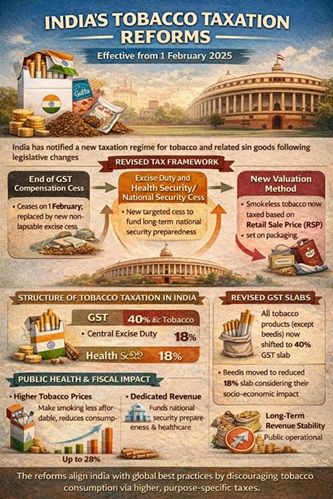
India follows a multi-layered taxation framework for tobacco products, involving:
Under GST, tobacco products have consistently been treated as demerit goods, attracting the highest tax incidence. However, complexity in valuation and cess structures led to uneven enforcement and revenue leakage.
The GST Compensation Cess on tobacco products will cease from 1 February, as its original purpose—compensating States for GST-related revenue losses—has largely been fulfilled.
Key Points:
Significance: Marks the closure of a temporary, transition-phase tax instrument under GST.
To replace the compensation cess, the government has introduced:
Significance: Reflects a shift from compensation-based cess to purpose-specific fiscal instruments.
The reform introduces major rationalisation in GST rates:
For smokeless tobacco products such as:
GST valuation will now be based on the Retail Sale Price (RSP) declared on packaging.
FAQsQ1. Why are tobacco products taxed heavily in India ? Due to their adverse health and social impacts and to discourage consumption while generating public revenue. Q2. What replaces the GST Compensation Cess on tobacco ? Revised excise duties and a new purpose-specific cess under the Health Security-cum-National Security Act, 2025. Q3. Why is the RSP-based valuation important ? It reduces tax evasion and ensures higher compliance in smokeless tobacco products. Q4. Why was the GST slab for beedis reduced to 18% while other tobacco products were raised ? Beedis are largely consumed by lower-income groups and produced in the informal sector. The differentiated GST treatment aims to balance public health objectives with socio-economic considerations, while higher-risk and more organised tobacco products face higher effective taxation. Q5. How do India’s tobacco taxation reforms align with global best practices ? The reforms move India closer to WHO recommendations by increasing real tobacco prices, reducing affordability, strengthening valuation mechanisms, and shifting towards predictable, purpose-specific revenue instruments rather than temporary cess-based taxation. |



Our support team will be happy to assist you!

 Contact Us
  New Batch : 9555124124/ 7428085757
  Tech Support : 9555124124/ 7428085757