(Preliminary Examination: Current Events of National and International Importance)
(Mains Examination, General Studies Paper 2: India and Its Neighborhoods - Relations; Bilateral, Regional, and Global Groupings and Agreements Concerning India and/or Affecting India's Interests) |
Context
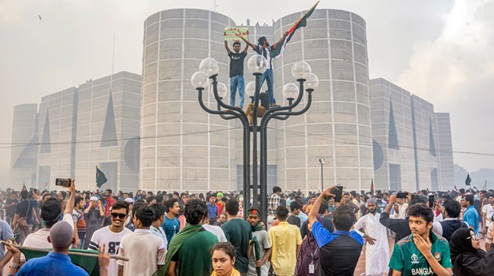
Bangladesh is currently going through a period of deep political crisis and widespread violence. Against this backdrop, the return of Tarique Rahman, the acting president of the Bangladesh Nationalist Party (BNP), after 17 years of exile, has given a new twist to the country's politics. However, this development, along with the intensification of anti-India rhetoric, has raised serious questions not only about internal stability but also about regional diplomacy.
Spontaneous Rebellion or Other Factors
- The unrest that began in July-August 2024 was often described as a sudden expression of public discontent, but facts that have emerged over time indicate that it was a well-planned regime change operation. Muhammad Yunus, Bangladesh's current Chief Advisor, publicly acknowledged in September 2024 that an organized strategy was at work behind this movement.
- In this process, Jamaat-e-Islami, with its historical alliance with Pakistan, has emerged as an influential force. Today, this organization appears to be expanding its influence not only on the streets but also within the administrative structure.
Attack on the Legacy of 1971
- A central goal of the current turmoil has been to undermine the political and cultural legacy created after the 1971 Liberation War.
- Since August 5, 2024, symbols, monuments, and institutions associated with the Awami League and the Liberation War have been systematically targeted. This appears to be not just a political protest but an attempt to redefine national memory.
Increasing Pressure on Minorities
- A serious aspect of this political shift is the increasing violence against minorities and the trend of open Islamization. Indeed, there have been allegations of attacks on Hindu, Buddhist, Christian, and Ahmadi communities, destruction of property, land grabbing, and even murders.
Mobocracy and Media Clampdown
- Mobocracy: It is becoming increasingly common for mobs to surround government offices, officials, and judges to enforce their demands.
- Institutional Capture: Appointments of Jamaat-supporters in the bureaucracy and educational institutions have increased.
- Media Repression: Pressure on independent journalism has increased. The offices of respected newspapers like Prothom Alo and The Daily Star have been attacked, and some journalists have been detained without trial.
Economic Decline and Distance from India
- Political instability has had a direct impact on the economy. Bangladesh, which had been growing at an average rate of 6.5-7% over the past 15 years, has now seen a change:
- Growth rates have declined
- Factories are closing
- Unemployment is rising
- Private investment is stagnant and inflation is high.
- A major reason for this is the disruption of decades-long economic and trade cooperation with India, which was a hallmark of Sheikh Hasina's rule.
Tarique Rahman's Return: Hope or Illusion
- Tarique Rahman's return home after 17 years has generated enthusiasm among BNP supporters. Sympathy for his ailing mother and his story of exile are likely to garner him public support. However, the reality is far more complex:
- No election appears free and fair due to the exclusion of the Awami League from the electoral process.
- The BNP itself is internally fragmented.
- The power of Jamaat-e-Islami is steadily growing.
- Therefore, while Rahman's return is symbolically significant, structural realities limit his scope for rapid political change.
Anti-India Sentiment: Old Currents, New Rise
- Anti-India sentiment is not new in Bangladesh. Even in 1971, a segment of the population was opposed to India's role. This undercurrent has coexisted with politics for decades.
- Despite this, India-Bangladesh relations have been based on trade, education, medical care, tourism, and people-to-people contacts, which have created deep mutual interests beyond politics.
Strategic Priorities for India
- Reassuring the Bangladeshi people: India must convey its message of goodwill to the general public, not just governments. Aid, trade, and dialogue must be continued. The recent export of 50,000 metric tons of rice to Bangladesh is an important step in this direction.
- Emphasis on inclusive elections: New Delhi should make it clear that long-term stability is possible only through free, fair, and inclusive elections involving all parties, including the Awami League.
The Importance of India-Bangladesh Relations
- India has been a central pillar of Bangladesh's economic development, and its geographical proximity, competitive prices, and historical ties make it a natural partner.
- Even growing engagement with Pakistan, China, or Turkey cannot match the speed, scale, and depth of India's support.
The Question of India's Security
- Bangladesh's importance to India is not merely diplomatic but also directly linked to security. In fact, cooperation is essential due to our shared border of over 4,000 kilometers and maritime connectivity.
- In the past, Pakistan-backed terrorist networks and militant groups from the Northeast have used Bangladeshi territory, which the Hasina government played a key role in curbing.
Growing Risks After August 2024
After August 2024, there have been growing fears that the Pakistani government and military may seek to re-establish pre-1971 military-strategic relations with Bangladesh, which could include a deeper military presence near the India-Bangladesh border. This scenario poses a serious regional security concern.
Conclusion
The current turmoil in Bangladesh is not merely an internal political crisis. Its far-reaching implications extend to India-Bangladesh relations, as well as regional stability and the security architecture of South Asia. However, for India, balance, dialogue, and a long-term strategic vision are now more essential than ever.






 Contact Us
  New Batch : 9555124124/ 7428085757
  Tech Support : 9555124124/ 7428085757