Prelims : Economy + CA
Mains : GS Paper 3 – Indian Economy, Employment; GS Paper 2 – Governance |
Why in News ?
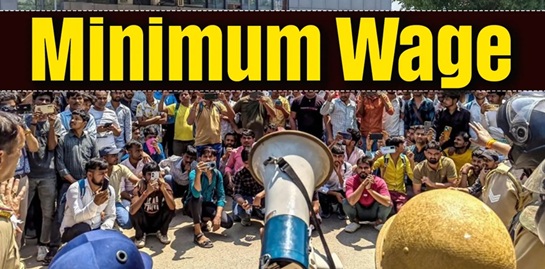
Recent large-scale protests by industrial workers in regions such as Noida, Gurugram, and other industrial hubs have brought attention to a deepening minimum wage crisis in India, where workers have mobilised collectively to demand higher wages, better working conditions, and effective enforcement of labour laws.
These protests have intensified due to rising inflation, wage stagnation, and growing disparities across states, making it a significant socio-economic issue.
What is Minimum Wage ?
Minimum wage refers to the legally mandated lowest wage that employers must pay workers, ensuring that employees can meet basic living standards.
It consists of two key components :
- Base Wage:
- This is the fixed component of wages, revised periodically by governments.
- It forms the core guaranteed income for workers and is ideally updated to reflect economic conditions.
- Variable Dearness Allowance (VDA):
- This component is linked to inflation and adjusted based on changes in the Consumer Price Index.
- It ensures that wages retain their real value despite rising prices.
However, the effectiveness of minimum wages depends on timely revisions and strict implementation.
Major Reasons Behind Worker Protests
1. Widening Gap Between Wages and Inflation
- One of the primary drivers of protests is the growing mismatch between wage growth and inflation levels.
- Over the years, the cost of essential goods such as food, fuel, housing, and transportation has increased significantly.
- However, minimum wages have not been revised proportionately, leading to a decline in the real purchasing power of workers.
- As a result, even full-time employment is no longer sufficient for meeting basic needs, creating economic distress and dissatisfaction.
2. Rising Cost of Living and Household Financial Stress
- Workers in urban and industrial areas face a severe cost-of-living crisis, which directly impacts their quality of life.
- Key expenses have risen sharply, including :
- Housing and rent, especially in industrial clusters and metropolitan regions
- Food and daily essentials, which form a major share of household expenditure
- Energy costs, including cooking gas and electricity
- With wages remaining low, workers struggle to sustain their families, leading to financial insecurity and indebtedness.
3. Delay in Minimum Wage Revisions
- Although minimum wages are expected to be revised periodically, there are often significant delays in updating base wages.
- In many cases:
- Revisions occur after long gaps, making wages outdated
- Interim increases fail to compensate for accumulated inflation
- This results in a structural lag where wages do not reflect current economic realities, fuelling dissatisfaction among workers.
4. Regional Wage Disparities
- Minimum wages vary widely across states, leading to significant regional inequalities.
- Workers in one state may earn considerably less than those in neighbouring states for similar work.
- This disparity creates :
- A sense of injustice among workers
- Migration pressures towards higher-paying regions
- Increased likelihood of protests in lower-wage areas
5. Impact of Economic Pressures on Industries
- Global and domestic economic challenges have increased production costs for industries.
- Rising fuel prices, supply chain disruptions, and economic uncertainty have affected business profitability.
- As a result :
- Employers are reluctant to increase wages significantly
- Workers bear the burden of rising costs without corresponding income growth
- This imbalance has contributed to labour unrest.
6. Unmet Expectations from Labour Reforms
- The introduction of new labour codes created expectations of :
- Improved wage structures
- Better working conditions
- Greater uniformity in labour laws
- However, delays in implementation and lack of clarity have led to frustration among workers, who feel that promised benefits have not materialised.
7. Poor Working Conditions and Labour Exploitation
- In addition to low wages, workers face several workplace challenges :
- Long working hours without adequate compensation
- Lack of overtime pay and weekly rest
- Unsafe or unhealthy working environments
- These issues highlight weak enforcement of labour laws and contribute to dissatisfaction.
8. Informalisation of Labour
- A large portion of India’s workforce is employed in the informal sector, where labour protections are minimal.
- This leads to :
- Absence of written contracts
- Lack of job security
- Limited access to social security benefits
- Informal workers are particularly vulnerable to exploitation and low wages.
9. Weak Collective Bargaining Mechanisms
- The weakening of trade unions has reduced workers’ ability to negotiate wages effectively.
- Fragmented labour laws and decentralised regulation have further diluted collective bargaining power.
- As a result, protests become the primary means for workers to express grievances.
10. Spillover Effect of Protests
- Protests in one region often inspire similar movements elsewhere.
- Key factors include :
- Awareness of wage increases in neighbouring regions
- Mobilisation of large groups of workers
- Shared grievances across industries
- This creates a chain reaction, turning local issues into broader national concerns.
Impact of the Crisis
1. Industrial Disruptions
- Worker protests have led to :
- Temporary shutdown of factories
- Delays in production
- Disruptions in supply chains
2. Law and Order Challenges
- In some cases, protests have escalated into clashes, creating challenges for administration and law enforcement.
3. Policy Responses by Governments
- Governments have responded through :
- Interim wage increases
- Formation of committees for review
- Engagement with worker representatives
However, these measures are often short-term solutions.
Core Issue: Wage Growth vs Cost of Living
The crisis highlights a structural imbalance :
- Wages are not keeping pace with inflation, leading to declining real incomes.
- Labour policies are fragmented and unevenly implemented.
- Economic growth has not translated into equitable income distribution.
Way Forward
1. Regular and Timely Wage Revisions
- Institutionalise periodic revisions linked to inflation indices to ensure wages remain relevant.
2. Establishing a National Floor Wage
3. Effective Implementation of Labour Codes
- Ensure uniform enforcement and clarity in labour regulations.
4. Strengthening Enforcement Mechanisms
- Improve monitoring and compliance to ensure employers adhere to wage laws.
5. Expanding Social Security
- Provide broader access to healthcare, pensions, and welfare schemes.
6. Strengthening Worker Representation
- Promote collective bargaining and dialogue between workers and employers.
Practice Questions
Prelims
Q. Which of the following components are part of minimum wage in India ?
- Base Wage
- Variable Dearness Allowance
- Bonus
(a) 1 and 2 only
(b) 2 and 3 only
(c) 1 and 3 only
(d) 1, 2 and 3
Mains
“Minimum wage stagnation in the face of rising inflation has led to widespread labour unrest in India.” Examine the causes and suggest reforms.
FAQs
Q1. Why are workers protesting in India ?
Due to low wages, rising costs, and poor working conditions.
Q2. What is the main issue ?
Mismatch between wages and cost of living.
Q3. What is VDA ?
An inflation-linked component of wages.
Q4. What is a national floor wage ?
A minimum wage benchmark across states.
Q5. What is the key challenge ?
Balancing fair wages with economic growth.
|






 Contact Us
  New Batch : 9555124124/ 7428085757
  Tech Support : 9555124124/ 7428085757