Prelims: (History & Culture + CA)
Mains: (GS 1 - Art & Culture) |
Why in News?
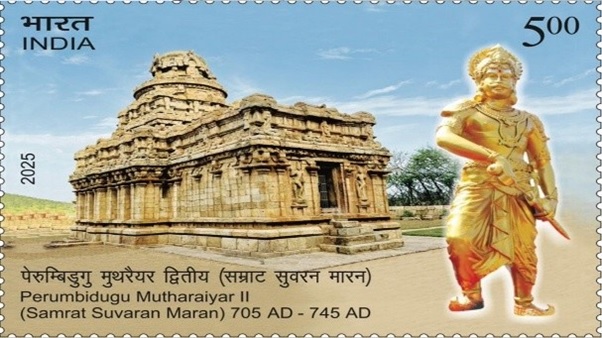
Recently, the Vice President of India released a commemorative postage stamp in honour of Perumbidugu Mutharaiyar II, also known as Suvaran Maran, recognising his historical contributions as a prominent ruler and administrator of early medieval South India.
Background and Historical Context
- Early medieval South India (7th–9th century CE) was marked by the dominance of imperial dynasties like the Pallavas, Chalukyas, and later the Cholas, alongside powerful regional chiefs and feudatories.
- Among these, the Mutharaiyars emerged as influential rulers in the Cauvery delta region, playing a crucial role in governance, military affairs, temple construction, and cultural patronage.
- Perumbidugu Mutharaiyar II stands out as one of the most illustrious rulers of this lineage, symbolising the transition of feudatories into semi-independent regional powers.
Perumbidugu Mutharaiyar II: Life and Reign
Identity and Titles
- Name: Perumbidugu Mutharaiyar II
- Period: c. 705 CE – 745 CE
- Other names:
- Suvaran Maran (indicating prosperity and royal authority)
- Shatrubhayankar (meaning “one who strikes fear in enemies”)
Political Role
- He belonged to the Mutharaiyar lineage, which initially served as feudatories of the Pallava dynasty.
- During his reign, Pallava power was gradually weakening, allowing chiefs like the Mutharaiyars to assert greater autonomy.
- Though nominally under Pallava overlordship, Perumbidugu Mutharaiyar exercised independent authority over his territories.
Military Contributions
- He fought several battles alongside Pallava king Nandivarman II (Nandivarman Pallavamalla).
- His military support was crucial in stabilising Pallava power against rival claimants and external threats.
- His epithet Shatrubhayankar reflects his reputation as a formidable warrior.
Administration and Governance
- Perumbidugu Mutharaiyar is remembered as a capable administrator, ensuring:
- Effective local governance
- Revenue collection from fertile Cauvery regions
- Maintenance of irrigation systems essential for agrarian prosperity
- His reign contributed to political stability in central Tamil Nadu during a period of dynastic flux.
Religious and Cultural Patronage
Religious Tolerance
- Though he patronised Shaivism, his court reflected religious pluralism.
- The Jain monk Vimalachandra is known to have visited his court, highlighting tolerance toward Jainism.
- This coexistence of Shaiva and Jain traditions was characteristic of early medieval Tamil society.
Temple and Cultural Contributions
- As Pallava feudatories, the Mutharaiyars were active temple builders.
- They were deeply involved in:
- Rock-cut cave temples
- Early structural temple architecture
- Their architectural activity continued up to the early 9th century, laying foundations later inherited and expanded by the Cholas.
Who Were the Mutharaiyars?
- A powerful regional clan of early medieval Tamil Nadu.
- Initially served as feudatories of the Pallavas.
- With Pallava decline, they rose as independent or semi-independent rulers.
- Core areas under their control included:
- Thanjavur
- Pudukkottai
- Perambalur
- Tiruchirappalli
- Regions along the Cauvery River
- Known for:
- Military strength
- Administrative efficiency
- Temple-building activities
- Their political legacy significantly influenced the rise of the Cholas, who later absorbed these regions.
Significance of the Commemorative Stamp
- Recognises the historical importance of regional dynasties often overshadowed by imperial powers.
- Highlights India’s effort to:
- Preserve local and regional history
- Promote awareness of lesser-known rulers
- Reinforces the role of cultural memory in national heritage.
FAQs
Q1. Who was Perumbidugu Mutharaiyar II?
He was a prominent ruler of the Mutharaiyar dynasty (705–745 CE), also known as Suvaran Maran, and a powerful Pallava feudatory in Tamil Nadu.
Q2. Why is he historically important?
He played a key military role alongside Pallava kings, administered Cauvery regions efficiently, and patronised religion and temple architecture.
Q3. What is the significance of the Mutharaiyars?
They were influential regional rulers who helped bridge Pallava rule and the later rise of the Cholas.
Q4. Which religions flourished under his reign?
Shaivism was patronised, but Jainism also enjoyed support, reflecting religious tolerance.
Q5. Why was a commemorative stamp issued in his honour?
To recognise his contributions to Indian history and highlight the importance of regional dynasties in nation-building.
|







 Contact Us
  New Batch : 9555124124/ 7428085757
  Tech Support : 9555124124/ 7428085757