The Government of India is launching the National One Health Mission (NOHM).
This mission is an important step towards adopting an integrated and coordinated approach between human, livestock, wildlife, and environmental health.
About the National One Health Mission
This is a multi-sectoral initiative adopting an integrated approach to human, livestock, wildlife, and environmental health. It aims to strengthen coordinated surveillance, diagnosis, and disease outbreak responses across sectors.
Vision:To build an 'integrated disease control and pandemic preparedness system' in India by uniting human, animal, and environmental sectors for improved health outcomes, enhanced productivity, and biodiversity conservation.
Approval: Approved in 2022 during the 21st meeting of the Prime Minister's Science, Technology, and Innovation Advisory Council (PM-STIAC).
Nodal Agency:Operated by the Indian Council of Medical Research (ICMR) under the Office of the Principal Scientific Adviser (PSA) to the Government of India.
Key Institute:National Institute of One Health, Nagpur, which serves as the anchor for coordinating mission activities. The Union Cabinet approved the Director position for this institute in February 2024.
Main Pillars of the One Health Mission:
Research and Development (R&D): Promoting targeted R&D for essential tools like vaccines, diagnostics, and therapeutics to address priority diseases.
Diagnostic Preparedness:Enhancing diagnostic care infrastructure, response capacities, and readiness for clinical care.
Data Integration:Streamlining the integration of data and information from human, animal, and environmental sectors for better access, analysis, and federated systems.
Community Participation:Ensuring ongoing community engagement to sustain response preparedness and foster participation.
About the 'One Health' Approach:
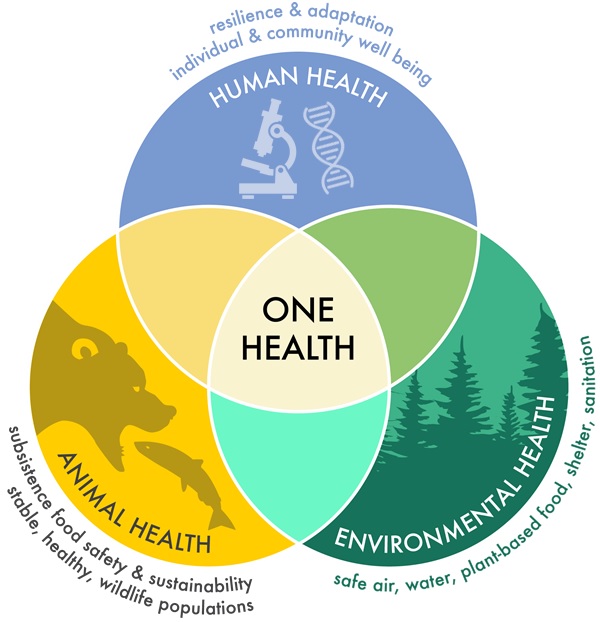
This is an integrated, unifying approach aimed at sustainably balancing and optimizing the health of people, animals, and ecosystems.
It is particularly crucial for preventing, predicting, detecting, and responding to global health threats like the COVID-19 pandemic, recognizing the interconnectedness of these sectors.
Why is this Mission Needed?
Zoonotic Risk Mitigation:Based on the global fact that about 60% of emerging infectious diseases are zoonotic (transmitted from animals to humans). This enhances India's ability to identify and prevent potential 'spillover' events in time.
Pandemic Prevention Preparedness: Establishes a proactive and preventive health-security framework, shifting India from a 'reactive model' to an 'anticipatory, systems-based public health framework.'
Rising Antimicrobial Resistance (AMR): Due to inappropriate use of antibiotics in humans, livestock, and aquaculture, resistance is rapidly increasing. The new NAP-AMR (2025-2029) integrates One Health surveillance to combat this.
Climate Change Impacts: Changing climate patterns are expanding the range of disease vectors like mosquitoes, increasing the spread of diseases such as dengue and malaria.
Livelihood Security:Improves livestock health, productivity, and disease resistance, boosting farmers' incomes and rural economic stability.
Ecosystem Health: Strengthens wildlife disease surveillance and biodiversity monitoring, enhancing ecological security and addressing environment-related disease dynamics.
Global Coordination:Aligns India's health policies with the "One Health" approach adopted by WHO, FAO, WOAH, and UNEP, positioning India as a regional leader in integrated health governance.
Initiatives Related to the One Health Approach:
Center of One Health (CoH) at NCDC:Coordinates between departments and agencies, running programs on rabies, zoonoses, leptospirosis, and snakebites. It promotes and institutionalizes the One Health approach in India.
One Health Support Unit in the Department of Animal Husbandry and Dairying:A dedicated team of experts in veterinary, human health, wildlife, and data, aimed at effectively implementing the National One Health Framework in India.
BSL-3/4 Laboratory Network:A national network of high-security labs (currently 22) for rapid testing and analysis of infectious disease outbreaks across human, animal, and environmental sectors. A new BSL-4 facility was foundation-laid in Gujarat in January 2026.
One Health Joint Plan of Action (OH JPA): A collaborative framework for 2022–2026 by the Quadripartite alliance (FAO, UNEP, WHO, WOAH) to promote the One Health approach globally.
National One Health Programme for Prevention and Control of Zoonoses (NOHP-PCZ):Approved for FY 2021-26 under the NCDC umbrella scheme, institutionalizing structural mechanisms for One Health.
The Way Forward
Statutory Mandate: Establish a statutory and formally notified inter-sectoral coordination authority to institutionalize coordination between human, animal, and environmental health sectors.
Capacity Building: Prioritize systematic training in veterinary epidemiology, wildlife disease surveillance, genomics, and field diagnostics to strengthen technical and operational capacities.
State-Level Strengthening: Set up 'State One Health Cells' with dedicated financial resources, trained manpower, and technical support for decentralized implementation. A governance model framework was released in December 2025.
Improved Diagnostics and Technological Innovation: Develop an integrated 'National One Health Digital Platform' for real-time data integration, risk assessment, and coordinated decision-making across ministries.
Climate Change Adaptation: Conduct research on climate impacts on disease spread and develop climate-resilient disease control strategies.
Global Partnerships: Expand strategic collaborations with WHO, FAO, WOAH, UNEP, and regional One Health networks to align with global standards and enhance preparedness for cross-border diseases.







 Contact Us
  New Batch : 9555124124/ 7428085757
  Tech Support : 9555124124/ 7428085757