Prelims: (Defence Technology + CA)
Mains: (GS 3 – Defence Technology, Internal & External Security, Indigenisation) |
Why in News ?
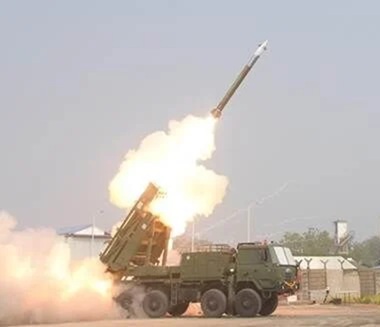
The Defence Research and Development Organisation (DRDO) has successfully conducted the maiden flight test of the Pinaka Long Range Guided Rocket (LRGR-120) at the Integrated Test Range (ITR), Chandipur, marking a major step in strengthening India’s long-range precision artillery capability.
Background & Context
Modern battlefield dynamics increasingly demand long-range, high-precision, rapid-fire artillery systems capable of neutralising enemy assets deep inside hostile territory. For India, with diverse terrain ranging from mountainous borders to plains and deserts, accurate long-range rocket artillery is essential for deterrence and quick response.
The Pinaka Multiple Launch Rocket System (MLRS) has emerged as the backbone of India’s rocket artillery. The development of the Long Range Guided Rocket (LRGR-120) represents an evolution from area-saturation fire to precision-guided deep-strike capability, aligning with India’s push for indigenous, technology-intensive defence systems.
What is the Pinaka Long Range Guided Rocket (LRGR-120) ?
The Pinaka LRGR-120 is an extended-range, precision-guided rocket developed for deployment with the Pinaka Multiple Launch Rocket System (MLRS) of the Indian Army.
It is designed to:
- Deliver accurate strikes at long distances
- Neutralise high-value targets such as:
- Enemy artillery batteries
- Command and control centres
- Logistics hubs
Development & Institutional Collaboration
The system has been developed by DRDO through coordinated efforts of multiple specialised laboratories:
- Armament Research and Development Establishment (ARDE) – Lead design and system integration
- High Energy Materials Research Laboratory (HEMRL) – Propulsion and energetic materials
- Research Centre Imarat (RCI), Hyderabad – Guidance and control systems
- Defence Research and Development Laboratory (DRDL) – Advanced missile technologies
This collaboration reflects India’s ecosystem-based defence innovation model.
Key Features of Pinaka LRGR-120
Extended Strike Range
- Maximum range: ~120 kilometres
- Enables deep-strike capability well beyond conventional artillery systems
Precision Guidance System
- Equipped with an advanced guidance system that dramatically improves accuracy
- Particularly effective in mountainous and complex terrain, where precision is critical
- Reduces collateral damage and ammunition expenditure
Backward Compatibility
- Fully compatible with existing Pinaka launchers
- No major structural modifications required
- Ensures cost-effective and rapid induction into service
Launcher Configuration
- In the Guided Pinaka system, launchers carry:
- Eight guided rockets (compared to higher numbers in unguided variants)
- Reduction is due to:
- Additional electronic and guidance components
Operational Significance for the Indian Army
- Enhances long-range precision firepower
- Enables stand-off engagement of enemy assets
- Strengthens deterrence along:
- Northern borders
- Western front
- Improves battlefield survivability by allowing launch platforms to operate from safer distances
Strategic & Security Implications
Shift from Saturation to Precision
- Traditional MLRS focused on area saturation
- LRGR-120 enables pin-point strikes, aligning artillery with modern network-centric warfare
Indigenous Defence Capability
- Reinforces Atmanirbhar Bharat in Defence
- Reduces dependence on imported rocket artillery systems
Export Potential
- Pinaka system has attracted international interest
- Guided long-range variant enhances India’s profile as a defence exporter
Challenges and Way Forward
Challenges
- Ensuring mass production at scale
- Integrating real-time targeting data and battlefield sensors
- Continuous improvement in guidance and counter-measure resistance
Way Forward
- Accelerate user trials and induction into Army regiments
- Integrate Pinaka LRGR with:
- Surveillance drones
- Battlefield management systems
- Continue R&D for extended-range and next-generation guided variants
FAQs
1. What is the range of the Pinaka LRGR-120 ?
It has a maximum strike range of approximately 120 kilometres.
2. Who developed the Pinaka Long Range Guided Rocket ?
It was developed by DRDO, led by ARDE with support from HEMRL, RCI, and DRDL.
3. What is meant by backward compatibility in Pinaka LRGR ?
It means the rocket can be fired from existing Pinaka launch systems without major modifications.
4. Why is guided rocket artillery important for India ?
It provides long-range, high-precision firepower, crucial for deterrence and rapid response in diverse terrains.
5. How does Pinaka LRGR support Atmanirbhar Bharat ?
It showcases indigenous design, development, and production of advanced artillery systems.
|






 Contact Us
  New Batch : 9555124124/ 7428085757
  Tech Support : 9555124124/ 7428085757