
- UPSC Exam
- State PCS
- One Day Exam
- Current Affairs
- PT Quiz
- Downlaods
- About Coaching
- Blog
- Videos

| Prelims: (Agriculture + CA) Mains: (GS 2 - Governance; GS 3 – Agriculture) |
The Ministry of Agriculture & Farmers’ Welfare recently conducted the PM Dhan-Dhaanya Krishi Yojana (PM-DDKY) – FPO Sangam, which saw participation from 72 Farmer Producer Organisations (FPOs) representing 15 states. The event aimed to strengthen market linkages by connecting FPOs with buyers, processors, exporters, warehouses, e-commerce chains, and retail networks.
India’s agriculture sector faces structural challenges such as:
Recognising these gaps, the Government launched the PM Dhan-Dhaanya Krishi Yojana (2025–26 to 2030–31) as a comprehensive, converged agricultural development programme, integrating efforts across multiple ministries. The FPO Sangam platform is an important component of the scheme, aimed at improving market access, price realisation, and long-term farmer–buyer partnerships.
Overview
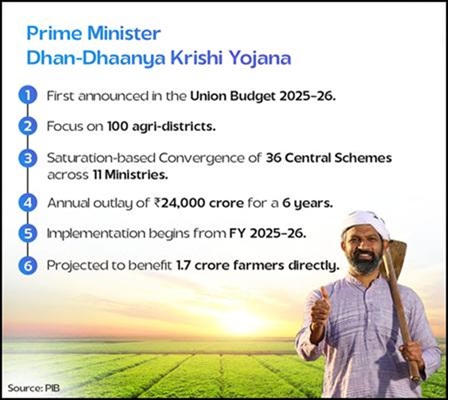
The PM Dhan-Dhaanya Krishi Yojana (PM-DDKY) is a nationwide agricultural mission to enhance productivity, strengthen value chains, promote diversification, support women & youth in farming, and achieve long-term food self-sufficiency.
Duration
2025–26 to 2030–31 (6-Year Mission)
The scheme brings together:
This avoids duplication, reduces administrative fragmentation, and ensures better resource utilization.
PM-DDKY funds are divided into:
|
Component |
Allocation |
|---|---|
|
Subsidies |
40% |
|
Infrastructure Development |
30% |
|
Loans & Credit Support |
20% |
|
Training, Skill Development & Market Linkages |
10% |
Districts are chosen using three major indicators:
1. Low Productivity
2. Moderate Cropping Intensity
3. Low Credit Access
This ensures that support is directed to districts with the highest development potential.
1. District DDKY Samiti
2. Central Monitoring
3. State Agriculture Departments
The FPO Sangam initiative aims to:
FPOs help small farmers overcome low bargaining power and achieve economies of scale.
FAQs1. Is PM-DDKY a new scheme or restructured from old ones ? It is a new umbrella programme that converges 36 existing schemes into one coordinated mission. 2. What is the duration of PM-DDKY ? It will run from 2025–26 to 2030–31. 3. Who will implement the scheme at the district level ? The District DDKY Samiti, led by the District Collector, will prepare and execute the District Agriculture Development Plan. 4. How will PM-DDKY help small farmers ? Through subsidies, credit support, improved market access, and FPO-led aggregation which increases bargaining power. 5. What role do FPOs play ? FPOs form the backbone of market linkages, helping farmers achieve better prices and access larger buyers and processors. |



Our support team will be happy to assist you!

 Contact Us
  New Batch : 9555124124/ 7428085757
  Tech Support : 9555124124/ 7428085757