Prelims: (Polity & Governance + CA)
Mains: (GS 2 – Governance, Transparency, Public Administration, Centre–State Relations) |
Why in News?
The Prime Minister’s flagship governance platform PRAGATI (Pro-Active Governance and Timely Implementation) recently achieved a significant milestone with the successful conduct of its 50th meeting, underlining its growing role in monitoring projects, resolving grievances, and ensuring administrative accountability.
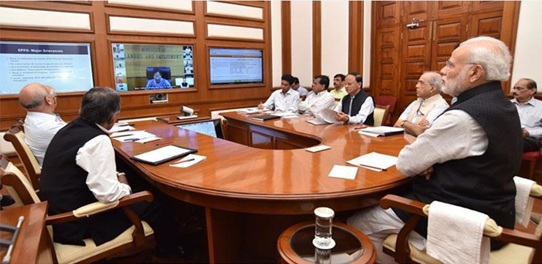
What is the PRAGATI Platform?
PRAGATI (Pro-Active Governance and Timely Implementation) is a distinctive, integrated, and interactive governance platform of the Government of India.
- It is designed to monitor and review key government programmes and infrastructure projects, along with issues highlighted by State Governments.
- It also serves as a mechanism to address public grievances, enabling faster resolution through direct administrative intervention.
- The platform was designed in-house by the Prime Minister’s Office (PMO) with technical support from the National Informatics Centre (NIC).
- Through PRAGATI, the Prime Minister directly engages with Central and State officials using real-time data and on-ground visual evidence.
Technological Architecture of PRAGATI
PRAGATI uniquely integrates three modern digital technologies:
- Digital Data Management: Ensures updated and consolidated information on projects, schemes, and grievances.
- Video Conferencing: Enables direct interaction between the Prime Minister and senior officials across the country.
- Geospatial Technology: Provides location-based visual evidence, satellite imagery, and real-time progress updates from project sites.
This combination enhances e-transparency, e-accountability, and evidence-based decision-making.
Key Features and Institutional Design
- Three-Tier System:
- Prime Minister’s Office (PMO)
- Union Government Secretaries
- Chief Secretaries of States
- At the apex level, the Prime Minister chairs PRAGATI review meetings with Chief Secretaries and Secretaries of Central Ministries/Departments.
- During reviews, the PM has access to live dashboards, including the issue under discussion, latest progress reports, and site visuals.
- A multi-tier follow-up mechanism ensures that decisions taken during meetings are implemented within specified timelines.
- Project Monitoring: Handled by the Cabinet Secretariat.
- Schemes and Grievances: Reviewed at the Ministry level under continuous oversight of the PMO.
Role in Project Monitoring and Grievance Redressal
- Issues flagged before the Prime Minister are drawn from a comprehensive database covering public grievances, ongoing programmes, and stalled projects.
- PRAGATI integrates and strengthens existing platforms such as:
- CPGRAMS (Centralised Public Grievance Redress and Monitoring System)
- Project Monitoring Group (PMG)
- Ministry of Statistics and Programme Implementation (MoSPI) databases
- It also considers correspondence received by the PMO from citizens, State dignitaries, and project developers.
- This integration allows for coordinated resolution, reducing bureaucratic delays and inter-departmental bottlenecks.
Expanding Scope and Governance Significance
- Initially focused on large infrastructure projects, PRAGATI has gradually expanded to include social sector schemes and public grievances.
- It has emerged as a people-centric governance instrument, improving Centre–State coordination and administrative responsiveness.
- By combining top-level political leadership with digital governance tools, PRAGATI strengthens cooperative federalism, outcome-oriented governance, and public trust.
FAQs
1. What does PRAGATI stand for?
Pro-Active Governance and Timely Implementation.
2. Who designed the PRAGATI platform?
It was designed in-house by the Prime Minister’s Office with support from NIC.
3. Which technologies are integrated into PRAGATI?
Digital data management, video conferencing, and geospatial technology.
4. How does PRAGATI improve governance?
By enabling real-time monitoring, direct decision-making, and time-bound follow-up of projects and grievances.
5. Which platforms are integrated into PRAGATI?
CPGRAMS, Project Monitoring Group (PMG), and MoSPI databases.
|






 Contact Us
  New Batch : 9555124124/ 7428085757
  Tech Support : 9555124124/ 7428085757