New
GS Foundation (P+M) - Delhi : 19th Jan. 2026, 11:30 AM GS Foundation (P+M) - Prayagraj : 09th Jan. 2026, 11:00 AM GS Foundation (P+M) - Delhi : 19th Jan. 2026, 11:30 AM GS Foundation (P+M) - Prayagraj : 09th Jan. 2026, 11:00 AM

PRAGATI Platform: A Major Platform for Pro-Active Governance and Timely Implementation

  • PRAGATI (Pro-Active Governance and Timely Implementation) is an innovative and integrated digital platform of the Government of India developed for monitoring, reviewing, and resolving major government programs, projects, and public grievances.
  • The platform has been internally designed by the Prime Minister’s Office (PMO) with technical support from the National Informatics Centre (NIC).
  • Recently, PRAGATI achieved an important milestone with the successful conduct of its 50th meeting, reflecting its effectiveness in governance.
  • The primary objective of PRAGATI is to promote e-Transparency and e-Accountability, ensuring the timely implementation of government schemes and projects.
  • It integrates three modern technologies:
    • Digital data management
    • Video conferencing
    • Geospatial technology
      • This technological convergence makes it a unique governance tool.

Background and Structure of PRAGATI

  • Initially, PRAGATI focused on monitoring large infrastructure projects. Over time, its scope has expanded to include social sector schemes and public grievances.
  • It operates through a three-tier system:
    • Top Level: Prime Minister’s Office (PMO)
    • Middle Level: Secretaries of the Central Government
    • Bottom Level: Chief Secretaries of State Governments
  • Through this structure, the Prime Minister can directly interact with both central and state officials.
  • During review meetings, the Prime Minister’s screen displays real-time updates, visual evidence, and project site information.
  • Meetings are conducted in real time using video conferencing, enabling participation of all stakeholders simultaneously.
  • The platform selects issues from databases related to public grievances, ongoing programs, and pending projects.
  • PRAGATI integrates data from:
    • CPGRAMS (Centralized Public Grievance Redress and Monitoring System)
    • Project Monitoring Group (PMG)
    • Databases of the Ministry of Statistics and Programme Implementation (MoSPI)
    • Representations received by the PMO from citizens, senior state officials, and project developers

Key Features of PRAGATI

Feature

Description

Integrated Monitoring

Real-time review of central and state projects. The Prime Minister interacts with officials using live project data and visual evidence.

Technological Integration

Combines digital data management, video conferencing, and geospatial technology to enhance transparency and efficiency.

Grievance Redressal

Ensures quick resolution of public grievances using integrated platforms such as CPGRAMS.

Follow-up Mechanism

A multi-level monitoring system ensures timely execution of decisions. Project monitoring is handled by the Cabinet Secretariat, while schemes and grievances are monitored by the PMO.

Expanded Scope

From infrastructure-focused monitoring to inclusion of social schemes and grievances, making it a citizen-centric governance tool.

Implementation and Impact

  • PRAGATI meetings are chaired by the Prime Minister, with participation from State Chief Secretaries and Central Secretaries.
  • After each meeting, the follow-up mechanism tracks the implementation of decisions.
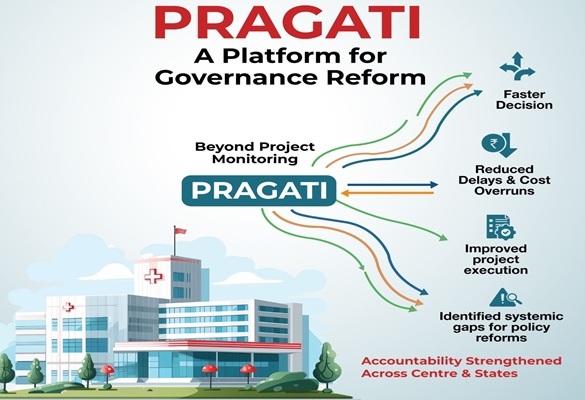
  • The system reduces delays, improves coordination, and ensures better utilization of resources.
  • PRAGATI has played a significant role in accelerating large infrastructure projects such as railways, roads, and energy projects.
  • The success of the 50th meeting highlights the platform’s contribution to improving governance efficiency.
  • PRAGATI is an integral part of India’s Digital India vision, strengthening e-Governance and service delivery.
Have any Query?

Our support team will be happy to assist you!

OR