|
(Prelims: Public Policy, Rights Issues, Economic and Social Development)
(Mains, General Studies Paper 2: Issues arising from government policies and interventions for development in various sectors and their design and implementation; issues related to education, development and management of social sectors/services related to human resources)
|
Context
The limited success of the Prime Minister's Internship Scheme (PMIS) is no longer just a matter of policy debate, but its impact is also directly visible in government expenditure figures. The poor implementation of the scheme during the financial year 2025–26 has severely impacted the budget utilization of the Ministry of Corporate Affairs. Between April and November 2025, the Ministry was able to spend only about 4% of its total budgetary allocation.
Large Gap Between Allocation and Expenditure
- According to Comptroller General of Accounts (CAG) data, the Ministry received a budget allocation of over ₹11,500 crore for the financial year 2026. In comparison, the actual expenditure in the first eight months was just over ₹500 crore.
- Nearly 94% of this total allocation, or over ₹10,800 crore, was earmarked for the Prime Minister's Internship Scheme alone. Consequently, the underutilization of the budget directly points to the poor performance of the PMIS.
- Even in FY2025, the Ministry was unable to utilize a significant portion of its allocated budget. Consequently, the Ministry's allocation was drastically cut by ₹2,667 crore in the next budget, reducing it to ₹1,078 crore.
Challenges at the level of both candidates and companies
- The Prime Minister's Internship Scheme (PMIS) data clearly shows that challenges exist at the level of both candidates and companies.
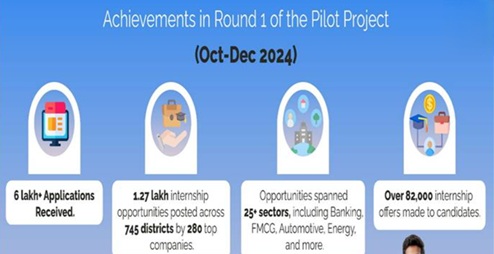
- Finance Minister Nirmala Sitharaman stated in a written reply to Parliament on December 15, 2025, that companies made over 82,000 internship offers, but only 28,000 were accepted. This means the acceptance rate was only 34%.
- A similar pattern was observed during the first phase. The PMIS pilot received 6.21 lakh applications against 1.27 lakh internship opportunities, meaning the number of applications was almost five times higher than the number of opportunities. However, by November 30, 2025, only 2,066 trainees had completed their internships.
- The situation was no better in the second phase. Over 83,000 offers were received for 1.18 lakh opportunities, but only less than 24,600 were accepted, leading to an acceptance rate falling below 30%.
About the Prime Minister's Internship Scheme
- The Government of India launched the Prime Minister's Internship Scheme (PMIS) on October 3, 2024.
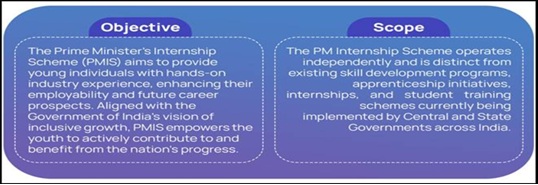
- The initiative aims to provide 10 million young Indians with 12-month paid internships in the country's top companies over the next five years, bridging the gap between academic education and industry demands.
- The Prime Minister's Internship Scheme (PMIS) is being implemented in all states and union territories of India. It will operate completely separate and independent from the country's existing skill development, apprenticeship, internship, and student training schemes.
- The platform now offers a simplified PMIS portal as well as a dedicated mobile app that allows users to easily filter opportunities by district, state, region, and location.
- PMIS Objective and Scope
Benefits for Trainees
- Students receive 12 months of practical work experience at top Indian companies. This means they learn not just in the classroom, but in real-world work environments in industry and government institutions.
- The Government of India provides ₹4,500 per month to each intern, with an additional ₹500 per month contributed by industry groups.
- A one-time grant of ₹6,000 is provided for the interns' incidental expenses.
- Under the Prime Minister's Internship Scheme, each intern receives insurance coverage under the Pradhan Mantri Jeevan Jyoti Bima Yojana and Pradhan Mantri Suraksha Bima Yojana.
Eligibility
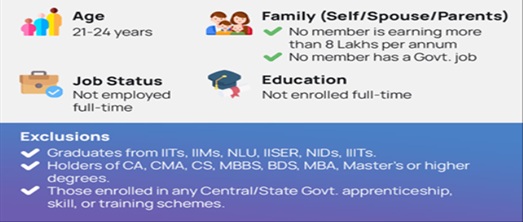
- The main eligibility criteria for a candidate are as follows:
- The candidate must be an Indian citizen.
- The candidate must be between 21 and 24 years of age.
- The candidate must not be working full-time.
- The candidate must not be enrolled in a full-time education course.
- Candidates enrolled in an online or distance learning program can apply.
- Educational Qualification: The candidate must have any one of the following:
- High School (10th) Passed
- Higher Secondary School (12th) Passed
- ITI Certificate
- Polytechnic Diploma
- Graduate Degree (BA, BSc, BCom, BCA, BBA, BPharma, etc.)
- The annual income of the candidate's family should not exceed ₹8,00,000/-
Achievements in the Pilot Phase – Phase 1 (October-December 2024)
Expansion of the Pilot Phase – Phase 2 (January-March 2025)
- More than 1.18 lakh internship opportunities are being provided across all 735 districts.
- 327 reputable companies are participating.
- Opportunities span diverse sectors such as automobile, travel and hospitality, banking and finance, manufacturing, metals and mining, FMCG, etc., and are suitable for candidates with diverse educational backgrounds.
Key Features of the Second Round of the Pilot Phase
Internship Opportunities
- ₹37,000 for graduates (BA, BSc, BCom, BBA, BCA, etc.)
- ITI ₹23,000 for candidates with a Bachelor's degree
- ₹18,000 for Diploma holders
- ₹15,000 for candidates with a 12th-grade pass
- ₹25,000 for candidates with a 10th-grade pass






 Contact Us
  New Batch : 9555124124/ 7428085757
  Tech Support : 9555124124/ 7428085757