Context
- Recently, researchers at the Raman Research Institute (RRI), an autonomous institute of the Department of Science and Technology (DST) in the central government, demonstrated a technique called Raman-Driven Spin Noise Spectroscopy (RDSNS).
- The new technique developed by the scientists is capable of instantaneously measuring the local density of cold atoms without causing any significant changes to them.
- This could prove crucial in developing near-term applications in quantum computation and quantum sensing, where instantaneous detection of atoms and their quantum states is crucial.
About Raman-Driven Spin Noise Spectroscopy (RDSNS)
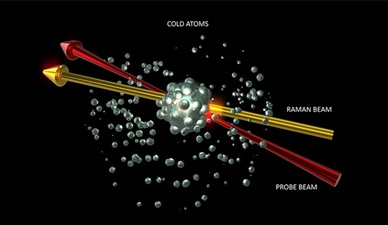
This technique overcomes these challenges by combining spin noise spectroscopy with the detection of polarization fluctuations of laser light passing through an atomic sample to determine the natural fluctuations of atomic spins.
Process and Method of RDSNS
- This method also uses two additional laser beams to coherently drive atoms between two adjacent spin states.
- These Raman beams generate transitions between atomic states and amplify the signal by approximately a million times.
- The probe has a volume of 0.01 mm³, which is achieved by focusing the probe to a mere 38 micrometers.
- It targets a small region of the atom cloud containing approximately 10,000 atoms.
- Importantly, the measured signal provides a direct measure of the local density, rather than just the total atomic number.
- The team of researchers used RDSNS to study potassium atoms in a magneto-optical trap (MOT). and found that the central density of the atom cloud saturated within a second, while the total atomic number measured through fluorescence took almost twice as long.
- This demonstrates an important difference—fluorescence reflects the global atomic count, while RDSNS shows how densely atoms are packed locally.
Need for RDSNS
Laser Cooling and Trapping Techniques
- In conventional cold atom experiments, the kinetic energy of atoms is reduced to near-zero temperatures through laser cooling and trapping techniques.
- In these experiments, the quantum properties of atoms become more pronounced. These cold atoms can be used as resources for quantum computers and quantum sensing.
- Methods such as absorption and fluorescence imaging are widely used to detect the quantum state of these atoms.
Inherent Limitations of the Techniques
- Absorption imaging is difficult when imaging dense atoms (atomic clouds) because the probe beam cannot penetrate deep enough to provide accurate density measurements.
- Fluorescence imaging, on the other hand, requires long exposure times to collect scattered photons, and both methods are often destructive, altering the state of atoms during the measurement.
Significance
- The broad significance of this work for quantum technologies is invaluable; fast, accurate, and uninterrupted density measurements are essential for devices such as gravimeters, magnetometers, and other sensors that rely on precise information about atomic density.
- By enabling microscopic local investigations without disrupting the system, RDSNS paves the way for studying phenomena such as density wave propagation, quantum transport, etc.
- This breakthrough, supported under the National Quantum Mission, marks RRI's breakthrough in the field of precision measurements in quantum research. puts it in the leading position.
Cold Atoms
- When atoms are cooled to ultra-low temperatures near absolute zero using lasers and magnetic fields, they reveal their wave-like nature, and the laws of quantum mechanics replace those of classical mechanics.
- This cooling dramatically slows the motion of atoms, revealing their quantum properties and allowing scientists to study fundamental physics, simulate quantum systems (quantum simulations), build precise atomic clocks, and develop quantum computers and sensors.
- This extreme cooling, often to temperatures of nanokelvins (billionths of a degree above 0 K), forces atoms to behave like waves, enabling unprecedented control and observation of quantum phenomena.






 Contact Us
  New Batch : 9555124124/ 7428085757
  Tech Support : 9555124124/ 7428085757