Prelims: (Polity & Governance + CA)
Mains: (GS 2 – Governance, Social Justice, Education) |
Why in the News?
The University Grants Commission (UGC) has notified revised regulations aimed at tackling caste-based discrimination in higher education institutions, introducing stronger compliance requirements, clearer institutional responsibility, and enforceable penalties for non-compliance.
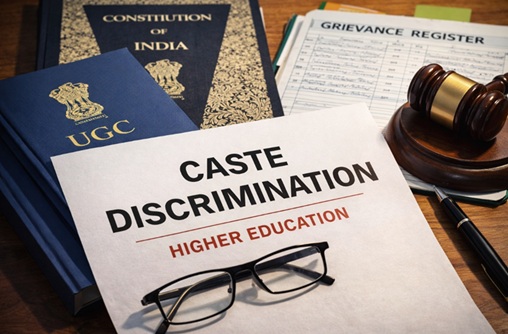
Background: Caste Discrimination in Higher Education
- Caste-based discrimination has remained a persistent challenge in India’s higher education system, disproportionately affecting students from Scheduled Castes (SCs), Scheduled Tribes (STs), and Other Backward Classes (OBCs).
- Issues such as social exclusion, academic marginalisation, biased evaluation, hostel segregation, and lack of effective grievance redressal have been repeatedly highlighted by committees, court judgments, and civil society reports.
- In response, the UGC had introduced anti-discrimination regulations in 2012, mandating the establishment of Equal Opportunity Cells in universities.
- However, weak implementation, limited monitoring, and evolving socio-academic realities exposed the need for a more robust and accountable regulatory framework.
University Grants Commission (Promotion of Equity) Regulations, 2026
- The University Grants Commission (Promotion of Equity in Higher Education Institutions) Regulations, 2026 replace the earlier framework.
- The regulations aim to institutionalise equity, strengthen grievance redressal, and embed accountability within university governance structures.
- A key departure from earlier rules is the explicit fixing of responsibility on institutional leadership, making heads of institutions directly accountable for ensuring compliance.
- The regulations seek to move beyond symbolic inclusion towards structural mechanisms that deter discrimination and enable timely redressal.
Expanded Definition of Discrimination
- Caste-based discrimination is defined as any unfair or biased treatment of SCs, STs, and OBCs solely on the basis of caste or tribe.
- The scope now includes both overt and subtle forms of discrimination that undermine equality, dignity, or access to education.
- The regulations also recognise intersectional discrimination based on religion, race, gender, place of birth, and disability.
- This broader framing aligns the regulations with Articles 14, 15, and 21 of the Constitution, reinforcing equality, non-discrimination, and dignity.
- However, unlike the 2012 regulations, the 2026 framework does not explicitly list discrimination during admissions or evaluation processes, which has attracted academic criticism.
Inclusion of OBCs and Removal of Penal Clause
- One of the most significant changes is the explicit inclusion of OBCs within the ambit of caste-based discrimination.
- Earlier draft regulations had excluded OBCs, triggering widespread opposition from scholars, student organisations, and social justice groups.
- The final regulations also remove the proposed penal clause for “false complaints”, which was criticised for discouraging victims from reporting discrimination.
- The removal of this clause strengthens access to justice, ensuring that fear of reprisal does not silence genuine grievances.
Institutional Mechanisms: EOCs and Equity Committees
- Every higher education institution must establish an Equal Opportunity Centre (EOC) to promote equity, inclusion, and social justice.
- Under each EOC, an Equity Committee must be constituted, chaired by the head of the institution.
- The committee must include representatives from SCs, STs, OBCs, women, and persons with disabilities, ensuring diverse representation.
- Equity Committees are required to meet at least twice a year, while EOCs must submit bi-annual reports.
- Institutions must also submit annual compliance reports to the UGC, enabling systematic oversight.
Monitoring and Enforcement Mechanism
- The UGC will constitute a national-level monitoring committee with representatives from statutory bodies, commissions, and civil society.
- This body will assess compliance, examine cases of discrimination, and recommend corrective and preventive measures.
- Non-compliance can invite stringent penalties, including:
- Debarment from UGC schemes
- Prohibition on offering degree or online programmes
- Removal from the list of recognised higher education institutions
- This marks a clear shift from advisory norms to enforceable regulation.
Significance and Way Forward
- The 2026 regulations represent a stronger institutional response to caste-based discrimination in higher education.
- By expanding coverage, strengthening monitoring, and removing deterrents to complaint filing, the UGC has reinforced constitutional values of social justice and inclusion.
- However, effective implementation will depend on institutional capacity, sensitivity training, transparent grievance redressal, and regular audits.
- For lasting impact, regulatory reform must be complemented by cultural and attitudinal change within academic spaces.
FAQs
1. What prompted the UGC to revise its anti-discrimination regulations?
Persistent implementation gaps and continued reports of caste-based discrimination in campuses.
2. Which groups are covered under the 2026 regulations?
Scheduled Castes, Scheduled Tribes, Other Backward Classes, and intersectional groups.
3. What is the role of Equal Opportunity Centres?
To promote equity, inclusion, and oversee grievance redressal mechanisms in institutions.
4. What penalties can institutions face for non-compliance?
Loss of UGC funding, restrictions on programmes, or derecognition.
5. What is the biggest challenge in implementing these regulations?
Ensuring institutional accountability alongside cultural change within campuses.
|






 Contact Us
  New Batch : 9555124124/ 7428085757
  Tech Support : 9555124124/ 7428085757