
- UPSC Exam
- State PCS
- One Day Exam
- Current Affairs
- PT Quiz
- Downlaods
- About Coaching
- Blog
- Videos

| Prelims: (Polity & Governance + CA) Mains: (GS 2 – Constitution, Judiciary, Social Justice & Governance) |
The Supreme Court of India has scheduled hearings from April 7 before a nine-judge Constitution Bench to consider review petitions against its 2018 verdict permitting women of all ages to enter the Sabarimala Temple.
The 2018 ruling had triggered widespread protests during the annual 41-day pilgrimage season and emerged as a politically sensitive issue in Kerala. While the Kerala government has maintained its position supporting women’s entry (as per its 2017 affidavit), the renewed hearings have gained significance amid the backdrop of upcoming Assembly elections.
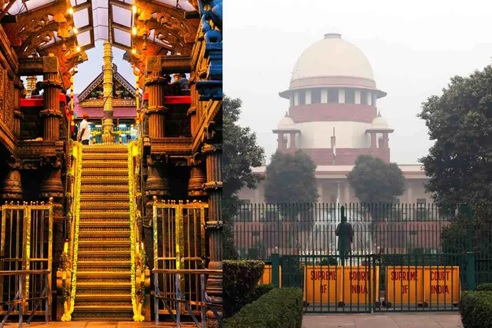
Location
The temple is located within the Periyar Tiger Reserve in the Western Ghats of Kerala and is one of South India’s most prominent pilgrimage centres.
Deity
It is dedicated to Lord Ayyappa, believed in Hindu tradition to be the son of Lord Shiva and Mohini (the female avatar of Lord Vishnu).
Unique Religious Practice
Devotees undertake a strict 41-day penance (vratham) before the pilgrimage. The observance includes:
Belief in Celibacy
Lord Ayyappa is worshipped as a Naishtika Brahmachari (eternal celibate deity).
Customary Entry Restriction
Traditionally, women between the ages of 10 and 50 (considered menstruating age) were restricted from entering the temple, based on the belief that their presence would violate the deity’s celibate character.
The first major legal challenge arose in 1990, when a petition alleged that women of menstruating age were entering the temple contrary to custom.
In 1991, the Kerala High Court upheld the ban, ruling that:
This judgment remained in force for nearly three decades.
In 2006, the Indian Young Lawyers Association filed a petition under Article 32 of the Constitution challenging Rule 3(b) of the Kerala Hindu Places of Public Worship Rules, 1965.
The petition argued that the restriction violated:
In September 2018, a five-judge Constitution Bench, by a 4:1 majority, struck down Rule 3(b) and allowed entry of women of all ages.
Key Observations
Justice Indu Malhotra dissented, holding that courts should not ordinarily interfere in essential religious practices unless they violate public order, morality, or health.
The verdict triggered widespread protests across Kerala and led to multiple review petitions.
Ahead of the 2019 pilgrimage season, the Supreme Court observed that the Sabarimala ruling may have broader implications for other religious practices across faiths.
The Court referred larger constitutional questions to a bench of at least seven judges but did not stay the 2018 judgment.
In 2020, a nine-judge bench led by then Chief Justice S.A. Bobde held that the review petitions were maintainable.
The bench framed seven key constitutional questions, including:
The matter is now scheduled for substantive hearing.
The case involves a delicate balance between:
The review proceedings may redefine how courts interpret “essential religious practices” and the limits of constitutional morality.
Significance
The outcome could have far-reaching implications for the balance between constitutional values and religious autonomy in India.
FAQs1.What was the 2018 Sabarimala judgment? The Supreme Court allowed women of all ages to enter the Sabarimala Temple, striking down the age-based restriction as unconstitutional. 2.Why is the case being reviewed? Multiple review petitions were filed challenging the 2018 verdict, raising broader constitutional questions about religious freedom and equality. 3.What constitutional provisions are involved? Articles 14, 15, 25, and 26 are central to the debate. 4.What is the essential religious practices doctrine? It is a judicial principle used to determine whether a practice is fundamental to a religion and therefore protected under Article 25 or 26. 5.What could be the impact of the upcoming hearing? The decision may redefine the balance between gender equality and religious autonomy and set important precedents for constitutional law. |



Our support team will be happy to assist you!

 Contact Us
  New Batch : 9555124124/ 7428085757
  Tech Support : 9555124124/ 7428085757