
- UPSC Exam
- State PCS
- One Day Exam
- Current Affairs
- PT Quiz
- Downlaods
- About Coaching
- Blog
- Videos

| Prelims: (Narco Analysis + CA) Mains: (GS 2 – Governance, Constituion, Ethics; GS 3 – Security) |
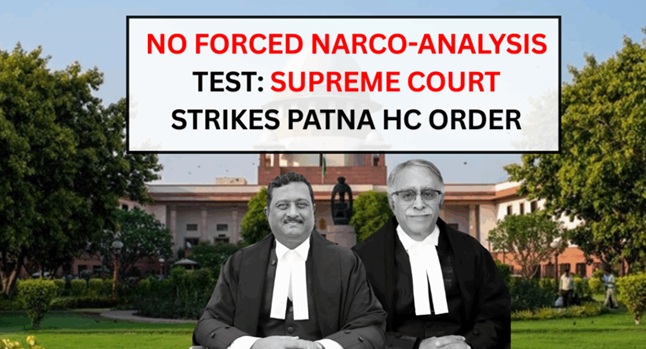
The Supreme Court of India has set aside a Patna High Court order permitting a compulsory narco analysis test in Amlesh Kumar v. State of Bihar (2025). The Court ruled that forced narco tests violate Articles 20(3) and 21, reaffirming earlier constitutional protections upheld in Selvi v. State of Karnataka (2010).
Narco analysis, along with polygraph tests and brain mapping, emerged as investigative tools in the early 2000s to solve complex crimes. However, repeated misuse—including coerced testing, custodial pressure, and lack of transparency—raised alarm regarding violations of personal liberty.
The Supreme Court’s landmark Selvi (2010) judgment attempted to regulate these tests by prohibiting involuntary administration. Despite this, some courts and investigating agencies continued to recommend narco tests in difficult criminal cases, which led to judicial confusion.
The Patna High Court’s 2025 order allowing an involuntary test revived concerns of:
The Supreme Court’s fresh ruling clarifies and reinforces the constitutional safeguards governing investigative procedures.
A narco test uses sedatives such as Sodium Pentothal (a barbiturate) to:
Investigators believe that in such a state, the subject may involuntarily reveal concealed information.
None of these are considered scientifically foolproof, and all raise concerns of testimonial compulsion.
1. Right Against Self-Incrimination – Article 20(3)
2. Personal Liberty & Mental Privacy – Article 21
The Court also invoked the Golden Triangle—Articles 14, 19 & 21, emphasising that investigative actions must be:
1. Selvi v. State of Karnataka (2010) — Landmark Ruling
The Supreme Court held that:
The Patna HC’s order violated these binding directions, leading to its dismissal.
2. Other Supporting Judgments
Manoj Kumar Saini v. State of MP (2023)
Vinobhai v. State of Kerala (2025)
Importance of Informed Consent
Kantian Ethics (Autonomy Principle)
Natural Justice
1. Reinforcing Rights-Based Policing
The judgment strengthens the rule of law and ensures that:
2. Balancing Victim Rights & Due Process
3. Enhancing Judicial Consistency
FAQs1. Is narco analysis completely banned in India ? No. It is allowed only with free, informed consent and strict safeguards. 2. Can narco test results be used as evidence in court ? They cannot be used as standalone evidence; they must be corroborated independently. 3. What happens if an accused refuses a narco test ? Refusal cannot be used against the accused. It is their fundamental right. 4. Does BNSS allow narco tests ? BNSS permits tests only when the accused voluntarily requests them, typically at the defence stage. 5. Are polygraph and brain mapping also covered by this ruling ? Yes. All three techniques require consent and are protected under Article 20(3). |



Our support team will be happy to assist you!

 Contact Us
  New Batch : 9555124124/ 7428085757
  Tech Support : 9555124124/ 7428085757