(Prelims: Current Events of National Importance, General Science)
(Mains, General Studies Paper 3: Science and Technology—Developments and Applications and Their Impact on Everyday Life, Achievements of Indians in Science and Technology) |
Context
The next leap forward in science will come from relatively underexplored areas, including the deep ocean and outer space. Futuristic marine and space biotechnology aims to utilize these challenging environments to develop new biological knowledge, advanced materials, and innovative manufacturing systems.
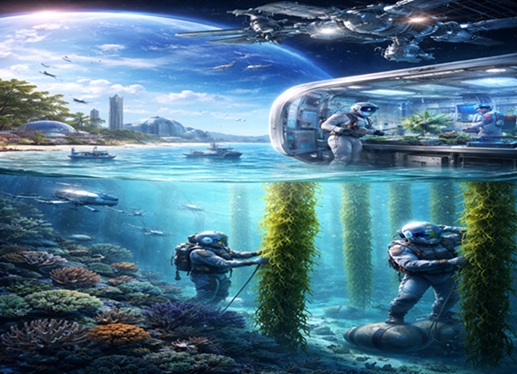
Emerging Opportunities from the Ocean
- Marine biotechnology studies microorganisms, algae, and diverse marine organisms to identify bioactive compounds, industrial enzymes, bio-based materials, nutritional components, and biostimulants.
- These deep-sea organisms have evolved to adapt to harsh conditions such as extreme pressure, high salinity, limited light, and nutrient deficiencies.
- These characteristics make them extremely useful for industrial applications and climate-tolerant technologies.
The Role of Life Sciences in Space
- Space biotechnology studies the behavior of biological systems in microgravity and radiation environments.
- It includes research at all levels, from microorganisms and plants to the human body.
- Experiments are being conducted on microbial-based biomanufacturing for food production, material manufacturing, and life-support systems in space.
- Additionally, research on astronauts' microbiomes could help develop health protection and probiotic solutions for long-term space missions.
The Importance of Space and Marine Biotechnology for India
- India's geographical location and natural resources give it a unique advantage in this field.
- Despite a coastline of over 11,000 kilometers and an exclusive economic zone of over 2 million square kilometers, India's share in global marine production remains limited. This fact points to the immense potential in this sector.
- Investment in marine biomanufacturing can not only provide new sources of food, energy, chemicals, and biomaterials but also reduce the growing pressure on land, freshwater, and traditional agriculture.
- Space biotechnology is essential for India's space exploration plans as it enables safe food supply, human health management, and biological production under difficult conditions.
- The combined development of these two sectors can accelerate India's bioeconomy, strengthen strategic self-reliance, and position the country as a leader in next-generation biomanufacturing.
Current Status: Potential and Limitations
- Today, the production of marine biomass, especially seaweed, in India is limited. Annual cultivation is limited to approximately 70,000 tons, leading to a dependence on imports for essential components such as agar, carrageenan, and alginates. These components are widely used in the food, pharmaceutical, cosmetic, and medical sectors.
- However, initiatives such as the Blue Economy, Deep Ocean Mission, and the recent BioE3 are moving the sector towards integrated marine






 Contact Us
  New Batch : 9555124124/ 7428085757
  Tech Support : 9555124124/ 7428085757