Prelims: (Polity & Governance + CA)
Mains: (GS 2 – Electoral Reforms, Democracy, Governance; GS 3 – Cyber Space & Regulation; GS 4 – Ethics) |
Why in News ?
Recent analysis of digital political advertisements during Assembly elections has exposed significant gaps in India’s election regulatory framework, particularly in regulating third-party and surrogate campaigners operating outside formal political party structures.
Background & Context
India’s election laws were framed in an era where political parties and individual candidates were the primary agents of voter mobilisation. Campaigning was largely physical, traceable, and geographically bounded.
However, the rise of digital platforms, social media, algorithm-driven advertising, political consultancies, influencers, and interest groups has fundamentally altered the nature of electioneering. Political persuasion today often occurs through actors who are neither candidates nor officially affiliated to political parties, creating regulatory blind spots in the electoral ecosystem.
India’s Election Campaign Ecosystem: A Structural Shift
- Traditional election regulations assume:
- Campaigning is conducted by recognised political parties or candidates
- Expenditure is direct, identifiable, and auditable
- The contemporary ecosystem is increasingly shaped by:
- Digital marketing agencies
- Influencers and content creators
- Ideological or interest-based groups
- Anonymous or surrogate social media pages
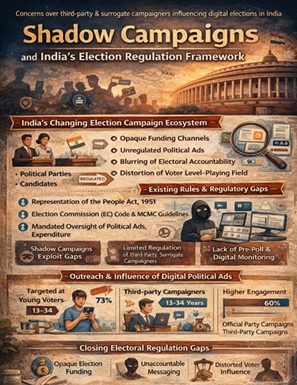
- These actors often operate outside formal party hierarchies, yet exert substantial electoral influence, weakening the effectiveness of existing election rules.
Existing Legal and Regulatory Framework
Key Laws and Guidelines
- Representation of the People Act, 1951
- Section 77 mandates disclosure of election expenditure by candidates
- Election Commission of India (ECI) Guidelines
- Pre-certification of political advertisements by the Media Certification and Monitoring Committee (MCMC)
- Restrictions on political advertisements during the final phase of polling
- Model Code of Conduct (MCC)
Regulatory Assumptions
- Political messaging originates from:
- Political parties
- Individual candidates
- Limited oversight exists for:
- Third-party political advertisers
- Surrogate or proxy campaigners
Emergence of Shadow Campaigns
What are Shadow Campaigns ?
Shadow campaigns refer to political communication and advertising conducted by third-party actors who are:
- Not formally linked to political parties or candidates
- Not directly accountable under election expenditure rules
Key Findings from Digital Ad Analysis
- Third-party advertisers often:
- Outspend official parties and candidates
- Generate significantly higher online visibility
- Even with similar expenditure, third-party campaigns:
- Achieve far more impressions
- Display higher cost efficiency
- This demonstrates that control over digital dissemination, rather than spending alone, determines electoral influence.
Demographic Reach and Influence Patterns
- Digital political advertisements—both official and third-party—are heavily consumed by young voters (13–34 years).
- However, third-party campaigns:
- Show a more evenly distributed reach across age groups
- Penetrate older demographics more effectively than party-led messaging
- This wider demographic reach makes shadow campaigners strategically indispensable in modern elections.
Financial Entanglements and Accountability Gaps
Blurred Financial Relationships
- Instances have emerged where:
- Advertisements on official party social media pages were funded by external entities
- Such expenditure may:
- Not be fully reflected in official election expenditure statements
- Escape scrutiny by the ECI
Consequences
- Understatement of the true cost of digital campaigning
- Lack of clarity on:
- Who finances political messaging
- Who is accountable for content and influence
Bi-directional Influence
- Third-party actors:
- Amplify party messaging
- Directly finance political communication
- This blurs the line between authorised and unauthorised expenditure.
Legal Contradictions and Enforcement Challenges
- Judicial precedents, including Supreme Court rulings, have held that:
- No individual or entity should publish political advertisements benefiting a party or candidate
- Despite this:
- Enforcement in the digital domain remains weak
- ECI guidelines are often:
- Time-bound
- Focused on print and traditional media
- Digital campaigns:
- Build influence over months
- Continue even on polling day, exposing regulatory limitations
Implications for Electoral Transparency and Fairness
- Opacity in funding undermines transparency
- Unequal digital reach distorts the level playing field
- Unaccountable actors influence voter behaviour
- Public trust in electoral integrity erodes
Unless regulatory oversight expands to include all major digital campaign stakeholders, these distortions may deepen in future elections.
Way Forward
Regulatory Reforms
- Expand the definition of “campaigners” to include third-party digital actors
- Mandate:
- Disclosure of funding sources for political ads
- Platform-level transparency obligations
Institutional Measures
- Strengthen ECI’s digital monitoring capacity
- Develop continuous (not time-bound) digital campaign oversight
Platform Accountability
- Require social media platforms to:
- Share real-time political ad data with ECI
- Clearly label political content and sponsors
FAQs
Q1. What are shadow campaigns in elections ?
Shadow campaigns are political communication efforts by third-party actors not formally linked to political parties or candidates.
Q2. Why are shadow campaigns difficult to regulate ?
They operate outside existing legal definitions of candidates and parties, especially in the digital space.
Q3. Which law governs election expenditure in India ?
The Representation of the People Act, 1951.
Q4. Why is digital campaigning a regulatory challenge ?
Because it is continuous, algorithm-driven, cross-platform, and often anonymously funded.
Q5. What is the key risk posed by shadow campaigns ?
They undermine transparency, accountability, and fairness in elections.
|






 Contact Us
  New Batch : 9555124124/ 7428085757
  Tech Support : 9555124124/ 7428085757