Prelims: (International Relations + CA)
Mains: (GS 2 – India–China Relations, GS 3 – Internal Security, Border Management) |
Why in News ?
A renewed diplomatic and strategic tussle has emerged between India and China over the Shaksgam Valley in Jammu and Kashmir, reviving concerns despite recent disengagement following the eastern Ladakh standoff. The region’s proximity to the Siachen Glacier, China’s Xinjiang, and Pakistan-occupied Kashmir (PoK) makes it a highly sensitive zone for India’s national security.
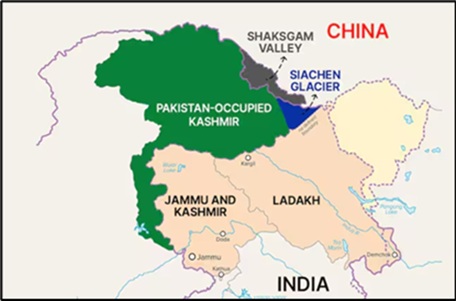
Shaksgam Valley: Location and Strategic Context
- Shaksgam Valley, also known as the Trans Karakoram Tract, lies in the Hunza–Gilgit region under Pakistan’s occupation, north of the Siachen Glacier.
- The valley spans over 5,000 sq km and is characterised by extreme terrain and sparse habitation.
- Although legally claimed by India, Pakistan exercised control over the area until 1963, when it entered into a boundary agreement with China.
- China had earlier asserted its strategic presence in the broader region by constructing infrastructure in Aksai Chin, linking Tibet and Xinjiang.
Why Shaksgam Valley Is Strategically Important for India ?
- The valley lies close to the Siachen Glacier, the world’s highest battlefield, making it crucial for military surveillance.
- From Indian positions in Siachen, movements in Pakistan-controlled areas to the south and Chinese activity near the Karakoram Pass to the north can be monitored.
- Control or influence over Shaksgam Valley affects India’s security along both:
- the Line of Control (LoC) with Pakistan, and
- the Line of Actual Control (LAC) with China.
- Any change in the status quo directly alters the strategic balance in the western sector of the India–China boundary.
China’s Expanding Infrastructure Footprint
- Strategic analysts warn that China’s “salami slicing” strategy—incremental actions that cumulatively alter ground realities—is approaching a critical point in Shaksgam.
- By mid-2024, China reportedly completed a road across the 4,805-metre Aghil Pass into Lower Shaksgam Valley.
- This development has brought Chinese construction teams, and potentially military patrols, within 50 km of Indian positions at Indira Col in Siachen.
- Historically, India’s defence posture in Siachen was focused mainly on Pakistan from the south.
- China’s northern access raises the spectre of a two-front contingency on the world’s highest battlefield.
Pakistan’s Cession of Shaksgam Valley to China
- Colonial Background: In 1936, under British influence, the Mir of Hunza ceded rights over the Taghdumbash Pamir and Raskam Valley, but retained control over Shaksgam Valley and the Aghil range.
- Post-Independence Legal Status: Following Jammu and Kashmir’s accession to India in October 1947, Shaksgam Valley legally became Indian territory. India, however, could not assert control due to Pakistan’s occupation of adjoining areas.
- China–Pakistan Agreement (1963): Pakistan, under President Ayub Khan, formally ceded the Shaksgam Valley to China through a boundary agreement, despite lacking legal authority to transfer Indian territory.
- Present-Day Implications: Since the Doklam standoff, China has intensified military and infrastructure development in the valley, transforming a legally Indian territory into a pressing security concern.
India’s Response and Broader Geopolitical Concerns
- India maintains that Pakistan illegally ceded approximately 5,180 sq km of Indian territory to China under the 1963 agreement, which New Delhi has never recognised.
- The Ministry of External Affairs (MEA) has reiterated that Shaksgam Valley is an integral part of India and that India reserves the right to take “necessary measures” to protect its interests.
- China has dismissed India’s objections, claiming its activities are legitimate.
- This stance exposes a contradiction: while China describes Kashmir as a bilateral issue between India and Pakistan, it continues strategic development in areas under Pakistan’s illegal occupation.
- The episode highlights enduring geopolitical tensions and the expanding strategic footprint of China in disputed regions.
FAQs
1. Where is Shaksgam Valley located ?
It lies north of the Siachen Glacier in the Hunza–Gilgit region under Pakistan’s occupation.
2. Why is Shaksgam Valley important for India ?
Its proximity to Siachen and the Karakoram Pass makes it crucial for monitoring both Pakistani and Chinese military activity.
3. When did Pakistan cede Shaksgam Valley to China ?
In 1963, through a boundary agreement that India does not recognise.
4. What is China’s “salami slicing” strategy ?
A tactic of making small, incremental moves that cumulatively change control in disputed areas.
5. What is India’s official position on Shaksgam Valley ?
India considers it its sovereign territory and rejects the legality of the 1963 China–Pakistan agreement.
|






 Contact Us
  New Batch : 9555124124/ 7428085757
  Tech Support : 9555124124/ 7428085757