
- UPSC Exam
- State PCS
- One Day Exam
- Current Affairs
- PT Quiz
- Downlaods
- About Coaching
- Blog
- Videos

| Prelims: (Temple Architecture + CA) Mains: (GS Paper 1: Indian Art & Architecture, Culture, History) |
The Prime Minister has highlighted the thousand-year survival of the Somnath Temple as a symbol of India’s indomitable civilisational spirit, as the country commemorates Somnath Swabhiman Parv (1026–2026) — marking one millennium since the first documented destruction of the shrine and its repeated resurgence thereafter. The year-long observance celebrates unbroken faith, cultural continuity, and national self-respect (Swabhiman) rooted in India’s civilisational consciousness.
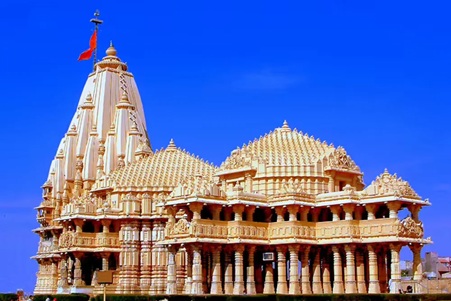
Somnath occupies a unique place in Indian history—not merely as a religious shrine but as a civilisational marker reflecting the continuity of Indian culture despite repeated political upheavals.
Located on India’s western coast, Somnath stood at the intersection of religion, maritime trade, geography, and political power. Its repeated destruction and reconstruction over centuries transformed it into a powerful metaphor for India’s resilience.
Post-Independence, the rebuilding of Somnath was consciously framed as a symbol of national regeneration, separate from sectarian narratives, reinforcing India’s commitment to cultural revival within a constitutional framework.
According to tradition, the temple was rebuilt multiple times:
Somnath Swabhiman Parv (1026–2026) is not merely commemorative but civilisational in intent. It underscores:
|
Jyotirlinga |
Location |
State |
|---|---|---|
|
Somnath |
Prabhas Patan |
Gujarat |
|
Mallikarjuna |
Srisailam |
Andhra Pradesh |
|
Mahakaleshwar |
Ujjain |
Madhya Pradesh |
|
Omkareshwar |
Mandhata |
Madhya Pradesh |
|
Kedarnath |
Kedarnath |
Uttarakhand |
|
Bhimashankar |
Khed (Pune) |
Maharashtra |
|
Kashi Vishwanath |
Varanasi |
Uttar Pradesh |
|
Trimbakeshwar |
Trimbak |
Maharashtra |
|
Baidyanath |
Deoghar |
Jharkhand |
|
Nageshwar |
Dwarka |
Gujarat |
|
Rameshwaram |
Rameshwaram |
Tamil Nadu |
|
Grishneshwar |
Ellora |
Maharashtra |
FAQsQ1. Why is Somnath called the first Jyotirlinga ? Because it is traditionally regarded as the earliest manifestation of Shiva’s Jyotirlinga form. Q2. What is the significance of Somnath Swabhiman Parv ? It marks 1,000 years of civilisational resilience since the first destruction of the temple in 1026 CE. Q3. Who led the post-Independence reconstruction of Somnath ? Sardar Vallabhbhai Patel, with intellectual support from K.M. Munshi. Q4. What architectural style is Somnath built in ? Kailas Mahameru Prasad style, part of the Nagara tradition with Māru-Gurjara elements. Q5. Why is Somnath important beyond religion ? It symbolises cultural continuity, resilience, and national self-respect. |



Our support team will be happy to assist you!


 Contact Us
  New Batch : 9555124124/ 7428085757
  Tech Support : 9555124124/ 7428085757