(Preliminary Examination: Current Events of National Importance, General Science)
(Mains Examination, General Studies Papers 2 and 3: Topics related to the development and management of social sectors/services related to health, education, human resources; Science and Technology – Developments and Applications and their Impact on Daily Life) |
Context
Since 1991, it has been established that folic acid supplementation by women before pregnancy can prevent more than 70% of spina bifida cases. Despite this, even after three decades, India remains one of the few countries where no concrete and widespread efforts have been made to increase public awareness about this effective measure. As a result, India continues to have one of the highest prevalence rates of spina bifida in the world.
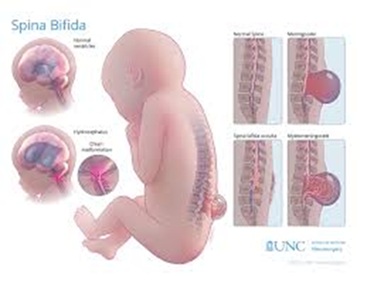
About Spina Bifida
- Spina bifida is a congenital spinal cord disorder that causes severe paralysis in childhood. The severity of paralysis in this disease can sometimes manifest as mild weakness in the legs.
- In severe cases, the entire body below the hips becomes completely paralyzed. As a result, many children become wheelchair-dependent from an early age.
- Children affected by this disease also experience excessive fluid accumulation in the brain (hydrocephalus), problems with urinary and bowel control, bone deformities such as clubfoot, and other medical complications.
- Although paralysis and urinary incontinence occur in many children, their intellectual abilities are generally not affected.
Causes of Spina Bifida
- Inadequate intake of folic acid before and during early pregnancy (major causes)
- Maternal malnutrition and anemia
- Unplanned pregnancies resulting from lack of micronutrient supplementation
- The combined role of genetic predisposition and environmental influences
Treatment of Spina Bifida
- Early surgical intervention: Immediately after birth, the defect in the spinal cord is surgically closed to reduce the risk of infection and prevent further nerve damage.
- Treatment of hydrocephalus: A ventriculo-peritoneal (VP) shunt is placed to drain excess fluid from the brain.
- Rehabilitation services: Long-term physiotherapy and occupational therapy are provided to improve the patient's mobility, function, and independence.
- Orthopedic care: Surgery, braces, or plaster casts are used as needed to correct bone deformities such as clubfoot.
Lack of meaningful efforts in India
- India is among the few countries where no concrete initiatives have been taken, either at the state or central government level, to raise public awareness about this simple and effective solution.
- The result of this neglect is that thousands of children are born with severe paralysis every year, causing serious social and economic hardship for many families.
- This condition affects over 25,000 children annually in India, making it one of the countries with the highest prevalence rates in the world. Furthermore, over 75% of Indian children with spina bifida lack access to essential medical services.
- This disease places a severe socio-economic burden on families, communities, and the entire health system. In this context, every rupee spent on prevention has the potential to save over 100 rupees spent on treatment and long-term rehabilitation.
Global Efforts and Research
- Many countries around the world have launched national public awareness campaigns and implemented schemes to promote folic acid supplementation to prevent spina bifida.
- Additionally, 68 countries have mandated folic acid fortification of certain staple foods through legislation. In these countries, the combined effect of awareness programs and food fortification has virtually eliminated cases that could have been prevented by folic acid, reducing the prevalence of spina bifida to less than 1 per 1,000 births.
- In contrast, the prevalence in India remains unacceptably high at approximately 4 per 1,000 births, primarily due to the lack of such effective and comprehensive efforts.






 Contact Us
  New Batch : 9555124124/ 7428085757
  Tech Support : 9555124124/ 7428085757