(Preliminary Examination: Current Events of National and International Importance)
(Mains Examination, General Studies Paper 3: Challenges to Internal Security through Communication Networks, Role of Media and Social Networking Sites in Internal Security Challenges, Cybersecurity Fundamentals, Money Laundering and Its Prevention) |
Context
The Central Government has begun taking concrete steps against digital arrest cases. These scams were depriving ordinary citizens, especially the elderly and vulnerable, of their earnings. To curb this, an Inter-Departmental Committee (IDC) was formed under the chairmanship of the Special Secretary (Internal Security) of the Ministry of Home Affairs, which has held several meetings so far. Representatives from online platforms such as Google, WhatsApp, Telegram, and Microsoft attended the recent meeting.
Inter-Departmental Committee (IDC)
- This high-level inter-departmental committee was constituted on December 26, 2025, comprising officials from multiple agencies to “comprehensively examine all aspects of the problem of digital arrests.”
- The IDC is chaired by the Special Secretary (Internal Security). It comprises officers of the Joint Secretary level or above from the following departments and agencies:
- Ministry of Electronics and Information Technology (MeitY)
- Department of Telecommunications (DoT)
- Ministry of External Affairs
- Department of Financial Services
- Ministry of Law and Justice
- Ministry of Consumer Affairs
- Reserve Bank of India (RBI)
- Central Bureau of Investigation (CBI)
- National Investigation Agency (NIA)
- Delhi Police
- Indian Cyber Crime Coordination Centre (I4C)
Objectives of the IDC
- Provide guidance to enforcement agencies on real-time issues
- Identify gaps in relevant laws, rules, circulars, and implementation
- Suggest corrective measures
- Provide input to the Supreme Court for further directions as needed
CBI's Role
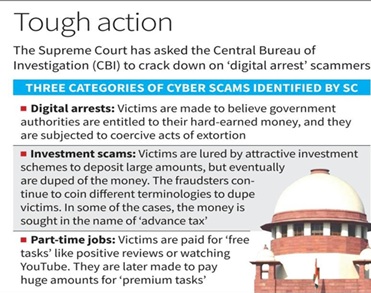
- On December 1, the Supreme Court directed the CBI to take action against 'digital arrest' scammers and their associates. The CBI was given 'full authority' to investigate the role of bankers and investigate mule accounts linked to cyber crimes.
- From 2022 to 2024, criminals in digital arrest cases posed as police officers and judges to defraud people of their money by threatening them with 'online arrest.' According to data presented by the government to the Supreme Court, ₹3,000 crore has been defrauded in digital arrest cases alone.
What is the Digital Arrest Scam ?
- The Digital Arrest Scam is a type of online fraud in which criminals siphon off people's hard-earned money.
- Criminals intimidate victims and falsely accuse them of illegal activities.
- They then demand money from the victim and pressure them to pay.
- This scam particularly targets the elderly and vulnerable, as they are more vulnerable to intimidation techniques.
Mechanism of Digital Arrest Scam
- In Digital Arrest scams, criminals often pretend to be law enforcement officials, such as CBI agents, Income Tax officers, or Customs officers, and contact the victim via phone.
- They then force the victim to speak via WhatsApp, Skype, or other video call platforms. Scammers threaten to issue a "digital arrest warrant," citing various allegations such as financial misconduct, tax evasion, or other legal violations.
- In some cases, scammers try to make the call appear legitimate by creating a police station-like atmosphere. Then, under pretexts such as "removing names," "assisting in an investigation," or "refundable security deposits/escrow accounts," people are coerced into transferring large sums of money to a designated bank account or UPI ID.
Methods to Prevent Digital Arrest Scams
The most important way to avoid frauds like Digital Arrest is vigilance. Here are some important tips to prevent this:
- Beware of calls from fake officials: Don't immediately take any phone call or message claiming you're in legal trouble seriously. Genuine law enforcement agencies never ask for payment or banking details.
- Avoid pressure and intimidation: Cybercriminals use tactics like "act immediately." Don't fall for these pressure tactics and don't make hasty decisions.
- Verify directly if you have doubts: If you suspect any call or message, contact the relevant government agency directly to verify their identity.
- Don't share personal information: Never share personal and financial information with unknown numbers over phone or video calls.
- Pay attention to government agency platforms: Government agencies don't officially use platforms like WhatsApp or Skype.
- Report the incident: If you believe you're a victim of fraud, immediately inform the local police or cybercrime department.
What to do after falling victim to a Digital Arrest scam
- Immediately inform your bank: Call your bank immediately and ask them to freeze or block your account to prevent further losses.
- Filing a complaint on the cybercrime portal: Register a case on the National Cybercrime Reporting Portal. This is a government platform that helps investigate cybercrime.
- Preserve evidence: Preserve all evidence you have, such as call records, transaction details, messages, emails, etc. This will be useful in further investigations and police action.
- Seek legal help: If necessary, seek the help of a lawyer or legal expert to protect your rights and ensure appropriate action.






 Contact Us
  New Batch : 9555124124/ 7428085757
  Tech Support : 9555124124/ 7428085757