Overview
- The Wild Life (Protection) Act, 1972 is India’s principal legislation for the protection of wildlife and biodiversity. It provides a legal framework for the conservation of wild animals, birds, plants, and their habitats.
_ACT,_1972.jpg)
Objectives of the Act
- Protect wild animals, birds, and plants
- Conserve biodiversity and ecological balance
- Establish Protected Areas (PAs)
- Regulate hunting, poaching, and wildlife trade
- Prevent illegal wildlife trafficking
Key Features of WLPA
Protected Areas (PAs)
- The Act provides for different categories of protected areas :
- Sanctuary
- Area declared for wildlife protection
- Certain regulated human activities may be permitted
- National Park
- Strictly protected ecosystem
- Human activities are highly restricted
- Conservation Reserve
- Declared mainly on government land
- Protects landscapes, wildlife corridors, and habitats
- Community Reserve
- Declared on community/private land
- Encourages community participation in conservation
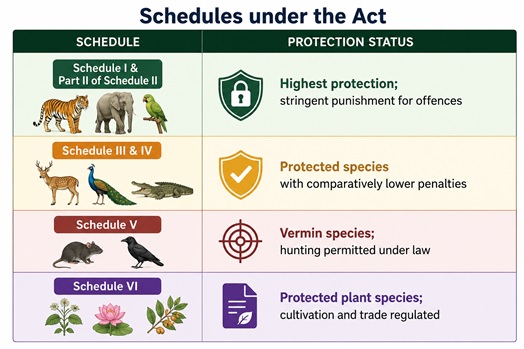
Schedules under the Act
Institutional Framework
National Board for Wildlife (NBWL)
- Apex advisory body for wildlife conservation
- Chaired by the Prime Minister
State Board for Wildlife (SBWL)
- State-level wildlife advisory authority
- Chaired by the Chief Minister
Wildlife Crime Control Bureau (WCCB)
- Combats poaching and illegal wildlife trade
- Coordinates wildlife crime enforcement across India
National Tiger Conservation Authority (NTCA)
- Supervises tiger conservation programmes
- Manages and strengthens tiger reserves
Chief Wildlife Warden (CWLW)
- The Chief Wildlife Warden is the chief implementing authority of the Wild Life (Protection) Act, 1972 at the state level.
Major Powers and Functions
- Issues permits for entry into protected areas, research and scientific studies, photography, filming, and tourism-related activities.
- Can permit hunting only when an animal is dangerous to human life or diseased/incapacitated beyond recovery.
- Manages sanctuaries and protected areas, regulates livestock grazing, and ensures livestock immunisation to prevent disease transmission to wildlife.
- Issues licences for the cultivation, trade, and transport of Schedule VI protected plant species.
- Supervises wildlife law enforcement, conducts search, seizure, and confiscation operations, and regulates possession and use of firearms near protected areas.
Wild Life (Protection) Amendment Act, 2022
_Amendment_Act.jpg)
Key Provisions
Rationalisation of Schedules
- Number of schedules reduced from 6 to 4 for simplification and better management
Alignment with CITES
- Incorporated provisions of Convention on International Trade in Endangered Species of Wild Fauna and Flora
- Strengthened regulation of international wildlife trade
Protection of Elephants
- Elephants continue to receive Schedule I protection
- Limited exemptions allowed for :
- Religious purposes
- Traditional use
Regulation of Invasive Alien Species
- Central government empowered to regulate invasive alien species harmful to ecosystems and native biodiversity
Enhanced Penalties
- Stricter punishment for wildlife crimes
- Minimum fine increased to ₹25,000 and above
Forest (Conservation) Act, 1980 (FCA)
_Act.jpg)
Purpose of the Act
- The Forest (Conservation) Act, 1980 was enacted to curb rapid deforestation and ensure that forest land is not diverted indiscriminately for non-forest activities.
Objectives
- Prevent large-scale deforestation
- Regulate diversion of forest land for non-forest purposes
- Maintain ecological balance and forest cover
- Ensure centralized scrutiny of forest diversion projects
Key Features
Mandatory Central Government Approval
- Prior approval of the Central Government is required for:
- De-reservation of reserved forests
- Diversion of forest land for non-forest purposes such as :
- Mining
- Dams
- Industries
- Infrastructure projects
- Assignment or lease of forest land to private entities, corporations, or agencies
Advisory Committee
- Constituted by the Central Government
- Assists in examining proposals related to forest land diversion and clearances
Importance of the Act
- Acts as a safeguard against indiscriminate diversion of forests by states
- Strengthens environmental governance and forest conservation
- Forms the basis of India’s forest clearance mechanism
Forest Rights Act, 2006 (FRA)
.jpg)
Full Name
- Scheduled Tribes and Other Traditional Forest Dwellers (Recognition of Forest Rights) Act, 2006
Background
- The Act was enacted to address the historical injustice faced by forest-dwelling communities whose traditional rights over forests were not formally recognized during colonial and post-colonial forest administration.
Objectives
- Recognize and vest forest rights in forest-dwelling communities
- Correct historical injustice faced by :
- Scheduled Tribes (STs)
- Other Traditional Forest Dwellers (OTFDs)
- Empower local communities in forest governance and conservation
Major Rights under FRA
Individual Forest Rights (IFR)
- Right to cultivate forest land for livelihood purposes
- Maximum limit: 4 hectares
Community Forest Rights (CFR)
- Rights over common forest resources, including:
- Grazing grounds
- Fishing resources
- Water bodies
- Collection and use of Minor Forest Produce (MFP)
- Access to Community Forest Resources (CFRs)
Habitat Rights
- Special rights granted to:
- Particularly Vulnerable Tribal Groups (PVTGs)
- Protects traditional habitats, culture, and livelihoods
Forest Protection & Management Rights
- Local communities are empowered to:
- Protect forests
- Regenerate degraded forest areas
- Conserve biodiversity
- Manage community forest resources sustainably
Role of Gram Sabha
- The Gram Sabha is the central authority under FRA and is responsible for:
- Receiving claims
- Verifying claims
- Approving or rejecting claims
- Protecting community forest resources
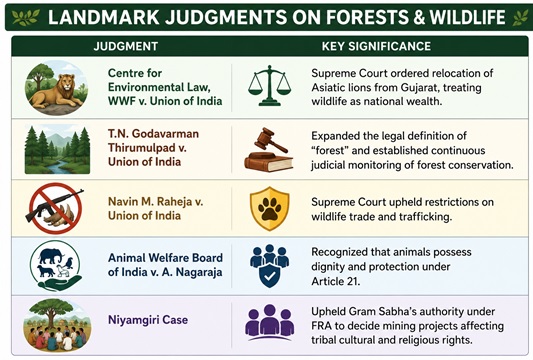
Landmark Judgments on Forests & Wildlife
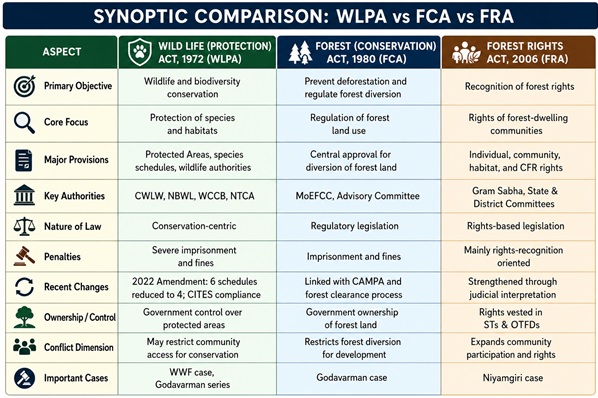
Synoptic Comparison: WLPA vs FCA vs FRA






 Contact Us
  New Batch : 9555124124/ 7428085757
  Tech Support : 9555124124/ 7428085757