
- UPSC Exam
- State PCS
- One Day Exam
- Current Affairs
- PT Quiz
- Downlaods
- About Coaching
- Blog
- Videos

| Prelims: (Polity & Governance + CA) Mains: (GS 2 – Health & Governance; GS 2 – Fundamental Rights; GS 3 – Science & Technology in Public Health) |
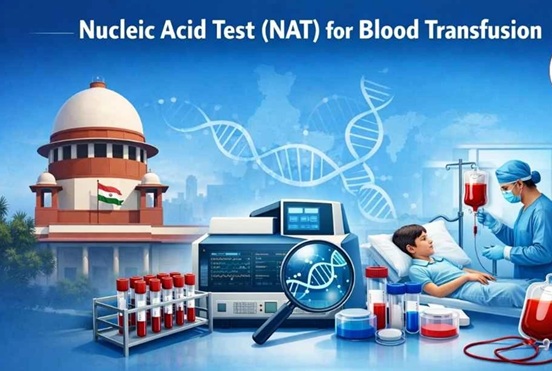
The Supreme Court of India has agreed to examine whether the Nucleic Acid Test (NAT) should be made compulsory across blood banks to ensure safer blood transfusion practices.
The matter arose from a petition filed by an NGO arguing that access to safe blood forms part of the fundamental right to life under Article 21 of the Constitution. The Court has sought additional data on cost-effectiveness, feasibility, and State-level implementation before taking a final decision.
The petition contends that:
The Bench has directed the petitioner to file an affidavit detailing:
This indicates a data-driven judicial approach balancing public health imperatives with fiscal feasibility.
NAT is an advanced molecular diagnostic technique that detects the genetic material (DNA or RNA) of viruses in donated blood.
Currently, most Indian blood banks rely on:
While ELISA is cost-effective, it may fail to detect infections during early stages. NAT significantly reduces this risk, thereby enhancing blood safety.
The issue has gained urgency following reported cases of children contracting HIV allegedly due to contaminated blood transfusions in States such as Madhya Pradesh and Jharkhand.
Thalassemia is an inherited blood disorder in which the body cannot produce adequate haemoglobin.
For such patients, even a small lapse in screening can result in life-threatening infections.
These incidents have been described as “preventable tragedies,” renewing debate over the adequacy of existing blood safety mechanisms.
Article 21 guarantees the right to life and personal liberty. Over the years, the Supreme Court has expanded its scope to include:
The petitioner argues that safe blood transfusion falls within this constitutional protection.
The Court’s willingness to examine the matter signals recognition of the intersection between public health governance and fundamental rights.
Blood safety in India is regulated under:
Currently, mandatory screening includes tests for:
NAT is not uniformly mandated nationwide.
During hearings, the Court raised concerns regarding:
Nationwide implementation would require:
The fiscal implications make the issue both a health governance and economic policy question.
1. Strengthening Blood Safety Standards
Mandatory NAT could substantially reduce the risk of transfusion-transmitted infections.
2. Human Rights Perspective
Reinforces the constitutional commitment to safeguarding life and dignity.
3. Health System Modernisation
Encourages adoption of advanced diagnostic technologies in public health infrastructure.
4. Vulnerable Population Protection
Particularly critical for thalassemia patients, trauma victims, and surgical patients.
5. Fiscal-Health Balance
Highlights the challenge of reconciling universal health standards with fiscal constraints.
FAQs1. What is the primary advantage of NAT over ELISA tests ? NAT detects viral genetic material and significantly reduces the infection detection window period. 2. Why is the issue linked to Article 21 ? Safe blood transfusion is argued to be part of the right to life and health under Article 21. 3. Is NAT currently mandatory in India ? No. It is implemented selectively in some hospitals but not mandated nationwide. 4. Why are thalassemia patients particularly vulnerable ? They require frequent transfusions, increasing cumulative risk of infection from contaminated blood. 5. What are the main obstacles to nationwide implementation ? High costs, infrastructure gaps, need for trained personnel, and fiscal constraints of States. |



Our support team will be happy to assist you!

 Contact Us
  New Batch : 9555124124/ 7428085757
  Tech Support : 9555124124/ 7428085757