Prelims: (Science & Technology + CA)
Mains: (GS Paper 2 – Governance, Public Policy; GS Paper 3 – Science & Technology, Economy, Inclusive Growth) |
Why in News ?
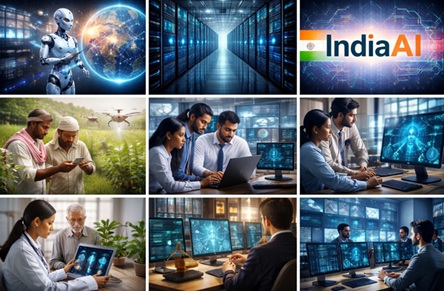
The Government of India has highlighted the scale and impact of the IndiaAI Mission, backed by an investment of over ₹10,300 crore and deployment of 38,000 Graphics Processing Units (GPUs), positioning Artificial Intelligence (AI) as a key driver of inclusive growth, innovation, and digital governance.
Background & Context
Artificial Intelligence is emerging as a foundational technology reshaping economies, governance systems, and societies worldwide. For India, AI represents not only a tool for economic expansion but also a means to address long-standing development challenges in healthcare, agriculture, education, urban governance, and climate resilience.
India’s AI strategy emphasises:
- Democratisation of computing power
- Indigenous model development
- Inclusive and responsible AI adoption
- Alignment with Digital Public Infrastructure (DPI)
This approach aligns with India’s long-term vision of Viksit Bharat @2047.
What is Artificial Intelligence ?
Artificial Intelligence refers to the ability of machines to perform tasks that typically require human intelligence, such as:
- Learning from data
- Pattern recognition
- Decision-making
- Language understanding and generation
AI systems rely on:
- Large datasets
- Algorithms and machine learning models
- High-performance computing infrastructure
Over time, AI systems improve autonomously, enabling applications such as chatbots, image recognition, predictive analytics, and large language models (LLMs).
India’s AI Ecosystem: Present Status
Key Indicators
- India’s tech sector revenue projected to exceed USD 280 billion
- Over 6 million professionals employed in tech and AI
- 1,800+ Global Capability Centres, with 500+ focused on AI
- Around 1.8 lakh startups, with nearly 89% using AI
- 87% of enterprises actively deploying AI solutions
- Around 26% of firms have achieved AI maturity at scale
Leading AI-Adopting Sectors
- Industrial & automotive
- BFSI
- Healthcare
- Retail and consumer goods
India’s Global Standing in AI
According to Stanford University’s 2025 Global AI Vibrancy Tool:
- India ranks 3rd globally in AI competitiveness
- Strong performance in:
- Talent pool
- Research output
- Startup ecosystem
- Policy and governance
India is also:
- Second-largest contributor to AI projects on GitHub
- Among the top four countries in AI skills and capabilities
IndiaAI Mission
Vision: “Making AI in India and Making AI Work for India”

Overview
- Approved in March 2024
- Budget outlay: ₹10,371.92 crore over five years
- Implemented by IndiaAI, under MeitY
Infrastructure Expansion
- Initial target: 10,000 GPUs
- Achieved: 38,000 GPUs
- Subsidised access at ₹65 per hour
Seven Pillars of the IndiaAI Mission
1. IndiaAI Compute
- Affordable access to high-end GPUs
- Enables startups, academia, and MSMEs to train AI models
2. IndiaAI Application Development
- Focus on India-specific challenges:
- Healthcare
- Agriculture
- Climate change
- Governance
- Education
- Over 30 AI applications approved
- Sector-specific hackathons to drive innovation
3. AIKosh (National Dataset Platform)
- Repository of high-quality datasets
- Over 5,500 datasets and 251 AI models
- Supports 20+ sectors
- Enables faster AI development
4. IndiaAI Foundation Models
- Development of sovereign large multimodal models
- Trained on Indian languages and datasets
- Ensures strategic autonomy in generative AI
- Multiple startups and academic consortia selected
5. IndiaAI Future Skills
- Capacity building and skilling:
- 500 PhD fellows
- 5,000 postgraduates
- 8,000 undergraduates
- AI and Data Labs in Tier 2 and Tier 3 cities
- ITIs and polytechnics integrated
6. IndiaAI Startup Financing
- Financial and global expansion support
- IndiaAI Startups Global programme
- Market access to Europe and other regions
7. Safe and Trusted AI
- Focus on ethical and responsible AI
- Key areas:
- Bias mitigation
- Explainability
- Privacy-preserving ML
- AI auditing and governance
AI in Governance and Everyday Life
Healthcare
- Early disease detection
- AI-assisted diagnostics
- Telemedicine in remote regions
Agriculture
- Weather prediction
- Pest surveillance
- Crop advisory systems
Education
- Personalised learning
- AI modules under NEP 2020
- Multilingual digital education platforms
Justice and Governance
- AI-enabled translation of judgments
- Intelligent case management
- Enhanced access to justice
Climate and Disaster Management
- AI-based cyclone and rainfall forecasting
- Fire and lightning prediction
- Climate advisory tools
AI for Inclusive Societal Development
As per NITI Aayog’s 2025 report, AI can empower:
- 490 million informal workers
- Improve access to:
- Healthcare
- Skilling
- Financial services
Digital ShramSetu Mission (Proposed)
- Voice-first AI interfaces
- Smart contracts for payments
- Micro-credentials and on-demand skilling
Challenges and Risks
- Digital divide and access inequality
- Data privacy and surveillance concerns
- Algorithmic bias
- Job displacement fears
- Cybersecurity risks
Way Forward
- Strengthening AI governance frameworks
- Expanding public AI infrastructure
- Ethical AI standards and audits
- Continuous skilling and reskilling
- Global collaboration with strategic autonomy
FAQs
1. What is the IndiaAI Mission ?
A national mission to build computing capacity, talent, datasets, and responsible AI systems.
2. Why are GPUs critical for AI ?
They enable high-speed processing required for training large AI models.
3. How does India ensure inclusive AI growth ?
Through subsidised compute access, regional labs, multilingual AI, and public-sector use cases.
4. What is India’s global rank in AI competitiveness ?
India ranks 3rd globally as per Stanford’s 2025 AI index.
5. How does AI support Viksit Bharat 2047 ?
By driving productivity, inclusion, innovation, and efficient governance.
|






 Contact Us
  New Batch : 9555124124/ 7428085757
  Tech Support : 9555124124/ 7428085757