
- UPSC Exam
- State PCS
- One Day Exam
- Current Affairs
- PT Quiz
- Downlaods
- About Coaching
- Blog
- Videos

| Prelims : International Relations, Geography (Strait of Hormuz) + Current Affairs Mains : GS Paper 2 – International Relations; GS Paper 3 – Economy, Energy Security |
The United States has imposed a naval blockade on Iran, particularly targeting maritime activity around the Strait of Hormuz, following the collapse of diplomatic negotiations.
This development has triggered widespread concerns across the global economy, as it directly affects one of the most critical energy supply routes in the world. The move has already led to rising oil prices, disruption in shipping activity, and fears of escalation into a larger geopolitical conflict.
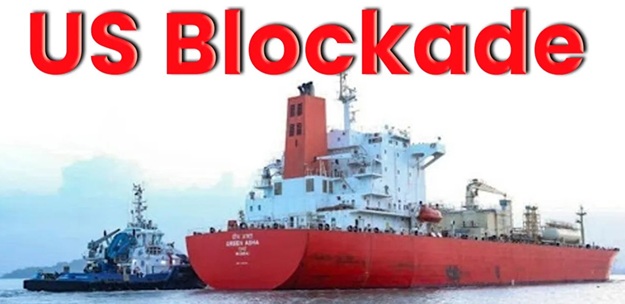
A naval blockade refers to a military strategy aimed at restricting a country’s maritime trade by preventing ships from entering or leaving its ports.
In this case, the United States has undertaken measures to :
This effectively isolates Iran from global maritime trade networks and is intended to exert economic and strategic pressure on the country.
The Strait of Hormuz is one of the most vital maritime chokepoints in the world, making this blockade particularly significant.
Any disruption in this region has immediate ripple effects across global energy markets and trade systems.
The blockade directly limits Iran’s ability to export oil, which reduces the overall supply available in global markets. Since oil markets are highly sensitive to supply changes, even a partial disruption creates significant upward pressure on prices.
In addition, the risk that the conflict could spread to other oil-producing countries further amplifies supply concerns, making markets react sharply.
The presence of military forces and the threat of interception discourage commercial vessels from operating freely in the region.
This disrupts not only oil trade but also the movement of other goods, affecting global supply chains.
Financial markets respond to geopolitical instability with heightened uncertainty.
This leads to price volatility and further instability in global markets.
The reduction in supply combined with heightened uncertainty leads to a rapid increase in global crude oil prices.
Higher oil prices have a cascading effect on economies worldwide, as oil is a fundamental input in transportation, manufacturing, and energy production.
Countries that rely heavily on oil imports face serious challenges:
Emerging economies, including India, are particularly affected due to their high dependence on imported energy.
Oil is central to global logistics, and any disruption affects transportation networks.
Thus, the blockade creates a chain reaction affecting multiple sectors beyond energy.
Shipping companies face increased operational risks while navigating conflict-prone regions.
These factors contribute to increased costs of goods globally.
The disruption is not limited to oil but extends to other commodities transported through the region, such as:
This broadens the scope of the economic impact.
Higher energy costs translate into increased production and transportation costs, which are eventually passed on to consumers in the form of higher prices.
This leads to inflationary pressures across economies, affecting both developed and developing nations.
Rising costs reduce consumer purchasing power and increase operational costs for businesses, leading to slower economic growth.
In extreme cases, economies may face stagflation, where inflation is high but growth remains stagnant.
Geopolitical uncertainty leads to instability in financial markets.
The blockade is perceived by Iran as an aggressive move, increasing the likelihood of retaliation and military confrontation.
The crisis highlights how global trade depends heavily on a few critical chokepoints, making the international system vulnerable to disruptions.
India, as a major oil-importing country, faces multiple challenges :
At the same time, India may respond by :
The blockade reflects a broader structural issue in the global system :
This highlights the fragility of globalisation and dependence on limited energy routes.
Prelims
Q. The Strait of Hormuz connects which of the following water bodies ?
(a) Arabian Sea and Red Sea
(b) Persian Gulf and Arabian Sea
(c) Mediterranean Sea and Red Sea
(d) Black Sea and Caspian Sea
Mains
“Geopolitical tensions in strategic chokepoints can disrupt global trade and energy security.” Discuss with reference to the US blockade on Iran.
FAQsQ1. What is a naval blockade? It is a military strategy to restrict maritime trade of a country. Q2. Why is the Strait of Hormuz important ? It is a major global oil transit route. Q3. Why did oil prices rise ? Due to supply disruptions and geopolitical uncertainty. Q4. How does it affect India ? Through higher oil prices and economic pressure. Q5. What is the key global concern ? Disruption of trade and energy security. |



Our support team will be happy to assist you!

 Contact Us
  New Batch : 9555124124/ 7428085757
  Tech Support : 9555124124/ 7428085757