Prelims: (International Relations + CA)
Mains: (GS 2 – Foreign Policy, Global Governance; GS 3 – International Trade, Economic Diplomacy, Strategic Resources) |
Why in News?
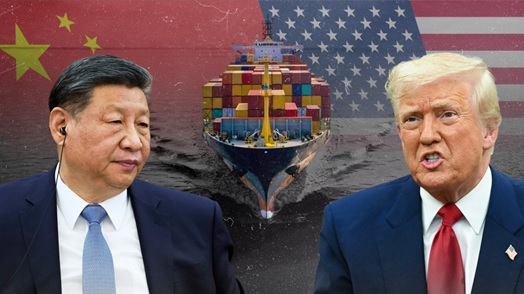
U.S. President Donald Trump’s second term has triggered sweeping geopolitical and economic disruptions, with his aggressive trade and foreign policies paradoxically strengthening China’s global economic position.
- In his first year back in office, President Trump signed hundreds of executive orders, relaunched a trade war, withdrew the United States from key international institutions, ordered mass deportations, and authorised military actions in Yemen, Iran, and Nigeria, reshaping global stability.
- Instead of isolating China, these actions have accelerated shifts in global trade alignments, weakened confidence in U.S. leadership, and expanded Beijing’s economic and diplomatic influence.
Background: Trump’s Upheaval and Its Unintended Impact
From Ally to Threat: Europe’s Shock
- Where Russia once dominated Europe’s threat perception, the United States has now emerged as a major source of uncertainty.
- This has unsettled transatlantic relations and altered Europe’s strategic calculations, pushing European states toward greater defence autonomy and economic diversification.
Markets Signal Global Anxiety
- Rising geopolitical and economic instability under Trump has driven investors toward safe-haven assets, pushing gold and silver prices to record highs.
- Market volatility reflects fears linked to the unpredictability of U.S. trade and foreign policies.
The China Paradox
- Despite Trump’s intent to isolate China through tariffs and technology restrictions, China has emerged economically stronger.
- By December 2025, China’s trade surplus surged to historic highs.
- China achieved 5% economic growth in 2025, meeting official targets.
- A booming trade surplus offset domestic challenges such as:
- Weak consumption, and
- A prolonged property crisis.
Rather than retreating, China responded by deepening integration with global markets, reinforcing its position in international trade and reshaping global trade relationships.
Canada–China Reset After Years of Strain
Canadian Prime Minister Mark Carney’s visit to Beijing marked a pivotal reset in bilateral ties after nearly a decade of diplomatic chill.
Key Outcomes
- Agreement on:
- Tariff reductions for Canadian canola and seafood, and
- Limited access for Chinese electric vehicles (EVs) to the Canadian market.
- Carney and President Xi Jinping signalled the beginning of a “new strategic partnership”, reflecting pragmatic realignment driven by shifting global trade dynamics and shared economic interests.
Beijing Draws Global Leaders
Carney’s visit fits into a broader pattern of world leaders re-engaging with China:
- South Korean President Lee Jae Myung visited Beijing earlier this month — the first such visit since 2019.
- UK Prime Minister Keir Starmer and German Chancellor Friedrich Merz are also expected to visit soon.
As the U.S. retreats from its traditional role as the anchor of global trade under Trump, countries are increasingly bypassing Washington to deepen partnerships with China and among themselves, reshaping the global economic order.
Global Supply Chains Are Stretching, Not Shrinking
Recent analyses indicate that global trade is reconfiguring rather than retreating.
Key Trends
- Average trade distances are at record highs, with expanding flows across Asia, West Asia, and Africa more than offsetting reduced U.S. trade.
- Trade surged in early 2025 as firms front-loaded shipments ahead of expected tariff changes.
This suggests that protectionism is not deglobalising trade but redirecting and rerouting it through alternative corridors and partnerships, many of which increasingly involve China.
China’s Rising Influence in Global Perceptions
A January 2026 paper by Timothy Garton Ash and colleagues highlights a growing global expectation that China’s influence will expand over the next decade.
Shifting Global Perceptions
- More countries now view Beijing as an ally or necessary partner, even as confidence in U.S. leadership declines.
- Another study shows that expectations of U.S. leadership under Trump have fallen sharply, including in countries such as India and South Africa.
- Many Europeans no longer see the U.S. as a reliable ally and are accelerating rearmament.
- Russians now view the European Union as a greater adversary than the U.S.
- Ukrainians increasingly look to Brussels rather than Washington for support.
These perception shifts indicate a fundamental rebalancing in global power alignments.
India’s Cautious Rebalancing Toward China
New Delhi has begun a calibrated opening in its engagement with China, reflecting a pragmatic reassessment of foreign policy options amid a sharply deteriorating economic relationship with the United States under the Trump administration.
Key Developments
- Even as border disputes and strategic differences persist, India and China have addressed some “low-hanging fruit” in bilateral ties.
- India now expects reciprocity from Beijing, particularly in:
- Easing curbs on Indian businesses, and
- Sensitive sectors such as rare earth magnets.
Trade Data Signals the Shift
- In December, India’s exports to China surged nearly 70% to $2 billion.
- Shipments to the United States fell by almost 2% to $6.8 billion, as steep U.S. tariffs reshaped export priorities.
- The U.S. has imposed tariffs of up to 50% on Indian goods, among the highest levied on any country — even exceeding those on China.
These measures have disrupted trade flows, strained diplomatic ties, and pushed India to diversify markets and recalibrate external economic partnerships.
Strategic Implications and the Road Ahead
Trump’s protectionist turn is accelerating:
- A shift away from U.S.-centric trade structures,
- A rise in China-centred economic networks, and
- The emergence of a more fragmented yet interconnected global economy.
While the U.S. aims to reduce dependence on adversaries, its policies are instead:
- Weakening its leadership credibility,
- Driving allies and partners toward alternative alignments, and
- Enabling China to consolidate economic and diplomatic influence.
For countries like India, the challenge will be to balance:
- Strategic competition with China,
- Economic pragmatism,
- Diversification of trade partners, and
- Preservation of strategic autonomy.
FAQs
1.Why is Trump’s trade policy strengthening China?
Because U.S. protectionism has redirected global trade flows toward China and weakened confidence in U.S. leadership, enhancing Beijing’s economic influence.
2.How has Europe responded to Trump’s policies?
Europe increasingly views the U.S. as a source of uncertainty, is rearming, and is recalibrating strategic and economic partnerships.
3.What changes are occurring in global supply chains?
Supply chains are stretching and rerouting rather than shrinking, with expanding trade across Asia, West Asia, and Africa.
4.How are global perceptions of China and the U.S. shifting?
More countries expect China’s influence to grow, while confidence in U.S. leadership has declined significantly.
5.Why is India rebalancing its engagement with China?
Due to deteriorating trade relations with the U.S., high tariffs on Indian goods, and the need to diversify markets while safeguarding strategic interests.
|






 Contact Us
  New Batch : 9555124124/ 7428085757
  Tech Support : 9555124124/ 7428085757