
- UPSC Exam
- State PCS
- One Day Exam
- Current Affairs
- PT Quiz
- Downlaods
- About Coaching
- Blog
- Videos

| Prelims: (International Relations + CA) Mains: (GS 2 – India and Bilateral Relations; GS 3 – External Sector, Agriculture, Industrial Policy) |
India and the United States have signed an interim trade agreement aimed at restoring trade flows after a period of tariff escalation. While presented as a breakthrough in bilateral ties, the pact has triggered debates over its economic impact, agricultural implications, and concerns regarding strategic autonomy.
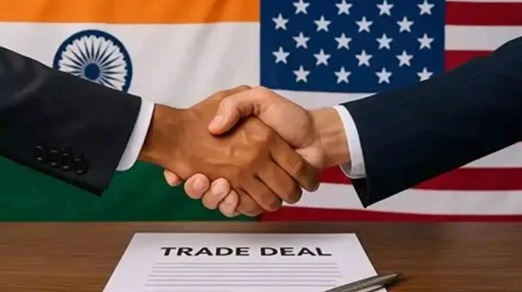
India and the United States share a deep strategic partnership spanning defence, technology, and trade.
In August 2025, the U.S. administration imposed:
These measures strained ties and disrupted trade flows. Nearly a year later, both sides agreed to an interim arrangement as a precursor to a broader bilateral trade agreement.
India will:
India has expressed intent to purchase approximately $500 billion worth of:
Reduced tariffs may benefit:
An 18% tariff may provide limited competitive advantage compared to countries facing higher duties.
The agreement:
A stabilised trade environment may:
The agreement does not explicitly safeguard tariff protection for sensitive products such as cereals.
If tariffs are lowered:
The U.S. has historically objected to India’s restrictions on GM food imports.
References to resolving “long-standing concerns” raise fears that India may ease restrictions, potentially affecting:
A central concern is asymmetry:
Compared to the pre-dispute 2.5% average, the current structure represents higher protectionism against Indian exports.
This raises questions about negotiating leverage and fairness.
Sovereignty and Strategic Autonomy
The Russian oil clause introduces geopolitical implications:
Critics argue this could constrain India’s independent foreign policy tradition.
The interim pact is a precursor to a full-fledged trade agreement. Its final shape will determine:
The government faces the challenge of ensuring economic gains do not undermine farmer livelihoods or sovereign decision-making.
1. Resets Bilateral Economic Engagement
Helps restore trade stability after tariff disputes.
2. Influences India’s Agricultural Policy
May shape future tariff protection strategies and GM regulation policies.
3. Impacts Make in India and Industrial Policy
Could affect domestic manufacturing competitiveness depending on tariff structures.
4. Signals Strategic Alignment
Demonstrates closer economic coordination between India and the U.S.
5. Raises Questions of Economic Sovereignty
Conditional trade concessions linked to geopolitical commitments may redefine India’s external economic diplomacy.
FAQs1. What is the U.S.–India interim trade agreement ? It is a temporary trade arrangement reducing tariffs and expanding market access, serving as a step toward a comprehensive bilateral trade deal. 2. Why was the agreement necessary ? It followed tariff escalations imposed by the U.S., including penalties linked to India’s Russian oil imports. 3. How does it affect Indian farmers ? Reduced agricultural tariffs may expose farmers to competition from subsidised U.S. agribusiness products. 4. What is the controversy regarding Russian oil ? The agreement reportedly links tariff relief to India limiting Russian oil imports, raising concerns about strategic autonomy. 5. Is the agreement final ? No, it is an interim arrangement and a precursor to a broader bilateral trade agreement. |



Our support team will be happy to assist you!

 Contact Us
  New Batch : 9555124124/ 7428085757
  Tech Support : 9555124124/ 7428085757