Context
- As global economies shift toward sustainable and cleaner processes for consumer products like plastics and textiles, biomaterials are ushering in a new era in the field of materials engineering.
- Materials engineering is the field that studies and develops the structure, properties, and processing of metals, ceramics, polymers, and nanomaterials to make products stronger, lighter, safer, and more efficient. It combines engineering, science, and technology to discover new materials and improve existing ones.
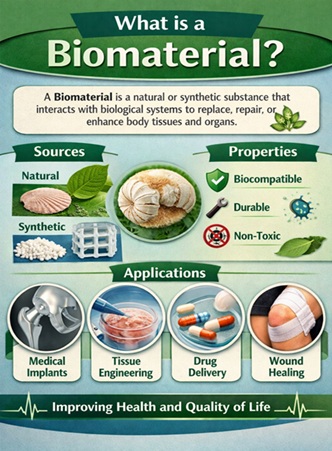
What is a Biomaterialn ?
- Biomaterials are substances that are derived entirely or partially from biological sources or produced through biological processes. They are developed to be used as alternatives to, or in conjunction with, conventional materials.
- Their use is steadily increasing in areas such as packaging, textiles, construction, and healthcare. Common examples include bioplastics made from plant sugars or starch, bio-based fibers used in the textile industry, and biodegradable surgical sutures and tissue structures used in the medical field.
Categories of Biomaterials
Biomaterials can be broadly divided into three categories:
- Drop-in biomaterials: These are chemically similar to petroleum-based materials and can be directly used in existing production systems, such as bio-PET.
- Drop-out biomaterials: These have different chemical structures and require new processing techniques or post-use systems, such as polylactic acid (PLA).
- Novel biomaterials: These offer different and improved properties than traditional materials, such as self-healing materials, bioactive implants, and advanced composites.
India's Need for Biomaterials
In the Indian context, biomaterials address multiple national priorities simultaneously.
- They can promote environmental protection, as well as foster industrial development, revenue generation, and increased farmer incomes.
- Domestic production of biomaterials in the country can reduce dependence on fossil fuel-based imports of plastics and chemicals.
- Additionally, new markets can open up for agricultural produce and crop residues, providing farmers with alternative sources of income beyond the food supply chain.
- As the global market shifts toward low-carbon and circular economy-based products, biomaterials will help Indian industry remain competitive on the export front.
- This sector also strengthens domestic policy commitments related to the ban on single-use plastics and climate change.
India at Present
- The biomaterials industry in India is rapidly emerging as a strategic and sustainable industrial opportunity, encompassing bioplastics, biopolymers, and other bio-derived materials.
- The bioplastics market size alone was estimated to be approximately $500 million in 2024 and is expected to remain on a strong growth trajectory in the coming years.
- The proposed PLA plant by Balrampur Chini Mills in Uttar Pradesh is one of the largest investments being made in this sector.
- Additionally, startups like Phool.co are converting flower waste from temples into useful biomaterials, while Praj Industries is building a demonstration-scale bioplastics plant.
- However, despite its abundant agricultural resources, India still has to rely on foreign sources for some advanced technologies, especially when converting raw materials into high-value end products.
Global Scenario
- The European Union has implemented the Packaging and Packaging Waste Regulation (EU) 2025/40, which recognizes that compostable packaging has clear environmental benefits in certain applications.
- The United Arab Emirates is establishing itself as a global manufacturing hub by investing extensively in PLA projects. Emirates Biotech has selected Sulzer technology for a two-stage PLA plant with an 80,000-tonne-per-annum capacity, which is expected to begin operations in 2028. When fully operational, it will be the world's largest PLA facility.
- The United States continues to be a leader in many transformative technologies involving biomaterials. Federal procurement policy, through the USDA's BioPreferred program, is also encouraging this sector.
Challenges
India has the opportunity to establish global leadership in the biomaterials industry, but it also faces challenges.
- If raw material supplies do not increase in tandem with growing demand, competition with food crops could increase.
- Similarly, excessive agricultural exploitation threatens to put pressure on water resources and lead to soil erosion.
- Furthermore, if waste management and composting infrastructure remains weak, the environmental benefits of biomaterials could be limited.
- Lack of coordination between agricultural, environmental, and industrial policies could slow adoption, and if timely action is not taken, India could remain dependent on imports while other countries are rapidly advancing.
Way Forward
- To fully capitalize on this opportunity, it is essential to expand biomanufacturing infrastructure, particularly fermentation and polymerization capabilities.
- Additionally, productivity of feedstocks derived from crops such as sugarcane, maize, and agricultural residues should be increased through advanced technologies.
- Investment in research and development, standardization, and innovation will be crucial for the development of both drop-in and novel biomaterials.
- Clear regulatory definitions, appropriate labeling regulations, and post-use solutions, such as recycling or industrial composting, will also be essential to strengthen consumer and industry confidence.
- Government procurement policies, timely incentive schemes, and support for pilot projects and shared facilities can play a key role in reducing the risk of initial investment.
- If India strengthens policy coordination and technological investment in time, it will not only meet its domestic needs but also emerge as a global export hub for biomaterials.






 Contact Us
  New Batch : 9555124124/ 7428085757
  Tech Support : 9555124124/ 7428085757