- Recently, several cases of Guillain-Barré Syndrome (GBS) have been reported in Mansa town of Neemuch district, Madhya Pradesh.
- The death of two patients has raised concern among the health department and the general public.
- Although GBS is a rare disease, it can become life-threatening if not diagnosed and treated on time.
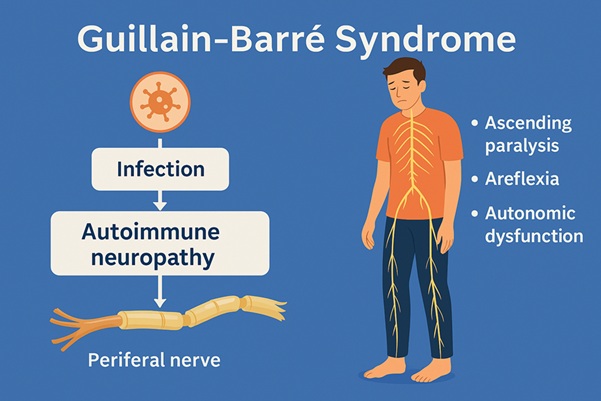
What is Guillain-Barré Syndrome ?
- Guillain-Barré Syndrome is a rare autoimmune neurological disorder.
- In this condition, the body’s immune system mistakenly attacks the peripheral nervous system.
The peripheral nervous system:
- Connects the brain and spinal cord to the rest of the body
- Controls muscle movement
- Transmits sensations such as pain, temperature, and touch
- When these nerves are damaged, symptoms like weakness, numbness, and paralysis may develop.
- Medically, GBS is also called Acute Inflammatory Demyelinating Polyneuropathy (AIDP).
- It can occur at any age but is more commonly seen in people between 30–50 years.
Causes of Guillain-Barré Syndrome
The exact cause is not fully known, but GBS often occurs after:
- Viral infections (flu, dengue, COVID-19, gastrointestinal infections)
- Bacterial infections
- Vaccination (very rare cases)
- Major surgery or serious illness
- In these situations, the immune system becomes overactive and mistakenly attacks the nerves.
Major Symptoms of GBS
Symptoms may develop slowly or progress very rapidly.
Early Symptoms
- Mild fever or recent infection
- Tingling or numbness in the legs
- Feeling of weakness
- Fatigue
Severe Symptoms
- Paralysis spreading upward from the legs
- Weakness in the arms
- Difficulty walking
- Trouble speaking or swallowing
- Breathing difficulty
- Weakness of facial muscles
- Symptoms can worsen within hours, days, or weeks.
- In some cases, patients may not be able to breathe independently and may require ICU care.
Can GBS Be Life-Threatening ?
Yes, if treatment is delayed, GBS can be fatal. However, with modern medical care, most patients recover.
The risk of death increases when:
- Breathing muscles are affected
- Severe infections occur
- Heart rhythm becomes abnormal
- Treatment is delayed
Treatment of Guillain-Barré Syndrome
There is no permanent cure, but treatment helps reduce severity and speed recovery.
Main Treatments
- Intravenous Immunoglobulin (IVIG) therapy
- Plasma Exchange (Plasmapheresis)
- Physiotherapy and rehabilitation
- Respiratory support (ventilator if needed)
- Most patients start walking within 6 months.
- Full recovery may take 1–2 years.
- Some patients may have long-term weakness, fatigue, or numbness.
Prevention and Precautions
GBS cannot be completely prevented, but risk can be reduced:
- Prevent infections (maintain hygiene, drink clean water, wash hands regularly)
- If weakness appears after fever or infection, consult a doctor immediately
- Avoid self-medication
- Inform a doctor if any unusual symptoms appear after vaccination





 Contact Us
  New Batch : 9555124124/ 7428085757
  Tech Support : 9555124124/ 7428085757