Prelims : Economy + CA
Mains : GS Paper 3 – Inclusive Growth; Employment; Poverty; Economic Development |
Why in News ?
Recent surveys such as the Annual Survey of Unincorporated Enterprises (ASUSE) have once again brought attention to the structural realities of India’s informal sector, particularly highlighting issues such as stagnant productivity, employment vulnerability, and uneven recovery from economic shocks.
- The informal sector continues to absorb the overwhelming majority of India’s workforce, making it indispensable for livelihood generation, especially among low-skilled and marginalised populations
- However, the sector is simultaneously characterised by precarious working conditions, lack of institutional support, and limited upward mobility, which restrict its ability to contribute effectively to long-term economic transformation
- The post-pandemic recovery phase has further exposed structural fragilities, including job losses, income instability, and reduced enterprise viability
- These developments have renewed policy focus on :
- Formalisation of enterprises
- Expansion of social security coverage
- Enhancing productivity and resilience
Thus, the informal sector lies at the intersection of India’s growth story and its developmental challenges, making it central to the discourse on inclusive growth.
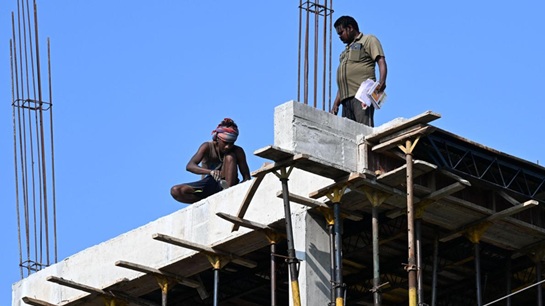
What is the Informal Sector ?
The informal sector refers to all economic activities that operate outside the formal legal, regulatory, and institutional framework of the state, often characterised by lack of registration, taxation, and compliance with labour laws.
- It includes :
- Unregistered micro and small enterprises
- Household-based production units
- Self-employed individuals and casual labour
- Key characteristics :
- Absence of written contracts and job security
- Lack of employer-provided benefits such as insurance, pensions, or paid leave
- Limited or no access to institutional finance and formal credit systems
- Typical examples :
- Street vendors, domestic workers, construction labourers, small shopkeepers, artisans
The informal sector is not merely a residual category but a structurally embedded component of India’s economy, supporting both consumption and production across regions.
Key Features of the Informal Sector in India
1. Overwhelming Dominance in Employment Structure
- The informal sector accounts for nearly nine out of every ten workers in India, making it the primary source of employment across rural and urban areas
- It performs a critical absorptive function by :
- Providing employment to surplus labour from agriculture
- Accommodating migrants and low-skilled workers who are unable to access formal jobs
- This dominance reflects :
- Limited capacity of the formal sector to generate sufficient employment
- Structural constraints in labour-intensive industrialisation
Thus, the informal sector acts as a shock absorber in the labour market, albeit at the cost of job quality and security.
2. Significant Yet Underestimated Contribution to the Economy
- The informal sector contributes a substantial share to :
- Gross Value Added (GVA)
- Overall economic output
- However, due to :
- Lack of proper documentation
- Limited data collection mechanisms
its contribution is often underestimated in official statistics, leading to policy blind spots
- Informal activities are deeply integrated into :
- Supply chains
- Local markets
- Service delivery systems
This duality—high contribution but low visibility—makes the sector economically vital yet institutionally neglected.
3. Prevalence of Self-Employment and Casual Work
- A large proportion of workers in the informal sector are :
- Self-employed
- Engaged in casual or daily wage labour
- This reflects :
- Lack of stable, salaried employment opportunities
- Low entry barriers into informal occupations
- While self-employment can indicate entrepreneurship, in many cases it is :
- A form of “disguised unemployment”
- Driven by necessity rather than opportunity
This highlights the distress-driven nature of employment in the informal economy.
4. Low Productivity and Limited Scale of Operations
- Informal enterprises typically :
- Operate at a very small scale
- Use labour-intensive and low-technology methods
- They face constraints such as :
- Limited access to capital
- Lack of technological know-how
- Poor infrastructure
- As a result :
- Productivity remains low
- Income levels are stagnant
This creates a vicious cycle of low investment and low returns, inhibiting growth and competitiveness.
5. High Vulnerability to Economic and Policy Shocks
- Informal sector workers and enterprises are extremely sensitive to :
- Economic downturns
- Policy changes
- External shocks
- Events such as :
- Demonetisation
- Implementation of GST
- COVID-19 pandemic
have disproportionately affected them due to :
- Lack of savings
- Absence of safety nets
- Informal nature of operations
This vulnerability underscores the sector’s lack of resilience and institutional protection.
Importance of the Informal Sector
1. Crucial Source of Employment and Livelihoods
- The informal sector provides livelihood opportunities to millions who would otherwise remain unemployed, particularly :
- Rural migrants
- Women
- Marginalised communities
- It plays a key role in :
- Preventing extreme poverty
- Maintaining social stability
2. Supporting Local and Regional Economies
- Informal enterprises cater to :
- Local demand for goods and services
- They contribute to :
- Rural non-farm economy
- Urban informal markets
- Their presence ensures :
- Accessibility and affordability of services
3. Promoting Entrepreneurship and Economic Participation
- Low entry barriers allow individuals to :
- Start small businesses with minimal capital
- This encourages :
- Grassroots entrepreneurship
- Economic participation
4. Complementing the Formal Sector
- Informal enterprises often :
- Act as suppliers, subcontractors, or service providers to formal industries
- They form an integral part of :
- Production and distribution networks
5. Flexibility and Adaptability
- The informal sector is highly flexible, enabling :
- Quick adaptation to changing market conditions
- This flexibility supports :
- Economic resilience at the grassroots level
Challenges Faced by the Informal Sector
1. Lack of Social Security and Institutional Protection
- Workers do not have access to :
- Health insurance
- Pension schemes
- Maternity benefits
- This exposes them to :
- Income shocks
- Health-related financial distress
2. Job Insecurity and Irregular Income
- Employment is :
- Workers face :
- Uncertain earnings
- Lack of job continuity
3. Poor Working Conditions and Exploitation
- Many workers operate in :
- Unsafe environments
- Unregulated workplaces
- Absence of labour laws leads to :
4. Limited Access to Credit and Technology
- Informal enterprises lack :
- Collateral for loans
- Financial literacy
- This restricts :
- Investment in technology
- Business expansion
5. Barriers to Formalisation
- Complex regulatory requirements discourage :
- Fear of taxation and compliance costs :
- Keeps enterprises informal
6. Gender and Social Inequality
- Women and marginalised groups are :
- Overrepresented in low-paying informal jobs
- This perpetuates :
- Inequality
- Social exclusion
Government Measures
1. Expansion of Social Security Coverage
- Policies aim to include :
2. Financial Inclusion Initiatives
- Schemes promote :
- Bank accounts
- Access to credit
3. Formalisation Policies
encourage integration into formal economy
4. Targeted Welfare Schemes
- Support vulnerable groups through :
- Direct benefit transfers
- Livelihood programmes
5. Skill Development and Digital Inclusion
- Focus on :
- Enhancing employability
- Improving productivity
Way Forward
1. Gradual and Inclusive Formalisation
- Avoid sudden disruptions
- Ensure transition does not:
2. Universal Social Security
- Extend :
- Basic protections to all workers
3. Simplification of Regulations
4. Enhancing Productivity
- Invest in :
- Technology
- Infrastructure
5. Strengthening Data Systems
- Improve :
- Measurement of informal activities
Practice Questions
Prelims
Q. The informal sector in India is characterised by :
(a) High job security
(b) Formal contracts
(c) Lack of regulation and social protection
(d) High capital intensity
Mains
“India’s informal sector is both a strength and a constraint for its economic development.” Analyse.
FAQs
Q1. What is the informal sector ?
Economic activities outside formal regulation.
Q2. Why is it important ?
It provides employment and supports livelihoods.
Q3. What is the biggest challenge ?
Lack of social security.
Q4. Why is formalisation difficult ?
High compliance costs and structural constraints.
Q5. What is the solution ?
Gradual formalisation with social protection.
|






 Contact Us
  New Batch : 9555124124/ 7428085757
  Tech Support : 9555124124/ 7428085757