New
Hindi Medium: (Delhi) - GS Foundation (P+M) : 21st Sept. 2026, 11:30 AM Hindi Medium: (Prayagraj) - GS Foundation (P+M) : 22nd Sept. 2026, 8:00 AM English Medium: (Delhi) - GS Foundation (P+M) : 6th Aug 2026 English Medium: (Prayagraj) - GS Foundation (P+M) : 19th Aug 2026, 11:00 AM Hindi Medium: (Delhi) - GS Foundation (P+M) : 21st Sept. 2026, 11:30 AM Hindi Medium: (Prayagraj) - GS Foundation (P+M) : 22nd Sept. 2026, 8:00 AM English Medium: (Delhi) - GS Foundation (P+M) : 6th Aug 2026 English Medium: (Prayagraj) - GS Foundation (P+M) : 19th Aug 2026, 11:00 AM

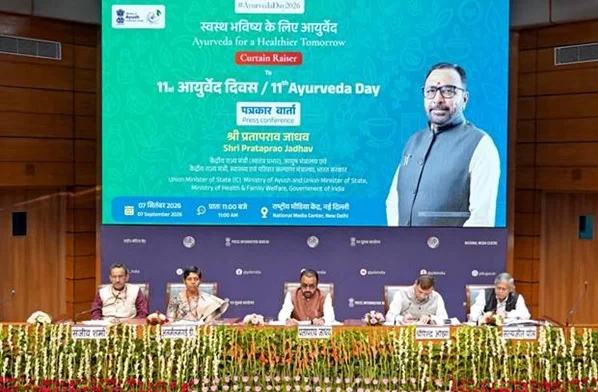
11th Ayurveda Day 2026: Theme, Key Initiatives and Significance

Prelims: Ayurveda Day, Ministry of Ayush, CCRAS, traditional medicine, safety dossiers and National Ayush Mission.
Mains: GS Paper II public health and healthcare delivery; GS Paper III scientific research, innovation and protection of traditional knowledge.
Keywords: CCRAS, AGNI, Safety dossier, Ayurveda Day

Why in News?

  • The Ministry of Ayush announced the 11th Ayurveda Day celebrations on 23 September 2026, with the main national programme in Nagpur, Maharashtra. The theme is “Ayurveda for a Healthier Tomorrow.”
  • The announcement emphasises evidence, research, innovation and community wellbeing. Planned launches include safety dossiers, treatment guidelines, reports and the CCRAS–AGNI Assessment Scale Web Portal. The programme also includes the first-ever report on the Ayush Services Sector. These are announced launches; the advance release does not establish their completion. 

Background

Evolution of Ayurveda Day

  • Ayurveda Day was first observed in 2016. Earlier celebrations coincided with Dhanvantari Jayanti, or Dhanteras, whose date changes annually under the lunar calendar.
  • The government designated 23 September as the fixed annual date, following a Gazette notification issued in March that year. A consistent date supports advance planning and international participation. Thus, the 2026 observance is the eleventh edition.

Understanding Ayurveda

Ayurveda is an Indian traditional medical system concerned with health, illness, diet and lifestyle. Its classical literature includes the Charaka Samhita and Sushruta Samhita. Contemporary policy places growing emphasis on evaluating traditional practices through scientific research and quality standards. 

Key Points

1. First Report on the Ayush Services Sector

The Research and Information System for Developing Countries (RIS) has prepared the first-ever report on this sector, scheduled for release at the national programme. It assesses Ayush services.

Policy significance: Sector-level evidence can help identify service gaps and guide planning. However, a sector report should not be confused with clinical evidence establishing the effectiveness of individual treatments.

2. Safety Dossiers and Treatment Guidelines

The planned releases include safety dossiers on Gokshura (Tribulus terrestris) and Chandrasura (Lepidium sativum), along with Standard Treatment Guidelines on Skin Disorders.

Safety documentation and treatment guidance serve different purposes: the former brings together safety evidence, while the latter supports more consistent clinical decisions. Their practical value depends on the quality of underlying evidence and implementation.

3. Research Reports and Digital Initiative

Other announced releases include:

  • “From Traditional Wisdom to Global Leadership: Ayush Vision 2030” report.
  • Status Report on Ayush-related Inventions in India.
  • CCRAS–AGNI Assessment Scale Web Portal.

CCRAS stands for Central Council for Research in Ayurvedic Sciences, while AGNI means Ayurveda Gyan Naipunya Initiative.

4. Scientific Deliberations

Scientific sessions are scheduled to examine Ayurveda’s road to 2047 and its potential contribution to reducing the burden of non-communicable diseases (NCDs). The policy question is how specific, adequately evaluated interventions can contribute to prevention and care within a coordinated health system.

Significance

The following points explain the potential policy implications of the announced initiatives.

  • Stronger accountability: Publicly accessible research and safety documentation can make health claims easier to assess.
  • More consistent care: Clear clinical guidance can reduce avoidable variation in practice when supported by sound evidence.
  • Better planning: Information on service availability can help policy maker’s direct resources towards underserved areas.
  • Research opportunities: Cooperation among clinicians, researchers and digital specialists can improve study design and documentation.
  • Public health awareness: Community engagement can encourage informed discussion about health, lifestyle and appropriate care.

Relevance for India

Public Health and Access

  • The National Ayush Mission supports the development of Ayush healthcare infrastructure and services. CCRAS, an autonomous organisation under the Ministry of Ayush, coordinates and promotes research in Ayurveda. These institutions provide a policy and research context for the observance.
  • For India, the central challenge is to translate awareness into measurable outcomes. Public programmes should track service quality, patient safety, access and health outcomes alongside participation figures.

Traditional Knowledge and Innovation

Systematic documentation can help preserve traditional knowledge and make it available for rigorous investigation. Research priorities should respond to public health needs, with transparent methods and publication of both favourable and unfavourable findings.

Economic and International Opportunities

Reliable services and credible research could support skilled employment, research partnerships and responsible wellness tourism. Such opportunities depend on quality assurance and accurate communication of benefits and limitations.

Challenges

  1. Evidence quality: Claims require well-designed, reproducible studies with clinically meaningful outcomes.
  2. Product consistency: Variation in ingredients, processing and quality can complicate evaluation and reliable use.
  3. Safety monitoring: Adverse-event reporting and follow-up must accompany wider adoption.
  4. Misleading promotion: Publicity should distinguish established findings from preliminary observations and traditional claims.
  5. Coordination of care: Integration requires clear professional responsibilities and timely referral pathways.
  6. Implementation capacity: New portals and guidelines need training, sustained funding and regular evaluation.

Way Forward

  • Invest in rigorous research: Prioritise transparent protocols, suitable comparison groups and independent assessment.
  • Strengthen quality assurance: Improve testing, traceability and consistent manufacturing standards.
  • Make evidence accessible: Publish research findings and safety information in clear language.
  • Evaluate digital tools: Assess usability, data quality, privacy and their contribution to clinical or research outcomes.
  • Support coordinated care: Build communication and referral systems around patient needs.
  • Measure outcomes: Assess whether initiatives improve safety, access and health rather than relying only on launch or participation numbers.

Conclusion

The 11th Ayurveda Day places evidence, research and community wellbeing at the centre of the discussion on traditional medicine. Its lasting contribution will depend on how effectively the announced resources support reliable research, safe practice and measurable improvements in healthcare.

Prelims MCQs

1. With reference to Ayurveda Day, consider the following statements:

  1. It was first observed in 2016.
  2. Since 2025, it has been assigned the fixed annual date of 23 September.
  3. It continues to be observed exclusively on Dhanteras.

Which of the statements given above are correct?

(a) 1 and 2 only
(b) 2 and 3 only
(c) 1 and 3 only
(d) 1, 2 and 3

Mains Practice Question

“The integration of traditional medicine into public healthcare requires scientific validation, quality assurance and patient-centred governance.” Discuss with reference to India’s Ayurveda ecosystem.

FAQs

1. When is the 11th Ayurveda Day being observed?

It is scheduled for 23 September 2026, with the main national programme in Nagpur, Maharashtra.

2. What is the theme of Ayurveda Day 2026?

The theme is “Ayurveda for a Healthier Tomorrow.”

3. Why is Ayurveda Day no longer tied to Dhanteras?

The government adopted a fixed date from 2025 to improve consistency, planning and global participation.

4. Who prepared the first Ayush Services Sector report?

It was prepared by the Research and Information System for Developing Countries (RIS).

5. What is the CCRAS–AGNI portal mentioned in the announcement?

It is the CCRAS–AGNI Assessment Scale Web Portal, listed among the planned launches. AGNI expands to Ayurveda Gyan Naipunya Initiative.

Have any Query?

Our support team will be happy to assist you!

OR