Prelims: Pradhan Mantri Jan Dhan Yojana (PMJDY), Financial Inclusion, JAM Trinity, RuPay Card, Direct Benefit Transfer (DBT)
Mains – GS Paper III: Inclusive Growth, Financial Inclusion, Digital Payments, Direct Benefit Transfer, Government Welfare Schemes
Keywords: PM Jan Dhan Yojana 12 Years, PMJDY 2026, Pradhan Mantri Jan Dhan Yojana, PMJDY 12th Anniversary, PMJDY Benefits, PMJDY Accounts, Financial Inclusion in India, JAM Trinity, Direct Benefit Transfer (DBT), RuPay Card, Digital Payments, Rural Banking, Women Financial Inclusion, Inclusive Growth |
Why in News?
The Pradhan Mantri Jan Dhan Yojana (PMJDY) completed 12 years on 28 August 2026.
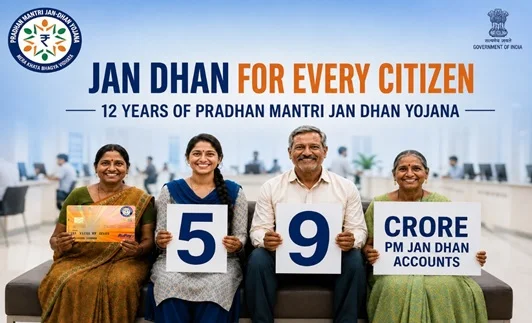
Key Points
- Launched on 28 August 2014, it is a National Mission for Financial Inclusion aimed at providing banking and financial services to the unbanked population.
- Key Milestones as of 19 August 2026
- 59.09 crore PMJDY accounts opened.
- ₹3.17 lakh crore total deposits.
- 55.7% of account holders are women.
- 77.8% of accounts are in rural and semi-urban areas.
- 41.29 crore RuPay cards issued.
What is Pradhan Mantri Jan Dhan Yojana (PMJDY)?
- The Pradhan Mantri Jan Dhan Yojana (PMJDY) is a National Mission for Financial Inclusion, launched on 28 August 2014.
- Its main objective is to provide unbanked people access to formal banking and financial services.
- Key Features
- Basic bank account with no minimum balance requirement.
- RuPay debit card for payments and withdrawals.
- Access to Direct Benefit Transfer (DBT) of government benefits.
- Overdraft facility for eligible account holders.
- Access to insurance and pension schemes.
- Promotes savings, digital payments and financial inclusion.
Key Benefits of PMJDY
- Zero-Balance Bank Account: A basic bank account can be opened with no minimum balance requirement.
- RuPay Debit Card: Account holders receive a RuPay debit card for ATM withdrawals and digital payments, along with accident insurance cover of up to ₹2 lakh, subject to eligibility conditions.
- Overdraft Facility: Eligible account holders can get an overdraft of up to ₹10,000.
- Direct Benefit Transfer (DBT): Government subsidies and welfare benefits can be directly transferred to beneficiaries' bank accounts, reducing delays and intermediaries.
- Insurance & Pension: PMJDY facilitates access to social-security schemes such as PMJJBY (life insurance) and PMSBY (accident insurance), along with pension schemes.
- Financial Inclusion: It connects previously unbanked people with formal banking, savings, credit and digital financial services.
Growth in PMJDY Deposits
PMJDY has recorded significant growth in both accounts and deposits over the last 12 years.
- As of 19 August 2026, total deposits reached ₹3,16,514 crore (₹3.17 lakh crore).
- Deposits increased by about 12.8 times compared with August 2015.
- The number of accounts increased by about 2.3 times.
- The average deposit per account reached ₹5,356.
- Average deposits per account increased by about 3.4 times since August 2015.
This growth indicates greater use of Jan Dhan accounts and increasing saving habits among account holders.
Women and Rural Financial Inclusion
PMJDY has significantly expanded banking access for women and people in rural and semi-urban areas.
- 55.7% (32.92 crore) of PMJDY account holders are women.
- 77.8% (45.95 crore) of PMJDY accounts are in rural and semi-urban areas.
- This has helped bring previously unbanked and underserved sections into the formal financial system.
What is the JAM Trinity?
JAM stands for Jan Dhan–Aadhaar–Mobile. It connects: Jan Dhan Account + Aadhaar + Mobile
- The JAM Trinity enables the government to transfer subsidies and welfare benefits directly into beneficiaries' bank accounts through Direct Benefit Transfer (DBT).
- Why is JAM Important?
- Enables direct transfer of government benefits.
- Reduces intermediaries and leakages.
- Makes welfare delivery faster and more transparent.
- Helps in better targeting of beneficiaries.
- Promotes digital payments and financial inclusion.
PMJDY and Digital Payments
PMJDY has helped expand digital payments and banking access across India.
- As of 19 August 2026, 41.29 crore RuPay cards had been issued to PMJDY account holders.
- RuPay cards enable ATM withdrawals and digital payments.
- They help bring previously unbanked people into India's digital financial system.
PMJDY and Access to Credit
PMJDY helps account holders move beyond basic banking towards formal credit and financial opportunities.
- Eligible account holders can get an overdraft facility of up to ₹10,000.
- Regular banking and savings can help build a financial history.
- Account holders may access credit through schemes such as Pradhan Mantri MUDRA Yojana (PMMY), subject to eligibility.
- Better access to formal credit can support self-employment, small businesses and income generation.
Why is PMJDY Important for India?
- Financial Inclusion: Brings previously unbanked people into the formal banking system.
- Inclusive Growth: Expands financial access, particularly among women and rural populations.
- Better Welfare Delivery: Supports Direct Benefit Transfer (DBT), helping government benefits reach beneficiaries directly.
- Digital Payments: RuPay cards and banking services encourage participation in the digital payment ecosystem.
- Financial Security: Provides access to insurance, pension, overdraft and credit facilities.
- Promotes Savings: Encourages people to save through formal bank accounts and develop regular banking habits.
Challenges Ahead
Despite its success, PMJDY still faces some challenges:
- Inactive or low-use accounts need to be brought into regular use.
- Financial and digital literacy remains limited among some beneficiaries.
- Access to formal credit needs further expansion.
- Digital fraud and cybersecurity risks require greater awareness.
- Banking services remain limited in some remote and rural areas.
- Insurance and pension coverage needs to be expanded.
- The digital divide can restrict access to digital banking services.
The next phase should focus on moving from bank account access to active and meaningful use of financial services.
PMJDY and Inclusive Growth
PMJDY has expanded beyond basic banking to support inclusive economic growth.
- Provides access to savings, credit, insurance and pension services.
- Enables efficient Direct Benefit Transfer (DBT) through the JAM framework.
- Promotes digital payments through RuPay cards.
- Improves financial participation of women, rural households and weaker sections.
Overall, PMJDY helps ensure that the benefits of India's economic and digital growth reach previously underserved sections of society.
Conclusion
After 12 years, PMJDY has become a key pillar of India's financial inclusion journey, bringing millions of people into the formal banking system. Going forward, the focus should shift from opening bank accounts to their active use, along with better access to credit, insurance, pensions and secure digital services, ensuring greater financial empowerment and inclusive growth.
Prelims Practice Question
Q1. Pradhan Mantri Jan Dhan Yojana (PMJDY) was launched in which year?
(a) 2012
(b) 2013
(c) 2014
(d) 2015
Mains Practice Question
“Pradhan Mantri Jan Dhan Yojana (PMJDY) has transformed financial inclusion from mere bank account access to broader financial empowerment.” Discuss the achievements of PMJDY and the challenges that remain in achieving meaningful financial inclusion in India.
|
FAQs
1. What is PMJDY?
PMJDY is a National Mission for Financial Inclusion that provides access to basic banking and financial services.
2. When was PMJDY launched?
It was launched on 28 August 2014.
3. How many PMJDY accounts have been opened?
As of 19 August 2026, 59.09 crore accounts had been opened.
4. How much money is deposited in PMJDY accounts?
Total deposits stood at about ₹3.17 lakh crore as of 19 August 2026.
5. What is JAM Trinity?
JAM stands for Jan Dhan–Aadhaar–Mobile, which supports direct and efficient delivery of government benefits.
|






 Contact Us
  New Batch : 9555124124/ 7428085757
  Tech Support : 9555124124/ 7428085757