Prelims: Goods and Services Tax (GST), GST Council, Article 279A, GST Registration, Input Tax Credit (ITC), GST Refunds, Inverted Duty Structure and GST Appellate Tribunal (GSTAT).
Mains: GS Paper III: Indian Economy, Taxation Reforms, Ease of Doing Business, Fiscal Federalism, MSMEs and Economic Growth. |
Why in news?
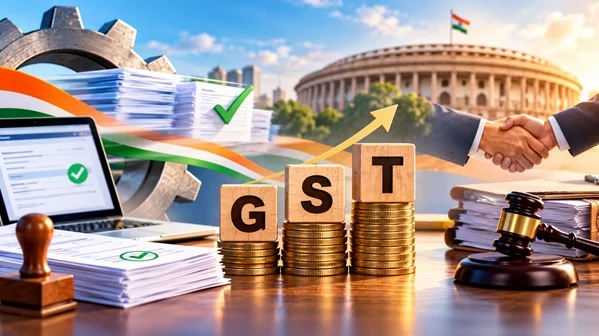
The GST Council has announced reforms aimed at simplifying GST registration, accelerating refund processing and reducing tax-related litigation.
Key Facts
|
Particular
|
Details
|
|
Reform Area
|
GST Administration and Compliance
|
|
Constitutional Body
|
GST Council
|
|
Constitutional Provision
|
Article 279A
|
|
Chairperson
|
Union Finance Minister
|
|
GST Implementation
|
1 July 2017
|
|
Major Focus
|
Refunds, Registration and Dispute Resolution
|
|
Beneficiaries
|
MSMEs, Exporters, Startups and Businesses
|
|
Key Institution
|
GST Appellate Tribunal (GSTAT)
|
|
Main Objective
|
Ease of Doing Business and Reduced Compliance Burden
|
What is the GST Council?
- The Goods and Services Tax Council is a constitutional body established under Article 279A of the Indian Constitution. The Council is chaired by the Union Finance Minister.
- It makes recommendations to the Union and State governments on important GST-related matters, including tax rates, exemptions and administrative reforms.
- Its members include the Union Minister of State responsible for Revenue or Finance and the Finance or Taxation Ministers nominated by the States.
- The Council represents an important example of cooperative fiscal federalism in India.
GST Council Voting Structure
|
Component
|
Voting Weight
|
|
Central Government
|
One-third
|
|
State Governments collectively
|
Two-thirds
|
|
Majority required for a decision put to vote
|
At least three-fourths of weighted votes of members present and voting
|
Major Reforms Announced at the 57th GST Council Meeting
The 57th GST Council meeting was held on 8 October 2026 in New Delhi, chaired by Union Finance Minister Nirmala Sitharaman.
- Simplification of GST Registration
- Clearer documentation requirements and a more user-friendly GST registration portal have been recommended.
- Eligible registration amendments will be accepted automatically, reducing unnecessary interaction with tax officers.
- Registration cancellation will be simplified through a phased, system-based mechanism.
- Small e-commerce sellers will be able to use an eligible platform operator's warehouse as their principal place of business in another state, subject to conditions.
- These reforms aim to reduce registration delays and help smaller businesses expand across states.
- Faster GST Refunds
|
Reform
|
Proposed Change
|
|
Refund acknowledgement
|
Time limit reduced from 15 to 10 days
|
|
Excess cash-ledger balance
|
Automatic full refund sanction
|
|
Zero-rated supplies
|
Risk-based provisional sanction of 90% of the claim
|
|
Inverted duty structure
|
Risk-based provisional sanction of 90% of the claim
|
|
Refund applications
|
Greater use of system-readable information
|
- Reforms to Reduce GST Litigation
- A ₹10,000 minimum tax-amount threshold was recommended for issuing show-cause notices, with provisions addressing certain pending cases.
- The maximum general penalty under Section 125 of the CGST Act was proposed to be reduced from ₹25,000 to ₹10,000.
- A reduced penalty of 5% was recommended in specified non-fraud cases where tax and interest are paid within the prescribed period.
- Common guidelines will improve the quality of notices, adjudication orders and personal hearings.
- Limits on pre-deposits for appeals involving only penalties are intended to reduce financial barriers to dispute resolution.
- Changes to Arrest and Prosecution Provisions
The Council recommended:
- Removing GST arrest powers by omitting Section 69 of the CGST Act, 2017.
- Increasing the monetary threshold for prosecution from ₹1 crore to ₹5 crore.
- Rationalising punishment provisions while retaining action against specified fraudulent activities.
- The objective is to move towards a more trust-based tax administration without eliminating safeguards against serious fraud.
- Input Tax Credit Reforms
- Input Tax Credit (ITC) allows eligible businesses to offset GST paid on purchases against GST payable on their sales.
- The Council recommended expanding ITC refund eligibility for specified capital goods and input services, removing certain restrictions on blocked ITC, improving invoice reconciliation and correction mechanisms and providing taxpayers an opportunity to object and seek a personal hearing when credit in their electronic credit ledger is blocked.
- These changes aim to reduce cascading taxation, working-capital blockage and disputes arising from mismatched returns.
- Easier GST Compliance for Small Businesses
- The Council approved in principle an optional Annual Return Quarterly Payment (ARQP) scheme for eligible businesses with turnover up to ₹5 crore that exclusively supply to unregistered customers.
- Conditional late-fee relief was recommended for certain small taxpayers.
- Return-filing improvements are intended to reduce mismatches between GST declarations and available tax credits.
- Reforms for Exporters and Interstate Trade
- The Council recommended changes to clarify export-of-services eligibility and related refund provisions.
- E-way bill enforcement would become more intelligence-based, with specified restrictions on vehicle interception in transit states.
- These measures are intended to reduce unnecessary logistical delays and improve cross-border business operations.
What is an inverted duty structure?
- It occurs when the GST rate on inputs is higher than the rate on the finished product, potentially leading to accumulated Input Tax Credit.
- The reforms aim to improve business liquidity and reduce delays in receiving eligible refunds.
Significance of the Reforms
- Ease of Doing Business: Simpler registration and compliance procedures can reduce administrative costs.
- MSME Development: Faster refunds can improve liquidity for smaller businesses.
- Reduced Litigation: Clearer procedures and proportionate penalties may reduce unnecessary disputes.
- Digital Governance: Automated processing can improve transparency and consistency.
- Export Competitiveness: Improved refund and credit mechanisms can reduce working-capital pressures on exporters.
- Cooperative Federalism: GST Council decisions demonstrate coordination between the Union and States on indirect taxation.
Challenges
- Implementation: Legislative amendments, notifications and portal upgrades are required
- Technology Dependence: Automated systems must be accurate, accessible and reliable
- Fraud Prevention: Faster processing must be balanced with effective risk assessment
- Centre-State Coordination: Consistent implementation across jurisdictions is essential
- Taxpayer Awareness: Small businesses need guidance on revised procedures
Prelims MCQ
Q. With reference to the GST Council and its recent reforms, consider the following statements:
- The GST Council is constituted under Article 279A of the Constitution.
- The Council has recommended increasing the GST prosecution threshold from ₹1 crore to ₹5 crore.
- The GST Council is chaired by the Governor of the Reserve Bank of India.
Which of the statements given above are correct?
(a) 1 and 2 only
(b) 2 and 3 only
(c) 1 and 3 only
(d) 1, 2 and 3
Mains Practice Question
Q. Discuss how recent GST administrative reforms can improve ease of doing business and reduce tax litigation in India.
|
FAQs
When was the 57th GST Council meeting held?
8 October 2026, in New Delhi.
Who chaired the meeting?
Union Finance Minister Nirmala Sitharaman.
What was the main focus of the reforms?
Simpler registration, faster refunds, improved ITC and reduced litigation.
What is the proposed minimum threshold for GST show-cause notices?
₹10,000 in tax amount.
What is the proposed refund acknowledgement period?
10 days instead of 15 days.
|




 Contact Us
  New Batch : 9555124124/ 7428085757
  Tech Support : 9555124124/ 7428085757